Astronomy News

Oct 12, 2017 by News Staff

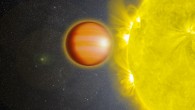
A new study in the Astronomical Journal finds that giant exoplanets with long-period orbits are more likely to be found around young stars that have a disk of dust and debris than those without disks. This artist’s rendering shows a giant exoplanet causing small bodies to collide in a disk of dust. Image credit: NASA / JPL-Caltech. The study, led by Caltech researcher Tiffany Meshkat, focused on exoplanets more than five times the mass of Jupiter. “Our...

Oct 12, 2017 by News Staff

A space telescope placed far beyond the orbit of the dwarf planet Pluto could one day deliver high-resolution images of distant exoplanets, according to...

Oct 11, 2017 by News Staff

In a nearby dwarf galaxy called the Small Magellanic Cloud, astronomers have discovered possibly the most luminous nova ever. SMCN 2016-10a was discovered...

Oct 11, 2017 by News Staff

Back in October 2012, a small (45-100 feet, or 15-30 m) asteroid known as 2012 TC4 had a close encounter with Earth. It passed our planet at a distance...

Oct 10, 2017 by News Staff

There are now five different lines of observational evidence pointing to the existence of Planet Nine, a super-Earth-sized world about 20 times farther...

Oct 9, 2017 by Enrico de Lazaro

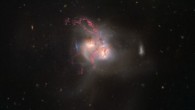
This NASA/ESA Hubble Space Telescope image shows a galaxy known as LEDA 17302. It is a galaxy type known as a blue compact dwarf galaxy. This image, taken...

Oct 9, 2017 by News Staff

University of Arizona astronomer Huan Meng and co-authors have found the long-term dimming of KIC 8462852 — a main-sequence F-type star located in...

Oct 6, 2017 by News Staff

Using data gathered by the Atacama Large Millimeter/submillimeter Array (ALMA) and the Rosetta Orbiter Spectrometer for Ion and Neutral Analysis (ROSINA)...

Oct 5, 2017 by News Staff

Astronomers using ESO’s Very Large Telescope Interferometer (VLTI) have captured striking images of HR 5171, a unique binary stellar system in the constellation...

Oct 5, 2017 by News Staff

A star about 1,480 light-years from Earth called KIC 8462852 has been a fascinating mystery since its discovery was made public in September 2015. Astronomers...

Oct 4, 2017 by News Staff

Five new pairs of merging supermassive black holes have been discovered by combining data from NASA’s Chandra X-ray Observatory, the Wide-Field Infrared...

Oct 3, 2017 by News Staff

An international team of researchers led by University of Portsmouth Professor Gong-Bo Zhao has found that the nature of dark energy may not be the cosmological...

Oct 2, 2017 by News Staff

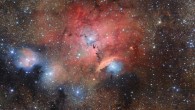
The Large Magellanic Cloud, a satellite galaxy to our own Milky Way Galaxy, is home to one of the largest and most intense regions of star formation known...

Sep 29, 2017 by News Staff

A striking new image captured by the NASA/ESA Hubble Space Telescope shows the galaxy NGC 4490. The scattered and warped appearance of the galaxy is the...

Sep 29, 2017 by News Staff

The NASA/ESA Hubble Space Telescope has photographed the farthest-discovered active inbound comet, C/2017 K2 (PANSTARRS). The comet’s orbit indicates...

Sep 28, 2017 by News Staff

Using ESO’s Very Large Telescope (VLT), astronomers have produced the first detailed optical maps of the gas and dust distributed throughout the spectacular...

Sep 27, 2017 by News Staff

The MPG/ESO 2.2-m telescope at ESO’s La Silla Observatory in Chile has taken a picture of NGC 1964, an incredibly beautiful spiral galaxy in the constellation...

Sep 26, 2017 by News Staff

The oxygen level in J0811+4730, a star-forming dwarf galaxy in the constellation Lynx, some 630 million light-years away, is the lowest yet discovered...

Sep 25, 2017 by Natali Anderson

Dr. Manuel Perger, a postdoctoral researcher at Spain’s Institute of Space Sciences (IEEC-CSIC), and colleagues have discovered a ‘super-Earth’ exoplanet...

Sep 25, 2017 by News Staff

NASA has released a stunning image snapped by the NASA/ESA Hubble Space Telescope of the small galaxy LEDA 31961. LEDA 31961. Image credit: NASA / ESA...