Astronomy News

Apr 21, 2021 by News Staff

Using the Australian Square Kilometre Array Pathfinder (ASKAP), the Atacama Large Millimeter/submillimeter Array (ALMA), the NASA/ESA Hubble Space Telescope, NASA’s Transiting Exoplanet Survey Satellite, and the du Pont Telescope, astronomers have observed the largest flare ever recorded from Proxima Centauri, the Sun’s closest stellar neighbor and one of the best-studied low-mass stars. An artist’s conception of a violent stellar flare from...

Apr 21, 2021 by News Staff

Astronomers using the Murchison Widefield Array (MWA), a low-frequency radio telescope in Australia, have discovered a new long-period, low-luminosity...

Apr 20, 2021 by Natali Anderson

Astronomers using the Spectro-Polarimetric High-contrast Exoplanet Research (SPHERE) instrument on ESO’s Very Large Telescope have discovered and directly...

Apr 19, 2021 by Enrico de Lazaro

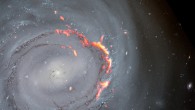
Astronomers using the NASA/ESA Hubble Space Telescope have produced a spectacularly detailed image of a part of the spiral galaxy NGC 4603. This Hubble...

Apr 16, 2021 by Enrico de Lazaro

Using the Low-Frequency Array (LOFAR), astronomers from the Canadian Hydrogen Intensity Mapping Experiment (CHIME) have found that fast radio bursts include...

Apr 15, 2021 by Sergio Prostak

Kepler-34, Kepler-35, Kepler-38, Kepler-64 and Kepler-413 — multiple star systems located between 2,764 and 5,933 light-years away in the constellations...

Apr 14, 2021 by News Staff

Ultralight bosons — hypothetical particles with masses less than a billionth the mass of an electron — could be responsible for the Universe’s...

Apr 12, 2021 by Enrico de Lazaro

A huge galaxy cluster called Abell 2813 has so much mass that it acts as a gravitational lens, causing light from more distant galaxies to bend around...

Apr 9, 2021 by News Staff

Located 6,500 light-years away in the constellation of Taurus, the Crab Nebula and its pulsar formed in a supernova whose light reached Earth in July 1054;...

Apr 9, 2021 by News Staff

Astronomers from the Gaia Gravitational Lenses group have identified 12 quadruply-imaged gravitationally-lensed quasars using machine-learning methods...

Apr 8, 2021 by News Staff

Astronomers using NASA’s Spitzer Space Telescope have identified three fastest-spinning ultracool dwarfs ever found: 2MASS J03480772-6022270, 2MASS J12195156+3128497,...

Apr 7, 2021 by Natali Anderson

Using data from the Atacama Large Millimeter/Submillimeter Array (ALMA), astronomers from India have detected acetone, disulfur monoxide, and carbon monoxide...

Apr 7, 2021 by News Staff

The two newly-discovered pairs of quasars, J0749+2255 and J0841+4825, existed 10 billion years ago and resided in the cores of merging galaxies, according...

Apr 6, 2021 by News Staff

As part of the Clusters Hiding in Plain Sight (CHiPS) survey, astronomers have discovered three new galaxy cluster candidates and confirmed two of them:...

Apr 5, 2021 by Enrico de Lazaro

Astronomers using the NASA/ESA Hubble Space Telescope have captured an amazing new photo of the face-on spiral galaxy Messier 61. This composite image...

Apr 1, 2021 by News Staff

Uranus, the seventh planet from the Sun, and its ring system appear to mainly produce X-ray emission by scattering solar X-rays, but some may also come...

Mar 31, 2021 by News Staff

Two teams of astronomers have performed polarimetric observations of 2I/Borisov, the first active extrasolar comet ever detected in our Solar System, using...

Mar 30, 2021 by News Staff

A gravitationally lensed gamma-ray burst, designated GRB 950830, helped astronomers detect a black hole about 55,000 times more massive than the Sun. An...

Mar 30, 2021 by Enrico de Lazaro

Astronomers using ESO’s Very Large Telescope (VLT) have produced a spectacularly detailed image of a bubble of hot hydrogen gas called Sharpless 2-305...

Mar 29, 2021 by Natali Anderson

Using data from NASA’s Transiting Exoplanet Survey Satellite (TESS) and the HARPS-N spectrograph at the 3.6-m Telescopio Nazionale Galileo, astronomers...