Featured News

Jan 4, 2024 by News Staff

Adorned with fins down the sides of its body, a distinct head with long antennae, massive jaw structures inside its mouth and growing to more than 30 cm (11.8 inches) in length, Timorebestia koprii was one of the largest animals in the Early Cambrian oceans. Reconstruction of Timorebestia koprii in the pelagic ecosystem preserved in Sirius Passet; other species shown in the foreground are Kiisortoqia, Siricaris, Kerygmachela, Pauloterminus, Kleptothule,...

Jan 3, 2024 by Enrico de Lazaro

The earliest known evidence of photosynthetic structures has been identified inside a collection of the enigmatic cylindrical microfossils Navifusa majensis...

Jan 2, 2024 by Enrico de Lazaro

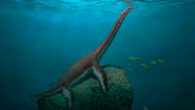
Paleontologists have described a new genus and species of small polycotylid plesiosaur from two specimens found in Wyoming and South Dakota in the United...

Jan 2, 2024 by Enrico de Lazaro

A huge, naked figure called Cerne Giant was cut into a Dorset hillside not, as many have supposed, in prehistory, nor in the early modern period, but in...

Dec 28, 2023 by Simon Braddy

Pterygotid eurypterids (sea scorpions), giant aquatic arthropods with big claws, were all regarded as apex predators but some scientists then suggested...

Dec 27, 2023 by News Staff

Researchers at the Smithsonian Institution’s National Museum of Natural History have performed a comprehensive taxonomic review of the soft-furred hedgehog...

Dec 25, 2023 by Enrico de Lazaro

Paleontologists from China and Brazil have identified a new species of chaoyangopterid pterosaur from two specimens, one of which is the most complete...

Dec 22, 2023 by Enrico de Lazaro

A new species of the extinct land snail genus Ferussina has been identified from a complete specimen found in Hațeg Basin, Romania. An artistic reconstruction...

Dec 22, 2023 by Enrico de Lazaro

Astronomical observations show that polycyclic aromatic hydrocarbons (PAHs) are abundant and widespread in the interstellar medium. PAH molecules consist...

Dec 21, 2023 by Natali Anderson

Biologists have discovered a new species of the terrestrially-nesting fanged frog genus Limnonectes living on Sulawesi Island, Indonesia. The species has...

Dec 19, 2023 by Enrico de Lazaro

Paleontologists have found the fossil of a previously unknown species of leptoceratopsid dinosaur that lived more than 70 million years ago in what is...

Dec 18, 2023 by Enrico de Lazaro

New images from the Near-Infrared Camera (NIRCam) instrument onboard the NASA/ESA/CSA James Webb Space Telescope shows Uranus, its ring system and some...

Dec 18, 2023 by News Staff

The Long Interspersed Element-1 (LINE-1) retrotransposon is an ‘ancient genetic parasite’ that has written around one third of the human genome through...

Dec 12, 2023 by Enrico de Lazaro

Potteromyces asteroxylicola parasitized on an extinct species of lycopsid plant called Asteroxylon mackiei, according to a paper published in the journal...

Dec 12, 2023 by Natali Anderson

Ornithologists in Colombia have photographed a wild green honeycreeper (Chlorophanes spiza) with distinct half green, or female, and half blue, male, plumage. A...

Dec 11, 2023 by Enrico de Lazaro

A new species of the mole genus Talpa has been identified in eastern Türkiye (Turkey) by a team of reseachers from Ondokuz Mayıs University, Indiana...

Dec 10, 2023 by Enrico de Lazaro

Paleontologists in Canada have found a 75-million-year-old skeleton of a juvenile of the tyrannosaurid dinosaur Gorgosaurus libratus with the remains of...

Dec 5, 2023 by Natali Anderson

Scientists from Anhui Normal University and elsewhere have identified a new species of the hedgehog genus Mesechinus living the scrubland and subtropical...

Dec 4, 2023 by Enrico de Lazaro

Female mosquitoes are among the most notorious hematophagous (blood-feeding) insects, sometimes causing severe allergic responses. Hematophagy in insects...

Dec 4, 2023 by Natali Anderson

The trans-Neptunian dwarf planet Eris is tidally locked to its small moon Dysnomia. Recently obtained bounds on the mass of Dysnomia demonstrate that Eris...