Featured News

Apr 12, 2022 by News Staff

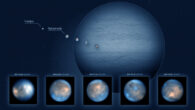
The estimated diameter of the nucleus of comet C/2014 UN271 (Bernardinelli-Bernstein) is approximately 137 km (85 miles) across, making it the largest nucleus ever seen in a comet by astronomers. The previous record holder is comet C/2002 VQ94, with a nucleus estimated to be 100 km (60 miles) across. This image, taken by Hubble’s Wide Field Camera 3 on January 8, 2022, shows comet C/2014 UN271 (Bernardinelli-Bernstein). Image credit: NASA / ESA...

Apr 11, 2022 by News Staff

Physicists from the Collider Detector at Fermilab (CDF) Collaboration have determined the mass of the W boson, a mediator of the weak force between elementary...

Apr 11, 2022 by News Staff

Using data from ESO’s Very Large Telescope (VLT), NASA’s Spitzer Space Telescope, the Subaru Telescope, the Keck Telescope, the Gemini South and North...

Apr 8, 2022 by News Staff

The newly-discovered galaxy, named HD1, existed when the Universe was just 330 million years old. HD1 (red object). Image credit: Harikane et al., arXiv:...

Apr 6, 2022 by News Staff

It’s raining vaporized rock on WASP-178b, and KELT-20b has its upper atmosphere getting hotter rather than cooler because it is being sunburned by intense...

Apr 5, 2022 by News Staff

Using the Subaru Telescope and the NASA/ESA Hubble Space Telescope, astronomers have found evidence for a Jupiter-like protoplanet around the young star...

Apr 4, 2022 by News Staff

Machu Picchu, one of the most recognized archaeological sites in the world, is located high (2,430 m above sea level) above the Urubamba River on a narrow...

Apr 1, 2022 by News Staff

Twenty years after scientists from the Human Genome Project produced the first draft human genome sequence, the Telomere to Telomere (T2T) Consortium has...

Mar 31, 2022 by News Staff

New research provides evidence that the four traits (i.e., mental energy and fatigue, physical energy and fatigue) may have unique yet overlapping gut...

Mar 31, 2022 by News Staff

Designated WHL0137-LS and nicknamed Earendel, the newly-detected star emitted its light around 900 million years after the Big Bang. Earendel (arrow) is...

Mar 29, 2022 by News Staff

Cryovolcanoes (ice volcanoes) are similar to normal volcanoes but instead of being formed from molten rock, they are made by frozen liquids like ammonia...

Mar 29, 2022 by News Staff

Using the Atacama Large Millimeter/submillimeter Wave Array (ALMA), astronomers have observed the carbon-rich star V Hydrae that is apparently transitioning...

Mar 28, 2022 by News Staff

New research led by Australian Museum paleontologists shows that monotremes are the last survivors of a diverse set of fossil species that once roamed...

Mar 28, 2022 by News Staff

New research published in the American Museum Novitates is the first to document biofluorescence in Arctic fishes. A juvenile variegated snailfish (Liparis...

Mar 28, 2022 by Enrico de Lazaro

The newly-identified species of extinct diving duck is the fourth species in the genus Manuherikia. An artist’s impression of a Manuherikia duck. Image...

Mar 24, 2022 by News Staff

By analyzing the density of bones of several spinosaurid dinosaurs and comparing them to other animals like penguins, hippos, and alligators, Field Museum...

Mar 22, 2022 by News Staff

The signature feature of black holes is that they are black — objects which fall into the hole can no longer be seen and can no longer influence...

Mar 22, 2022 by News Staff

Odd Radio Circles are large, circular astronomical objects which are bright around the edges at radio wavelengths. Theories on what causes these mysterious...

Mar 21, 2022 by News Staff

Dr. Melvin Vopson, a physicist with the School of Mathematics and Physics at the University of Portsmouth, has already published research suggesting that...

Mar 21, 2022 by News Staff

There were five finalists — three snails, one mussel and a tusk shell or scaphopod — in the Mollusk of the Year 2022 competition, an international...