Planetary researchers analyzing images from NASA’s New Horizons spacecraft have found evidence that liquid nitrogen may still be seeping up from beneath the dwarf planet’s giant glacier, Sputnik Planitia, marking the first suggested case of recently flowing liquid on Pluto’s surface.

This Pluto mosaic was made from New Horizons LORRI images taken on July 14, 2015, from a distance of 49,700 miles (80,000 km). This view is projected from a point 1,118 miles (1,800 km) above Pluto’s equator, looking northeast over the dark, cratered Cthulhu Regio toward the bright, smooth expanse of icy plains called Sputnik Planum. Pluto’s North Pole is off the image to the left. This mosaic was produced with panchromatic images from the New Horizons LORRI camera, with color overlaid from the Ralph color mapper onboard New Horizons. Image credit: S.A. Stern et al.
Sputnik Planitia is a 1,200 x 2,000 km (746 x 1,243 miles), nitrogen-ice-filled basin that fills the western lobe of Tombaugh Regio, Pluto’s famous heart-shaped structure.
There, New Horizons imagery from its 2015 flyby shows a network of dark, narrow streaks and softer, wider dark patches tracing the boundaries of the glacier’s polygonal convection cells.
The pattern closely resembles what happens on Earth’s ice sheets when meltwater darkens the surface, either by enlarging ice grains or depositing dark impurities.
Because solar heating and other conventional explanations are too weak or too diffuse to produce such sharply bounded features on Pluto, liquid nitrogen is the best explanation.
“The surface of Sputnik Planitia is quite young, probably less than one million years based on modeling of the surface overturn, and thus these features that we are looking at must have formed since then,” said Southwest Research Institute’s principal scientist Dr. Kelsi Singer.
“Pluto has many unique terrains seen nowhere else in the Solar System, and this area of Sputnik Planitia is one of them.”
“Its surface provides a different set of conditions compared to what we are used to on Earth, and exploring that allows us to better understand how materials behave in environments that are difficult to produce on Earth.”
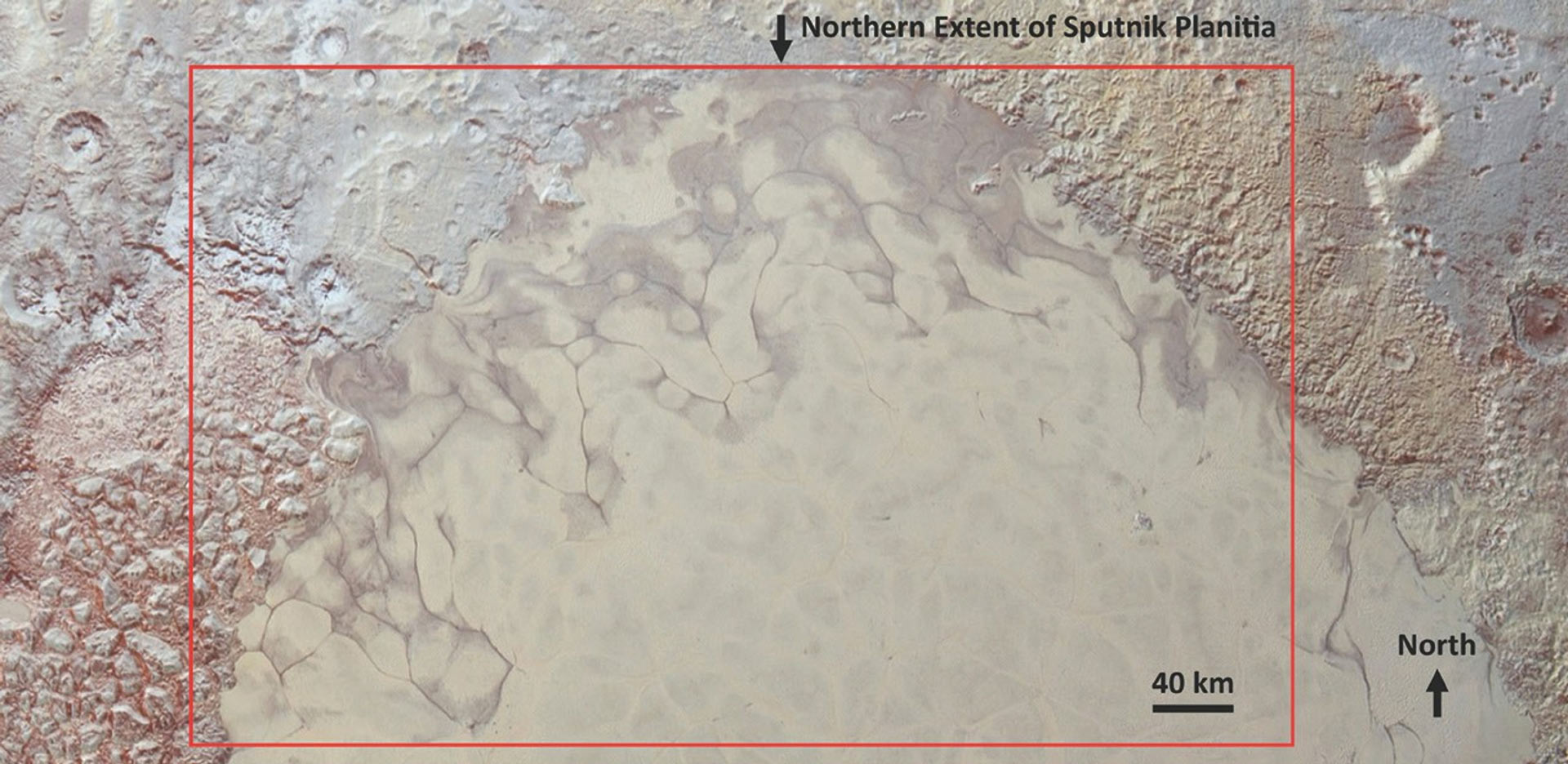
Pluto’s northern Sputnik Planitia glacier is shown here in a color mosaic made from NASA’s New Horizons imagery. The red box has been added to show most of the region containing dark features attributed to the wetting of the glacier by liquid nitrogen sourced from a basal melting process beneath the glacier. Image credit: NASA / Johns Hopkins APL / SwRI.
The authors propose that heat from Pluto’s interior melts nitrogen ice at the base of the glacier, where it collects in reservoirs before erupting upward through narrow fractures, a process they compare to volcanic dike systems on Earth.
Because liquid nitrogen is less dense than the solid ice around it, it would rise buoyantly, eventually reaching the surface near the centers of the glacier’s convection cells before spreading toward the cell edges and refreezing, darkening the ice as it goes.
The researchers calculate that such eruptions would need to occur as short, intense pulses — releasing on the order of 100,000 to 1 million m3 of liquid over periods of hours to days — since the steady trickle of melt produced underground is far too slow to explain the flows on its own.
“Pluto never stops surprising us,” said New Horizons principal investigator Dr. Alan Stern, also from the Southwest Research Institute.
“In addition to suggesting that liquids have recently expressed themselves on Pluto’s surface, this result also suggests a new kind of time-variable feature on Pluto.”
Similar processes could potentially be at work elsewhere in the outer Solar System, including on Neptune’s moon Triton, whose geysers have puzzled scientists since Voyager 2’s 1989 flyby, and possibly on the distant dwarf planet Eris, which also appears to host thick deposits of nitrogen ice.
“We point out that Eris could be a good candidate to also display evidence for basal melt and/or liquid flows to its surface,” they said.
“Presently, no other Kuiper Belt dwarf planet has shown evidence for nitrogen ice on its surface, but if such discoveries are later made, the mechanism we have described here might also be operating.”
“Of course, for both Eris and dwarf planets where deep nitrogen reservoirs may be discovered in the future, evidence for this phenomenology would have to await high-resolution mapping akin to what has been accomplished on Pluto.”
A paper on the findings was published July 31 in the Planetary Science Journal.
_____
S.A. Stern et al. 2026. Evidence for Possible N2 Basal Flow beneath Pluto’s Northern Sputnik Planitia. Planet. Sci. J 7, 185; doi: 10.3847/PSJ/ae7e85