Planetary researchers at the University of Sydney have proposed a new way to classify the soils of Mars, along with a new word for them: areth (the name comes from Ares, the Greek name for Mars).
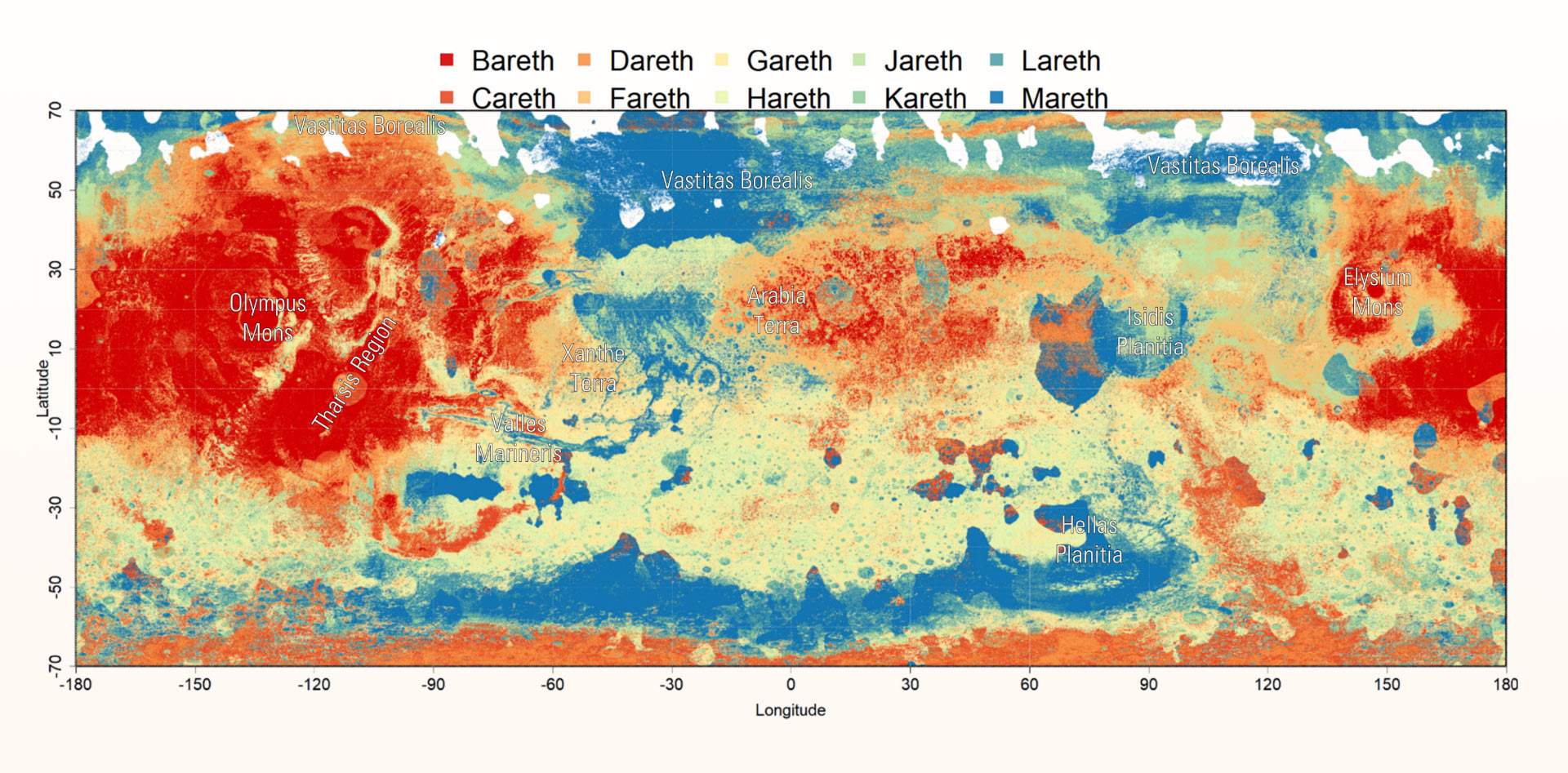
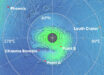
Classification of realms across the Martian surface. Image credit: McBratney et al., doi: 10.1016/j.catena.2026.110649.
Mars has no formal, workable soil classification. Earth systems lean heavily on vertical layers, or horizons, and nobody has detailed depth-by-depth data for the Red Planet.
The new system, called the Provisional Polythetic Areth Classification System (PPACS), instead relies on surface and near-surface properties inferred mostly from orbital data.
“This is the first time a classification system of this scale has been developed for Martian soils,” said University of Sydney Ph.D. student Daniel Irving, corresponding author of the study.
“Scientists have mapped Mars’ geology, mineralogy and chemistry before, but our system brings together multiple properties into a single framework, helping us understand how different Martian soils relate to one another and where they’re found.”
“A future greenhouse on Mars would need more than air, water and light,” said Professor Alex McBratney, first author of the study.
“Its builders would also need to know what lies beneath to understand better starting points for growing plants.”
The PPACS system has three tiers: 10 realms, each split into 10 assemblages, each split into 20 forms, for 2,000 terminal classes.
The classification is accompanied by a detailed map covering 92% of the Martian surface, allowing the researchers to visualize the distribution of different soil types.
As a proof of concept, they assessed all 2,000 soil classes for characteristics important to plant production, including water-holding capacity, pH, profile thickness, clay content and gravel content.
One soil class, known as Nohibareth, emerged as the most promising candidate, scoring 0.93 on the study’s zero-to-one grading scale.
“People often think soil needs lots of organic matter to function, but there are soil types on Earth, particularly in arid regions, that contain very little organic matter,” Professor McBratney said.
“These results from Mars actually make us think more deeply about this kind of soil on Earth, and what we might do with it.”
“Every rover mission collects valuable information about Mars, but scientists need consistent ways to organize and compare that knowledge,” Irving said.
“This gives us a framework that can grow and evolve as new data becomes available.”
The results were published on October 7, 2026 in the journal CATENA.
_____
Alex McBratney et al. 2026. Areths and the Provisional Polythetic Areth Classification System (PPACS): a hierarchical and nomenclatural framework for Martian soil classification. CATENA 275: 110649; doi: 10.1016/j.catena.2026.110649