Using data collected by NASA’s Perseverance rover, planetary scientists have revealed that a geologically puzzling formation in Jezero crater experienced multiple distinct episodes of water-related alteration, deepening its significance as a target in the search for ancient signs of life on Mars.
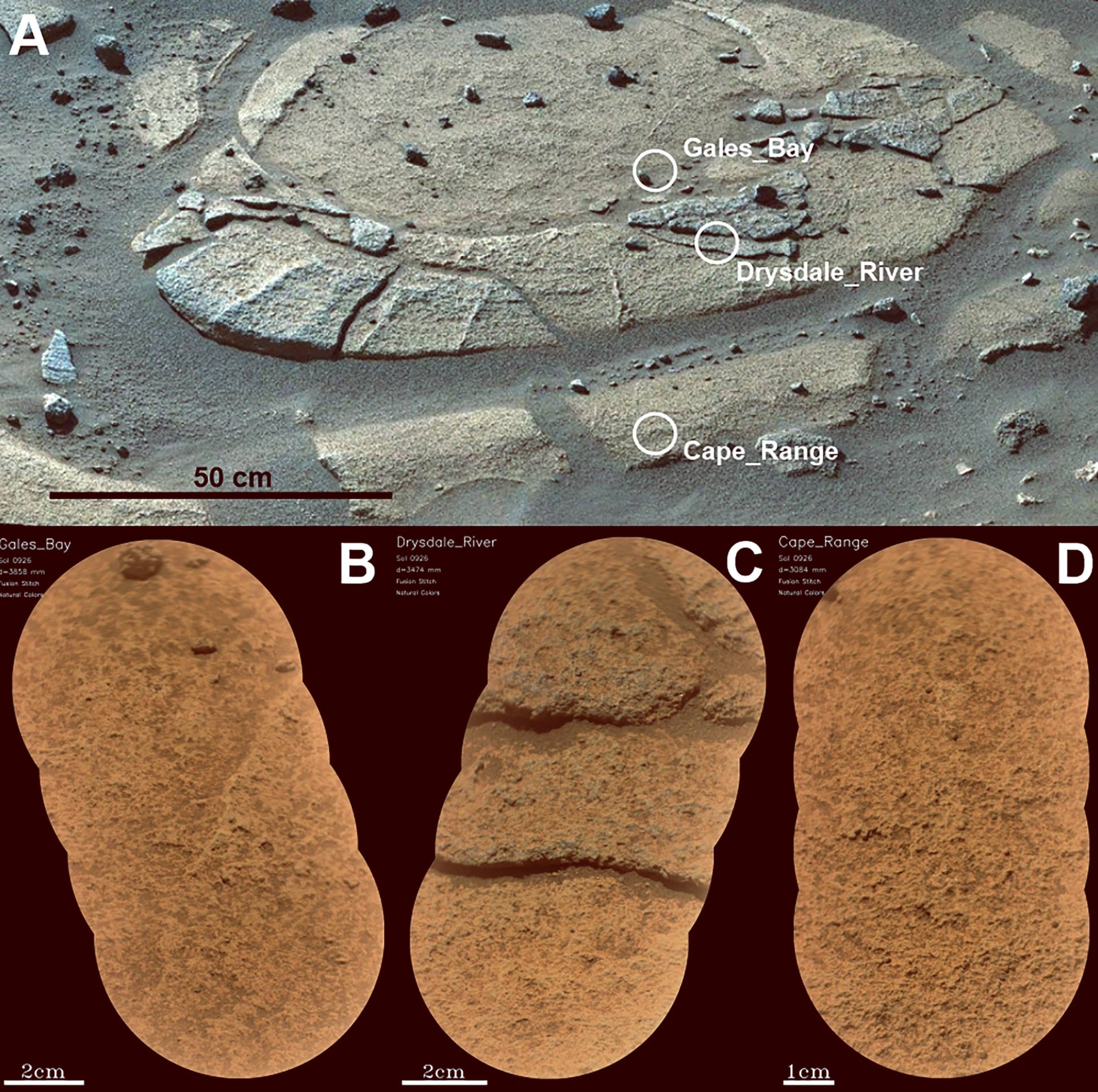
The concentric feature in the East Margin of the Margin unit, Jezero crater, Mars. Image credit: Bedford et al., doi: 10.1038/s43247-026-03997-9.
NASA’s Perseverance rover landed in Jezero crater in February 2021 to investigate the geological record and look for signs of ancient life.
Jezero crater is 45 km (28 miles) in diameter and is situated on the northwestern side of the 1,200 km (746-mile) Isidis impact basin, and northeast of the Syrtis Major volcanic province near a region known as Nilli Fossae.
In new research, Purdue University planetary scientist Candice Bedford and colleagues focused on the Margin unit, a band of olivine- and carbonate-rich rock that traces the inner rim of the crater near an ancient lake shoreline.
Using chemical and imaging data gathered by Perseverance’s SuperCam instrument across more than 185 rock targets, they determined that the unit originated as a crystalline, olivine-rich igneous rock, likely formed by slow cooling deep within a magma body.
“Igneous rocks are excellent record-keepers, particularly because mineral crystals within them preserve details about the precise moment they formed,” the researchers said.
“In this case, they preserved an astonishingly complex record of water activity on early Mars.”
Below what they believe was once the second terrace level of the ancient Jezero lake, the scientists identified evidence of three separate fluid-driven alteration events.
First, carbon dioxide-rich fluids moving through cracks in the bedrock formed carbonate-rich deposits that later eroded into distinctive ridges.
Later, exposure to lake water or shifting groundwater chemistry remobilized that carbonate and precipitated silica into pore spaces within the rock.
Finally, hydrothermal fluids surged through younger fractures, depositing veins rich in fluorite and calcium-sulfate minerals, a signature more commonly associated with hydrothermal systems on Earth.
The authors also found signs that parts of the Margin unit were physically reworked by lake-shore or debris-flow processes.
“Before we arrived at the Margin unit, the main hypothesis — derived from orbital observations — was that the carbonate seen from orbit formed from interaction with the lake that existed in Jezero crater,” Dr. Bedford said.
“But now we know that this location became a sort of crossroads for aqueous systems.”
“The Margin unit findings are important because Jezero crater sits inside one of the largest exposures of carbonate on Mars, so what we learn here reaches well beyond this crater.”
“Some of the Margin unit rocks also contain silica,” added Dr. Eleni Ravanis, a planetary scientist at the University of Hawai’i at Manoa.
“Turning olivine into carbonate can leave silica behind, and we see more of that silica in rocks that sat below the water line.”
The team’s results suggest the Margin unit’s alteration was driven by a combination of groundwater circulation and possible direct interaction with the Jezero paleolake over an extended period.
“The Margin unit recorded a complex aqueous history driven by multiple alteration events from distinct groundwaters and/or exposure to the lake, cementing the Margin unit and the samples collected by Perseverance as primary targets of astrobiological interest,” the researchers concluded.
Their paper appears in the journal Communications Earth & Environment.
_____
C.C. Bedford et al. 2026. Lake- and groundwater-associated alteration of the olivine-rich Margin unit in Jezero crater, Mars. Commun Earth Environ 7, 728; doi: 10.1038/s43247-026-03997-9