Modern humans have populated Europe for more than 45,000 years. However, our knowledge of the genetic relatedness and structure of ancient hunter-gatherers...
Different genetic traits can be beneficial (for example, fending off disease) or harmful (making humans more susceptible to illness), depending on the...
Neanderthal art was perhaps more abstract than the stereotypical figure and animal cave paintings Homo sapiens made after Neanderthals disappeared about...
Humans, whales, elephants, and naked mole-rats all share a somewhat rare trait for mammals: their bodies are covered with little to no hair. The common...
In at least 400 European caves such as Lascaux, Chauvet and Altamira, Upper Paleolithic humans drew, painted and engraved non-figurative signs from at...
Scientists from the Institute for Fundamental Biomedical Research at the Biomedical Sciences Research Center ‘Alexander Fleming’ and the Smurfit Institute...
Modern humans have admixed with multiple species of archaic hominins. Papuans, in particular, owe up to 5% of their genome to Denisovans, a sister group...
Like modern HIV, ancient human endogenous retroviruses (HERVs) had to insert their genetic material into their host’s genome to replicate.
Possible sites...
A new modeling study by Leiden University and University of Cambridge scientists predicts the appearance of Homo sapiens and the Protoaurignacian culture...
Paleontologists have re-examined the remains of extinct, large-bodied marsupials recovered from Pleistocene-aged layers of Nombe Rockshelter in the highlands...
Archaeologists excavating Liang Tebo Cave on the Indonesian island of Borneo have discovered the skeletal remains of a young individual who had the distal...
Neanderthal brains were similar in size to those of modern humans but differed in shape. What scientists cannot tell from fossils is how Neanderthal brains...
Studies of human fossils, and the DNA extracted from them, reveal a complex history of interbreeding between various human lineages over the past 100,000...
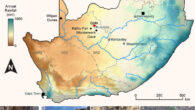
Detailed, well-dated palaeoclimate and archaeological records are critical for understanding the impact of environmental change on human evolution. In...
A team of researchers has discovered 88 fossilized human footprints in Utah’s West Desert, the United States.
Dr. Daron Duke speaks with visitors to...
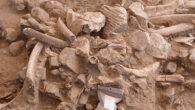
Archaeologists have found butchered bones from a mother mammoth and her calf and signs of controlled fire at the Hartley locality, an open-air site on...
Researchers have sequenced and analyzed the genome of a Late Pleistocene hominin from Red Deer Cave located in Southwest China, which was previously reported...
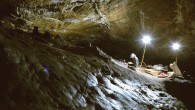
Cueva de Ardales is a hugely important Paleolithic site in Malaga, Spain, owing to its rich inventory of rock art. According to new research, Neanderthals...
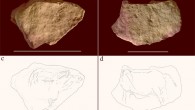
Archaeologists have examined the engraved limestone plaquettes excavated from Montastruc, a rockshelter site in southern France. These plaquettes are likely...