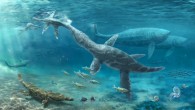
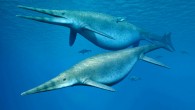
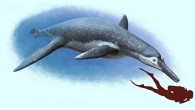
Jurassic deep-water reptiles thrived as sea levels rose, while species that dwelled in the shallows waters disappeared, according to new research from...
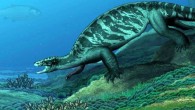
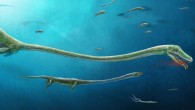
Paleontologists in China have discovered a 228-million-year-old extinct species of turtle, known for its weird disc-like body without a shell and its toothless...
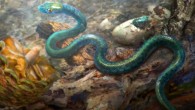
The fossilized remains of an embryonic-to-hatchling snake have been found preserved in Cretaceous amber from Myanmar (also known as Burma).
Xiaophis myanmarensis...
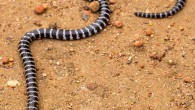
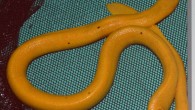
A team of scientists led by a University of Queensland biologist has discovered a new species of bandy-bandy snake on the west coast of the Cape York Peninsula...
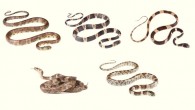
An international team of researchers has discovered five new species of snail-eaters (tribe Dipsadini) living in the forests of Ecuador and Peru.
The five...
An international team of paleontologists from the Natural History Museum, London, the University of Birmingham and Virginia Tech has formally given an...
According to a study released this week in the journal PLoS ONE, an isolated bone from the lower jaw of a prehistoric marine reptile found in Somerset,...
A team of paleontologists from Yale University, Smithsonian Institution and Johns Hopkins University has discovered a new species of reptile that lived...
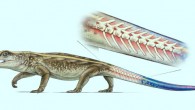
A new study shows how a group of ancient reptiles called captorhinids could detach their tails to avoid predation.
This is an illustration of Captorhinus,...
Neuronal cell types in the avian brains linked to goal-directed behaviors and cognition are similar to cells in a region of the mammalian brain called...
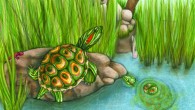
University of Pennsylvania paleontologist Steven Jasinski has announced the discovery of a previously unknown species of fossil turtle in the Gray Fossil...
A team of scientists from Northwestern University, the Field Museum of Natural History and Phoenix Zoo has discovered and described a distinctive new subspecies...
A new species of marine reptile from the Cretaceous period has been identified from fossils found on the eroded banks of the Volga River.
Artist’s reconstruction...
The first ever evidence of live birth in a group of animals previously thought only to lay eggs has been discovered by an international team of paleontologists...
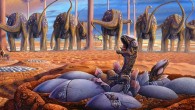
Non-avian dinosaur eggs took a long time to hatch — between 3 and 6 months, according to new research on the teeth of fossilized dinosaur embryos.
Herds...
An international team of paleontologists has discovered that Limusaurus inextricabilis, a species of Jurassic dinosaur, lost its teeth in adolescence and...
Herbivorous, or plant-eating, mammals have bigger bellies than their usually slim carnivorous counterparts, according to a study led by University of Zurich...
According to a new study published in the journal Molecular Phylogenetics and Evolution, the yellow-bellied kingsnake (Lampropeltis calligaster), a snake...