Astronomers believe that our Universe began forming the first stars when it was a few hundred million years old. Since then, the Universe has become a...
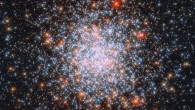
Globular clusters are ancient groups of hundreds of thousands or even millions of stars, gravitationally bound into a single structure about 100-200 light-years...
As far back as 40,000 years ago (Upper Paleolithic), ancient people kept track of time using relatively advanced knowledge of astronomy.
The Lascaux Shaft...
Astronomers using data from NASA’s Transiting Exoplanet Survey Satellite (TESS) have discovered a hot-Jupiter exoplanet orbiting the early F-type star...
Globular clusters are densely packed, spherical collections of several hundred thousand stars. They are among the oldest known objects in the Universe...
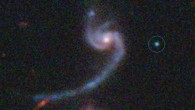
Two teams of astronomers have finally found the long-sought progenitor star to a Type Ic supernova by sifting through Hubble archival data.
An artist’s...
2MASS J18082002-5104378 B, an ultra metal-poor star located some 1,950 light-years away from Earth, is approximately 13.53 billion years old, making it...
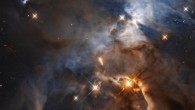
Like a fly that wanders into a flashlight’s beam, a protoplanetary disk surrounding the young star HBC 672 is casting a giant shadow, nicknamed the ‘Bat...
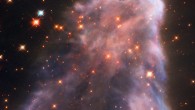
The NASA/ESA Hubble Space Telescope has captured a new photo of a stunning and slightly eerie nebula called IC 63.
IC 63 is classified as both a reflection...
A team of U.S. astronomers has discovered that small planetary systems with multiple planets are more likely to form around stars that have lower amounts...
Stellar superflares from young red dwarfs may make conditions uninhabitable on fledgling planets, according to the new results of the Habitable Zones and...
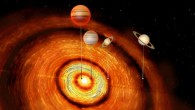
Astronomers using the Atacama Large Millimeter/submillimeter Array (ALMA) have discovered a 2-million-year-old planetary system containing at least four...
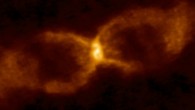
Using the Atacama Large Millimeter/submillimeter Array (ALMA), astronomers found evidence that a white dwarf and a brown dwarf collided in a ‘blaze of...
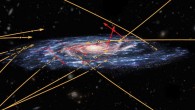
Astronomers using data from ESA’s star mapping Gaia mission to look for hypervelocity stars being kicked out of our Milky Way Galaxy were surprised to...
Astronomers using NSF’s Karl G. Jansky Very Large Array have discovered a fast-moving jet of material propelled outward from a strongly magnetized neutron...
In October 2017, a fast moving, cigar-shaped comet of extrasolar origin was discovered close to the Earth with the Pan-STARRS1 telescope in Hawai’i....
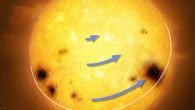
Our Sun rotates faster at its equator than at its poles. This process is known as differential rotation and is seen in the motion of sunspots. Now, a team...