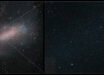
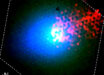
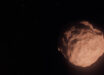
High-resolution images from ESO’s Very Large Telescope and the Large Binocular Telescope reveal that the E-type asteroid (44) Nysa may be unlike any other world in the Solar System, with three connected lobes and a newly discovered satellite that could help explain how the bizarre object formed.
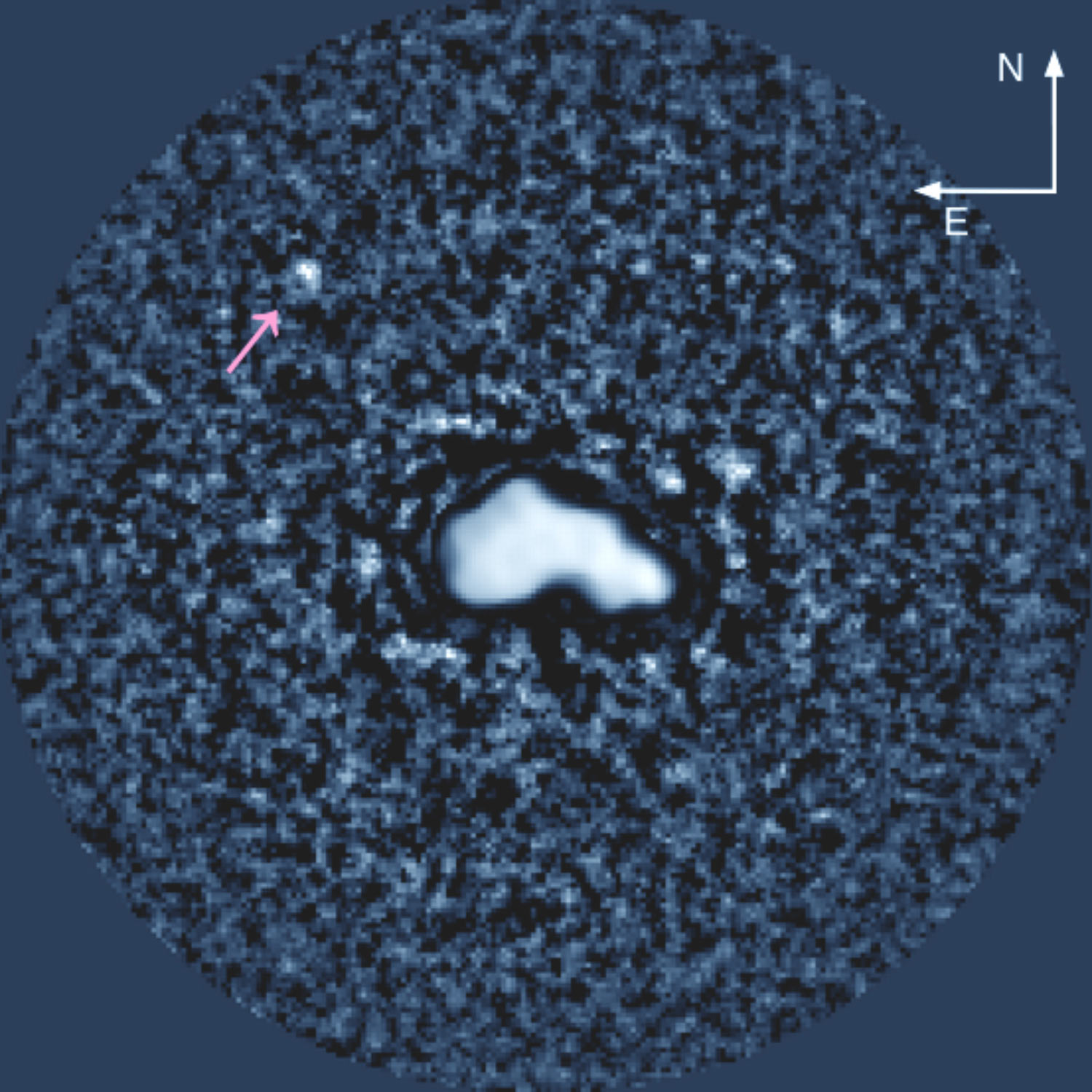
This image of the Nysa system was captured on February 15, 2026. Image credit: Minker et al., arXiv: 2607.25786.
Nysa is one of the brightest and largest asteroids with an enstatite-like (E-type) surface composition in the main belt.
This rare type is associated with enstatite-rich meteorites including aubrites and enstatite chondrites and is thought to be formed from the same feedstocks as the terrestrial planets.
“The images reveal a remarkably unusual object,” said Dr. Kate Minker, an astronomer at Lowell Observatory.
“The most likely explanation is that Nysa is either a contact trinary, consisting of three connected components, or an extremely irregular coherent body unlike anything we’ve previously observed.”
“These observations had to be combined with specially developed image processing techniques to further sharpen the images and remove the bright halo surrounding the asteroid, potentially hiding faint companions,” added Dr. Anthony Berdeu, an astronomer at ESO.
To resolve Nysa’s shape, the astronomers used the SPHERE instrument on ESO’s Very Large Telescope and the SHARK-VIS instrument on the Large Binocular Telescope.
Both instruments use adaptive optics to correct atmospheric blur and obtain crisp images of this asteroid.
“These observations likely represent the closest competition to spacecraft-quality imaging ever achieved from the ground, made possible by an exceptional combination of advanced instrumentation and sophisticated data-reduction techniques,” Dr. Minker said.
The data show that the asteroid is 80 km across and is composed of three distinct blobs, or ‘lobes,’ joined by two narrower sections that encircle the asteroid, or ‘necks’.
All previous identifications of asteroids with a neck have been interpreted as ‘bilobates,’ having just two lobes, but Nysa has a unique ‘trilobate’ structure.
The researchers have two possible explanations for how Nysa got its odd shape.
Either the asteroid originates from a single object that was heavily deformed though collisions, or is a composite of three objects that impacted and merged, forming necks at the point of contact.
Further research is needed to clarify which hypothesis holds true, but for now astronomers are delighted to have determined the structure of Nysa, which had long evaded attempts to identify its true nature.
“The new images appear consistent with several earlier clues that Nysa is really a unique object,” said Dr. Al Conrad, an astronomer at the Large Binocular Telescope Observatory.
“For the first time, we can directly investigate whether those clues point to a deeply indented body or to a true multi-lobed structure.”
The team’s paper will be published in the journal Astronomy & Astrophysics.
_____
Kate Minker et al. 2026. Unmasking (44) Nysa: Evidence for a trilobate structure. A&A, in press; arXiv: 2607.25786