VLSS J0318.9+5755, a strange, musical-note-shaped radio source hiding behind the Milky Way’s dusty disk, has turned out to be the glowing remains of an ancient black hole outburst inside a massive, colliding galaxy cluster.
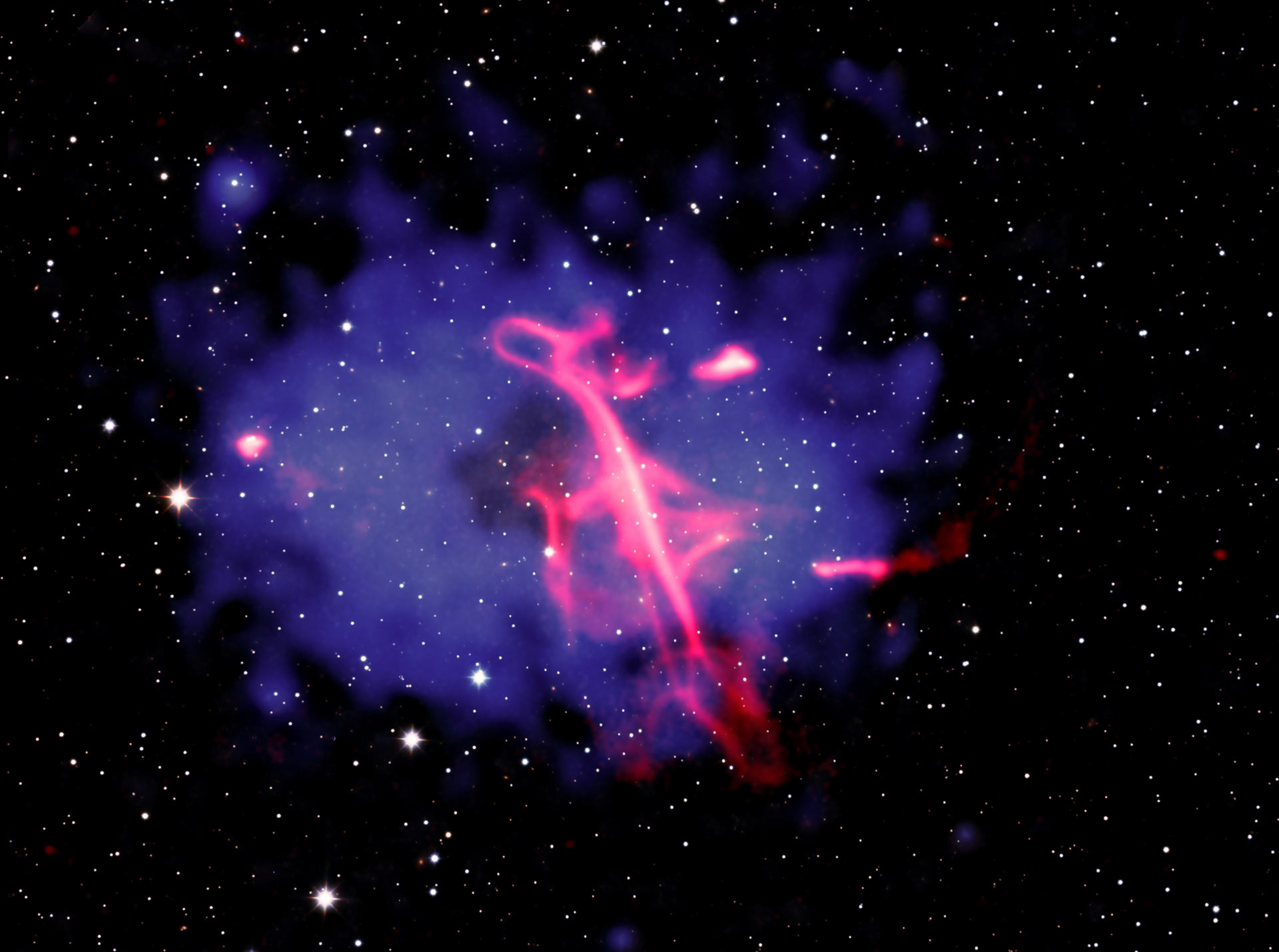
This composite image of the Treble Clef and its galaxy cluster contains X-rays from Chandra and eROSITA, radio data from LOFAR, and infrared data from UKIRT. Image credit: NASA / CXC / INAF-IRA / Botteon et al. / UKIDSS-GPS / ASTRON / LOFAR / SAO / N. Wolk.
Nicknamed the Treble Clef for its looping, filamentary shape, VLSS J0318.9+5755 was spotted by Dr. Andrea Botteon of Italy’s INAF and colleagues while they were combing through data from the LOFAR Two-meter Sky Survey.
The object had been detected before, in the 1960s and later surveys, and was once suspected to be a pulsar because it lies so close to the Galactic plane.
A 2004 study tentatively linked it to a galaxy cluster, but it had not been investigated further until now.
Using new observations from the Giant Metrewave Radio Telescope, LOFAR’s low-frequency survey data, and X-ray data from NASA’s Chandra X-ray Observatory and the SRG/eROSITA telescope, Dr. Botteon’s team confirmed that a massive galaxy cluster does sit behind the source.
The cluster lies approximately 1.5 billion light-years away; the Treble Clef itself stretches about 2.5 million light-years and is made up of thin filaments. Its radio spectrum is extremely steep, dropping off sharply at higher frequencies.
The astronomers classify it as a radio phoenix: old, faded plasma from an earlier burst of black hole jet activity that was revived, probably by gas motions stirred up in the cluster collision.
They estimate the plasma is around 190 to 200 million years old.
“The Treble Clef likely formed in a two-stage process,” the researchers said.
“First, an earlier outburst from a supermassive black hole in the galaxy cluster’s center drove clouds of charged particles and magnetic fields away at close to the speed of light.”
“This led to a type of cosmic crescendo and initially produced bright radio waves that later faded as the particles lost energy.”
“Next, the collision between the two clusters compressed or reenergized the cloud, which became brighter again in radio waves.”
“Shock waves — similar to the sonic booms from supersonic jets — from the collision may have played a role in this reenergizing process.”
The team’s paper will be published in the journal Astronomy & Astrophysics.
_____
A. Botteon et al. 2026. The Treble Clef radio phoenix and its old nonthermal filaments. A&A, in press; arXiv: 2607.06659