Physicists at Northwestern University have held a single positron — the antimatter twin of the electron — in a trap for months and manipulated it one quantum jump at a time. They call their setup a ‘one-positron quantum cyclotron.’
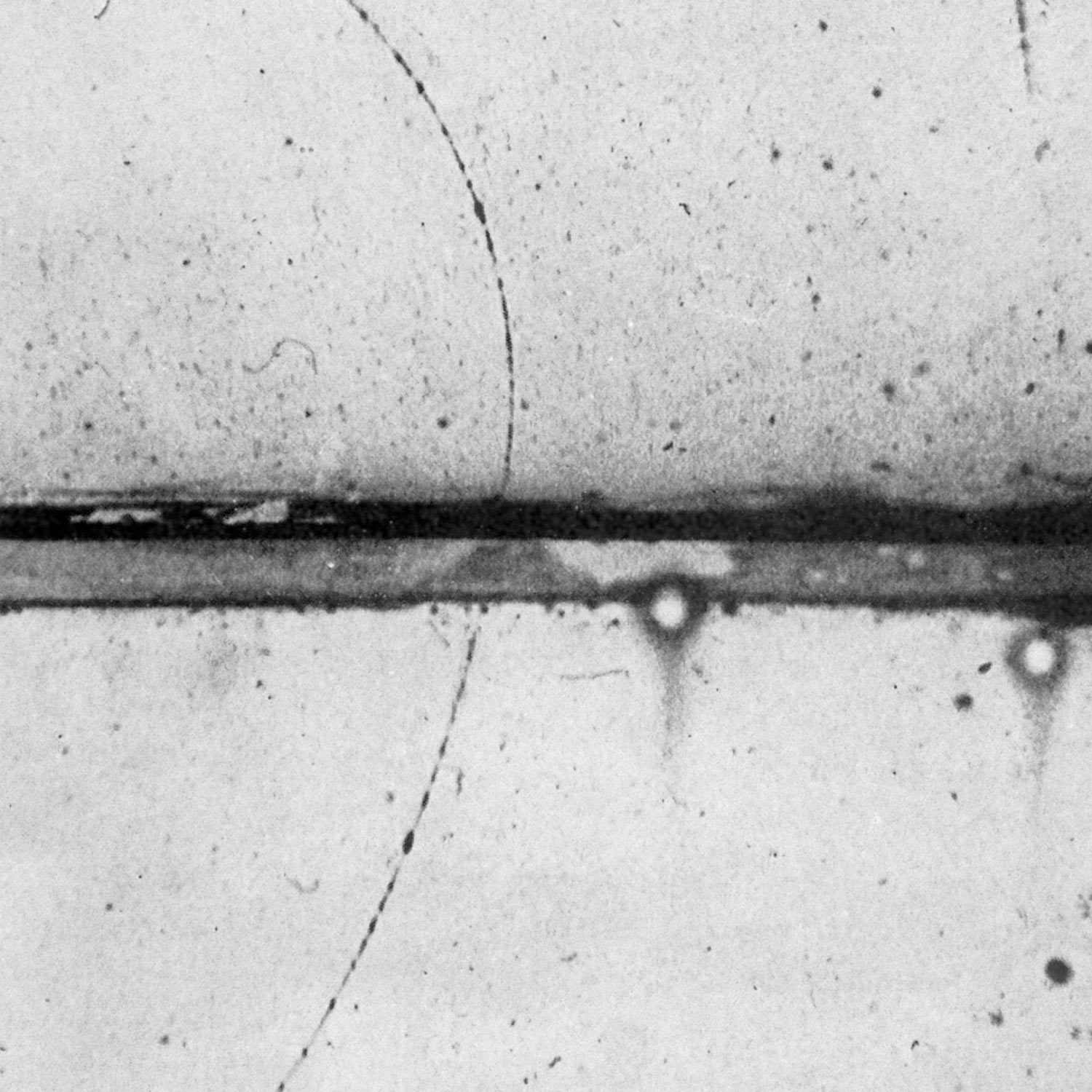
Cloud chamber photograph by the American experimental physicist Carl David Anderson of the first positron ever identified.
Antimatter is hard to study because it is destroyed on contact with ordinary matter.
A positron that touches the wall of a container annihilates with an electron and vanishes.
Northwestern University Professor Gerald Gabrielse and his colleagues avoided this by suspending the positron in a Penning trap, which uses electric and magnetic fields to hold a particle in the middle of an empty, nearly perfect vacuum. The trap was chilled to about 0.3 degrees above absolute zero.
“If you take an electron and an anti-electron (or positron) and collide them together, they both disappear,” Professor Gabrielse said.
“We describe that as annihilation, a concept that fuels science fiction writers’ imaginations.”
“The big mystery of the Universe is the Big Bang should have created equal amounts of matter and antimatter.”
“But, if that were true, it would annihilate, and we’d be left with nothing.”
“There’s clearly something wrong with that theory, and that’s what we’re trying to figure out.”
The team’s source of antimatter particles was sodium-22, a radioactive isotope whose decay emits positrons with great energy.
The researchers slowed one down and loaded it into the trap, a process that takes 8 to 11 hours with their simple, low-intensity source.
They then cooled it into its lowest cyclotron energy state, the quantum-mechanical equivalent of the lowest rung on a ladder.
Using tuned microwaves, they nudged the positron up that ladder and flipped its spin, watching each change through tiny shifts in the frequency at which the particle oscillates. The size of those shifts also indicated that only one positron was in the trap.
“We cool it down so much that it’s in its quantum ground state,” Professor Gabrielse said.
“We actually coaxed this very fast positron to sit there and behave for months at a time.”
The Standard Model predicts that electrons and positrons should be perfect mirror images, a principle known as CPT symmetry.
A mismatch between the two magnetic moments would show that the theory is incomplete.
It might also help explain why the Universe contains so much more matter than antimatter, when the Big Bang should have produced equal amounts.
“Current theories suggest that there will be no difference in the two measurements,” Professor Gabrielse said.
“If it turns out they are not equal, that would be the biggest discovery in physics in the last century.”
With further optimization, a positron measurement matching the electron’s precision now seems feasible.
“This would test the fundamental CPT symmetry invariance of the Standard Model more than 30 times more precisely than has been possible in the lepton sector,” the authors said.
The team’s work was published this week in the journal Physical Review Letters.
_____
T.G. Myers et al. 2026. One-Positron Quantum Cyclotron. Phys. Rev. Lett 137, 173001; doi: 10.1103/gbkc-6nlj