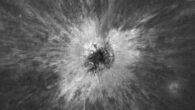
Using images from the LROC instrument onboard NASA’s Lunar Reconnaissance Orbiter (LRO), scientists have discovered the biggest newly formed impact crater...
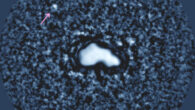
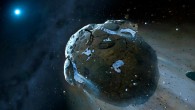
High-resolution images from ESO’s Very Large Telescope and the Large Binocular Telescope reveal that the E-type asteroid (44) Nysa may be unlike any...
The Chicxulub impact not only plunged Earth into an impact winter but also produced a dust blanket that later overheated the planet, according to new research...
By analyzing nickel isotopes preserved in the 66-million-year-old debris left by the Chicxulub impact, researchers conclude that the asteroid responsible...
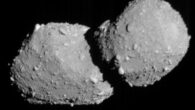
On July 5, 2026, Japan Aerospace Exploration Agency’s Hayabusa-2 spacecraft completed the first asteroid encounter of its extended mission, flying past...
On July 2, 2026, the Tianwen-2 probe closed to within 20 km (12.4 miles) of the small near-Earth asteroid 2016 HO3, one of only seven Earth quasi-satellites...
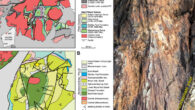
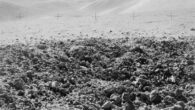
Zircon crystals and impact-altered minerals show that a massive asteroid slammed into what is now the Pilbara region of Western Australia about 3 billion...
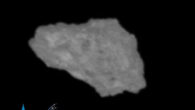
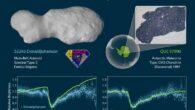
The main-belt asteroid Donaldjohanson, a heavily cratered fragment born from a catastrophic breakup 155 million years ago, appears to wobble through space...
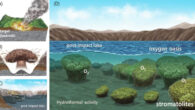
Planetary scientists analyzing a lunar meteorite known as Northwest Africa (NWA) 12593 have uncovered evidence of an asteroid impact that occurred 3.5...
By studying fungal microfossils in 66-million-year-old rock samples from the Denver Basin in Colorado, Johns Hopkins University microbiologists have confirmed...
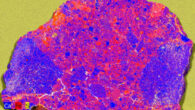
A new nanoscale analysis of the Bennu sample OREX-800066-3 returned by NASA’s OSIRIS-REx mission shows that organic compounds and minerals cluster into...
Astronomers using the Vera C. Rubin Observatory have discovered over 11,000 new asteroids, including hundreds of trans-Neptunian objects and 33 previously...
A new analysis of isotopic signatures across planets and meteorite parent bodies suggests our home world formed entirely from inner solar system material,...
New measurements show that the DART impact in 2022 not only shortened the orbit of the moonlet Dimorphos around its parent asteroid, Didymos, but also...
Earlier work has demonstrated that an extremophile bacterium species called Deinococcus radiodurans can survive the radiation, cold, and desiccation associated...
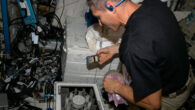
As human space exploration pushes farther from Earth, the need for sustainable ways to obtain local resources is becoming increasingly urgent, as routine...
Planetary scientists analyzing oxygen isotopes in lunar soil from the Apollo mission sites conclude that meteorite bombardment over 4 billion years could...