New infrared observations of the Eskimo Nebula, a bipolar double-shell planetary nebula in the constellation of Gemini, reveal clumps of dust, ionized gas and expanding shells surrounding a central star.
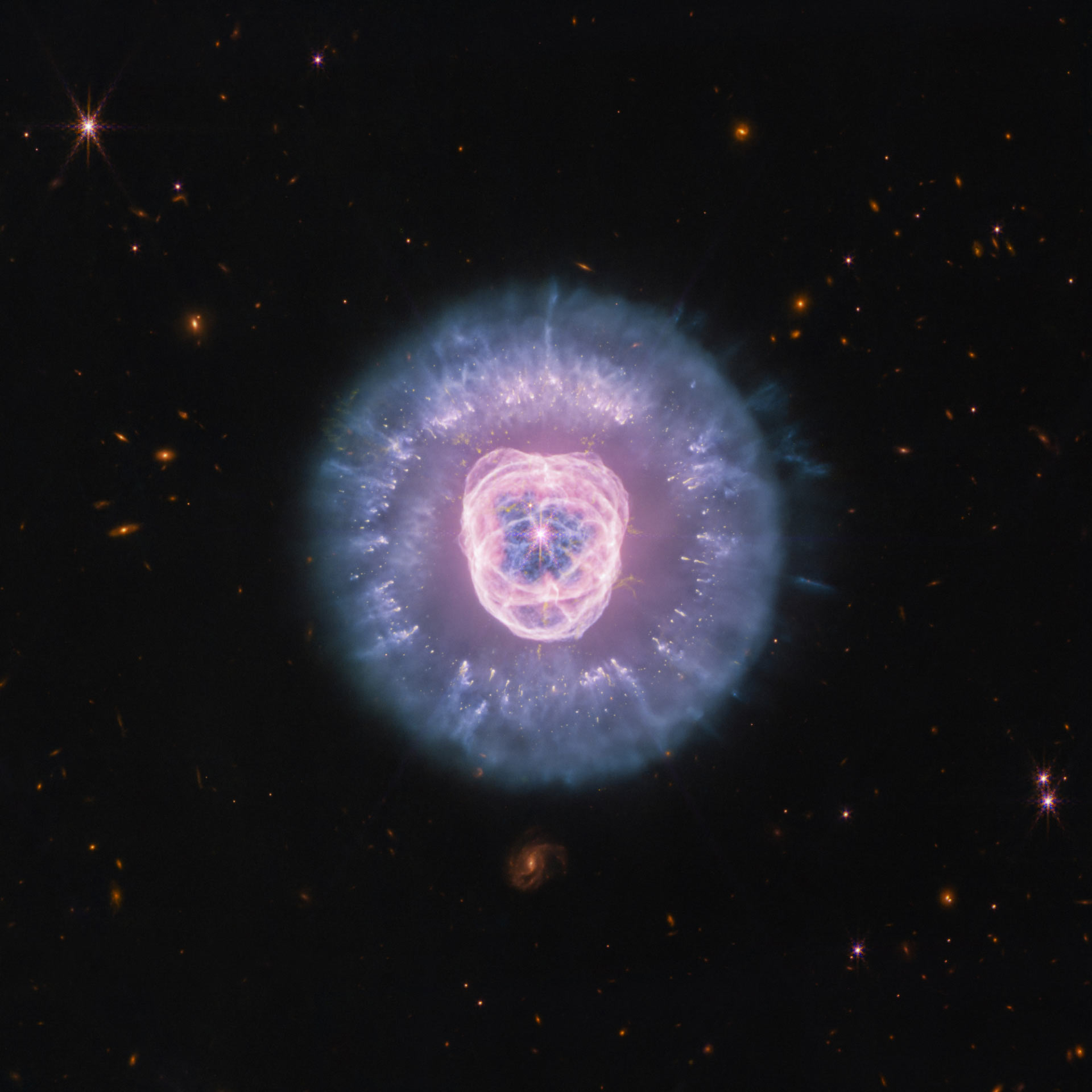
This Webb/NIRCam/MIRI image shows the Eskimo Nebula, a bipolar planetary nebula some 4,200 light-years away in the constellation of Gemini. Image credit: NASA / ESA / CSA / Webb / STScI / Alyssa Pagan, STScI.
The Eskimo Nebula is located approximately 4,200 light-years away in the constellation of Gemini.
Otherwise known as NGC 2392, the Clownface Nebula and the Lion Nebula, the nebula was first spied by the German-British astronomer William Herschel on January 17, 1787.
“Webb’s infrared vision highlights features like compact clumps of dust and a haze of ionized gas,” the Webb astronomers said in a statement.
“It’s taken several thousand years for this collection of gas and dust to reach its current shape, and the nebula’s components continue to be altered.”
“The source of these constant changes and the reason for the nebula’s distinct appearance is located at the center: the remains of a dying star.”
“The oxygen-rich central star has left behind a white dwarf that is ‘cooking’ everything from the inside and producing a bubble of ionized gas as it does.”
“The gas bubble is expanding over time and destroying dust that is in its path.”
“Understanding why the swept-up gas has a complex structure of rings and shells, a common feature in planetary nebulae, is an ongoing endeavor.”
The new image of the Eskimo Nebula was captured using the NIRCam and MIRI instruments onboard the NASA/ESA/CSA James Webb Space Telescope.
“The Eskimo Nebula will continue to undergo changes as its gas and dust migrate away from the stellar core,” the astronomers said.
“We estimate the nebula will eventually disperse in approximately 10,000 years, a relatively short period in astronomical terms.”