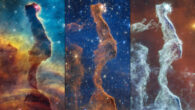
The NASA/ESA Hubble Space Telescope and the NASA/ESA/CSA James Webb Space Telescope have turned their cameras on an eerie pillar of gas and dust with a...
Crowded star clusters in the early Universe could have built giant stars, seeded black holes and fed the mysterious little red dots, according to a team...
New radio observations with NSF’s Karl G. Jansky Very Large Array (VLA) and the Atacama Large Millimeter/submillimeter Array (ALMA) show the red supergiant...
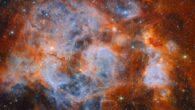
Astronomers using the NASA/ESA/CSA James Webb Space Telescope have captured a spectacular new view of N159, one of the richest HII complexes in the Large...
The enrichment in metals (any element heavier than hydrogen and helium, including carbon, oxygen, iron and gold) likely came from generations of exploding...
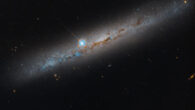
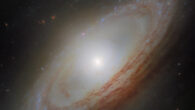
Astronomers using the NASA/ESA Hubble Space Telescope have captured a new view of NGC 1827, an intermediate spiral galaxy seen edge-on in the constellation...
A team of astronomers led by University of Warwick’s Dr. Mark Hollands has converted white dwarf spectra into the colors a human eye would perceive.
The...
Planets are supposed to form alongside their stars, but new research suggests that planets may also be born later, from the debris of a dying star, and...
For the first time, astronomers have directly detected radio emission from a planet beyond our Solar System.
This artist’s impression shows how the gas...
A barred spiral galaxy called NGC 4698 has a bizarre structure in which its central stars and gas rotate perpendicular to the galaxy’s main disk, possibly...
Although the famous Carrington Event of 1859 is often described as the first major space weather event to affect technology, earlier incidents did occur....
Astronomers using ESO’s Visible and Infrared Survey Telescope for Astronomy (VISTA) have observed the densest, most crowded regions at the centers of...
Astronomers have found new evidence that 3I/ATLAS, only the third confirmed interstellar object ever detected entering the Solar System from beyond, formed...
Astronomers have combined 2,884 Type Ia supernovae — which are used to measure cosmic distances — with cosmic microwave background and galaxy-mapping...
A new images from the NASA/ESA Hubble Space Telescope reveals LHA 120-N44, a striking nebula located roughly 160,000 light-years away in the Large Magellanic...
A new image from the Gemini North telescope on Maunakea in Hawai’i offers the sharpest look yet at a striking pair of interacting spiral galaxies, cataloged...
Astronomers using the NASA/ESA/CSA James Webb Space Telescope have revealed a surprisingly large population of faint, low-mass stars in distant galaxies,...
The mysterious objects spotted in the early Universe may not be isolated points of light after all. A new analysis of images of 217 ‘little red dots’...
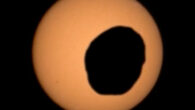
Perseverance has caught the silhouette of Phobos, one of the two Martian moons, sweeping across the solar disk in a fresh transit video from Jezero crater.
This...