Astronomers have released the largest-ever 2D map of our Universe, charting nearly 4 billion stars, galaxies and other objects across roughly 75% of the sky. Created as part of the DESI Legacy Imaging Surveys, the map is publicly viewable through the Legacy Survey Sky Viewer. It could help scientists hunt for gravitational lenses, supernovae, dark matter and clues to dark energy.
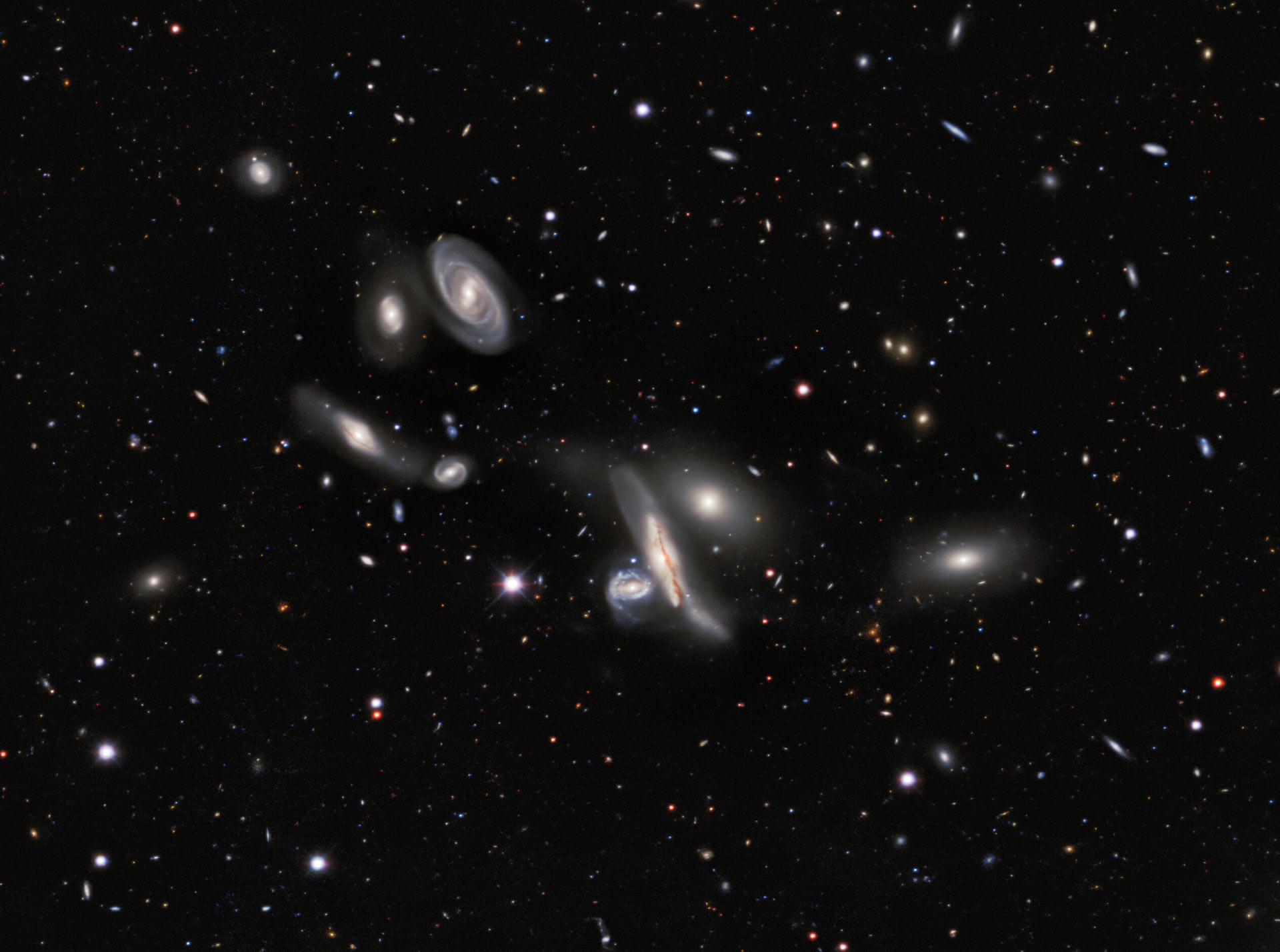
This image shows the Copeland Septet, a group of galaxies located in the constellation of Leo. Image credit: DESI Legacy Imaging Surveys / LBNL / DOE / KPNO / CTIO / NOIRLab / NSF / AURA.
The new map builds on earlier versions from the DESI Legacy Imaging Surveys that have already proved invaluable.
“It’s part of the fabric of astronomy research now,” Dr. David Schlegel, a co-lead of the Legacy Surveys and an astronomer at the Lawrence Berkeley National Laboratory.
“When you’re working with astronomical objects today, you often start by pulling up the Legacy Imaging Viewer to see what you’re looking at.”
Covering roughly 75% of the sky in visible and near-infrared light, the map provides a deep view of the extragalactic Universe not blocked by the dust and stars of our own Milky Way
The astronomers expect it will remain the most comprehensive 2D map of our Universe for years to come.
It was built by combining 263,407 telescope exposures from three ground-based sky surveys.
More than 160 scientists contributed to data collection for the project, and a team of 20 astronomers produced the final dataset released today.
“Explorations of our Universe always start with images of the night sky,” said Dr. Arjun Dey, a co-lead of the Legacy Surveys and an astronomer at NSF’s NOIRLab.
“The DESI Imaging Legacy Surveys are just one step in this venerable human tradition.”
“For our team, these data are fundamental to the investigation of the expansion history of the Universe and the formation of our Galaxy.”
“But the skies belong to everyone, and this survey gives everyone the chance to marvel at their wonders.”