Astronomy News

Oct 30, 2018 by News Staff

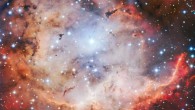
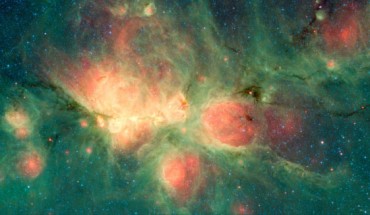
New images from NASA’s Spitzer Space Telescope show the star-forming region NGC 6334, also known as the Cat’s Paw Nebula or Bear Claw Nebula. This image from Spitzer’s IRAC and MIPS instruments shows the Cat’s Paw Nebula. Image credit: NASA / JPL-Caltech. The Cat’s Paw Nebula resides in the constellation Scorpius and is approximately 5,500 light-years away from Earth. Discovered by English astronomer John Herschel in 1837, the star-forming...

Oct 29, 2018 by News Staff

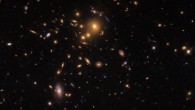
SDSS J0915+3826, a giant group of galaxies located approximately 4 billion light-years away, is so massive that its gravity bends light like a lens, making...

Oct 29, 2018 by News Staff

A research team from Hungary has confirmed the existence of two enigmatic celestial objects called Kordylewski dust clouds (KDCs) — large concentrations...

Oct 26, 2018 by News Staff

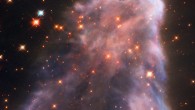
The NASA/ESA Hubble Space Telescope has captured a new photo of a stunning and slightly eerie nebula called IC 63. IC 63 is classified as both a reflection...

Oct 25, 2018 by News Staff

The Very Large Telescope (VLT), a telescope facility operated by the European Southern Observatory (ESO) on Cerro Paranal in the Atacama Desert of northern...

Oct 25, 2018 by News Staff

A team of U.S. astronomers has discovered that small planetary systems with multiple planets are more likely to form around stars that have lower amounts...

Oct 23, 2018 by News Staff

Astronomers using NASA’s Chandra X-ray Observatory have confirmed that a supernova remnant called Kes 75 contains the youngest known pulsar in our Milky...

Oct 22, 2018 by News Staff

The NASA/ESA Hubble Space Telescope has captured a vivid image of the unbarred spiral galaxy NGC 5033. This Hubble image shows the spiral galaxy NGC 5033....

Oct 19, 2018 by News Staff

Stellar superflares from young red dwarfs may make conditions uninhabitable on fledgling planets, according to the new results of the Habitable Zones and...

Oct 18, 2018 by News Staff

Astronomers using ESO’s Very Large Telescope have spotted a gigantic galaxy proto-supercluster in the early Universe, just 2.3 billion years after the...

Oct 17, 2018 by News Staff

A distant relative to GW170817, the first source identified to emit gravitational waves and light, has been discovered. Reported in the journal Nature...

Oct 16, 2018 by News Staff

Astronomers using the Atacama Large Millimeter/submillimeter Array (ALMA) have discovered a 2-million-year-old planetary system containing at least four...

Oct 16, 2018 by Sergio Prostak

C/2016 R2 (PanSTARRS), a visitor from the Solar System’s distant Oort Cloud, sports a very complex tail dominated by blue light and is unusually rich...

Oct 15, 2018 by News Staff

For the first time, a new computer simulation that incorporates the physical effects of Einstein’s general theory of relativity shows that gas in supermassive...

Oct 15, 2018 by News Staff

A stunning new image from the NASA/ESA Hubble Space Telescope shows the effects of gravitational lensing caused by SDSS J0952+3434, a very massive group...

Oct 12, 2018 by News Staff

A team of astronomers led by Caltech’s Kishalay De has discovered the first recorded ‘ultra-stripped’ supernova — a faint type of supernova...

Oct 11, 2018 by News Staff

Astronomers using CSIRO’s Australian Square Kilometre Array Pathfinder (ASKAP) at the Murchison Radio-Astronomy Observatory have nearly doubled the known...

Oct 10, 2018 by News Staff

Using the Atacama Large Millimeter/submillimeter Array (ALMA), astronomers found evidence that a white dwarf and a brown dwarf collided in a ‘blaze of...

Oct 8, 2018 by News Staff

The NASA/ESA Hubble Space Telescope has taken a detailed image of a spectacular part of the spiral galaxy Messier 95. This Hubble image reveals a detailed...

Oct 5, 2018 by News Staff

Astronomers have detected gamma rays coming from the outermost regions of an unusual star system within our Milky Way Galaxy. The source is a microquasar...