Featured News

Oct 15, 2020 by News Staff

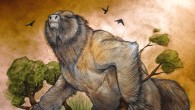
Paleontologists in Morocco have discovered the fossilized remains that belonged to a unique small, long-beaked pterosaur. An artist’s impression of Leptostomia begaaensis. Image credit: Megan Jacobs, University of Portsmouth. The new pterosaur species, named Leptostomia begaaensis, lived between 113 and 94 million years ago (mid-Cretaceous period). The flying reptile had a very long flattened toothless beak, and was similar in size to a turkey. It...

Oct 14, 2020 by News Staff

The bright frosts observed in 2015 in the equatorial region of Cthulhu on Pluto are mostly made of methane-rich ice, according to new research. This image,...

Oct 13, 2020 by Sergio Prostak

A team of ornithologists from the United States, Colombia and Denmark has described six new cryptic species in the rufous antpitta (Grallaria rufula) complex...

Oct 13, 2020 by News Staff

Using ESO’s Very Large Telescope (VLT) and New Technology Telescope (NTT), the Las Cumbres Observatory global telescope network, and NASA’s Neil Gehrel...

Oct 12, 2020 by News Staff

Planetary researchers have mapped and characterized ancient sand dune fields in the canyons of Valles Marineris on Mars. Their discovery offers new insights...

Oct 12, 2020 by News Staff

An international team of researchers has discovered two new species of the murine genus Colomys living in Africa: one in Liberia and Guinea and one in...

Oct 12, 2020 by News Staff

The median artery of the human forearm is an example of microevolutionary changes in the internal anatomy of the human body, according to new research...

Oct 9, 2020 by News Staff

Paleontologists have found the remains of Mesopithecus pentelicus — an extinct species of Old World monkey that lived in Europe and Asia between...

Oct 9, 2020 by Enrico de Lazaro

Astronomers using the HARPS (High Accuracy Radial velocity Planet Searcher) spectrograph at ESO’s La Silla Observatory in Chile have detected gaseous...

Oct 8, 2020 by News Staff

A new genus and species of mosasaur has been identified from a 1-m- (3.3-foot-) long skull and isolated bones found in a phosphate mine in Morocco. Life...

Oct 7, 2020 by Enrico de Lazaro

Paleontologists in Mongolia have found the fossilized skeletal remains from a new genus and species of two-fingered oviraptorosaur that walked the Earth...

Oct 7, 2020 by Natali Anderson

Astronomers using ESO’s Very Large Telescope Interferometer have captured the first direct images of the recently-discovered giant planet Beta Pictoris...

Oct 6, 2020 by Natali Anderson

An international team of astronomers has discovered a hot terrestrial planet orbiting the rapidly-rotating low-mass star TOI-540. An artist’s impression...

Oct 6, 2020 by News Staff

Catalase, a naturally occurring enzyme commonly used worldwide in food production and as a dietary supplement, holds potential as a low-cost therapeutic...

Oct 6, 2020 by News Staff

Astronomers using twin 8.1-m telescopes at Gemini Observatory in Chile have captured the most detailed near-infrared image yet of the Carina Nebula’s...

Oct 5, 2020 by News Staff

A team of geobiologists and astronomers from the United States and Germany has identified 24 extrasolar planets that may have conditions more suitable...

Oct 5, 2020 by Enrico de Lazaro

A new genus and species of sebecosuchian crocodyliform that roamed Earth during the Cretaceous period has been identified from a partial skeleton found...

Oct 2, 2020 by News Staff

Using the MUSE and FORS2 instruments on ESO’s Very Large Telescope (VLT), astronomers have spotted a group of six galaxies around SDSS J1030+0524, a...

Oct 2, 2020 by Natali Anderson

Astronomers using NASA’s Chandra X-ray Observatory have detected an extragalactic candidate planet circling a binary system in Messier 51 (also known...

Oct 1, 2020 by News Staff

Astronomers using the NASA/ESA Hubble Space Telescope have tracked the fading light of a Type Ia supernova in NGC 2525, a barred spiral galaxy located...