Featured News

Sep 21, 2020 by Natali Anderson

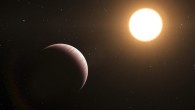
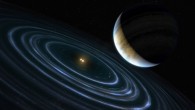
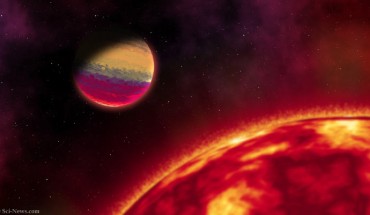
Astronomers have discovered two planets orbiting a bright dwarf star in the binary stellar system Gliese 414. An artist’s impression of the Gliese 414 system. Image credit: Sci-News.com. Gliese 414 is located approximately 39 light-years away in the constellation of Ursa Major. Also known as GJ 414, HD 97101 or HIP 54646, the system is 12.4 billion years old. It consists of a relatively active K7V-type dwarf star, Gliese 414A, and its smaller M2V-type...

Sep 21, 2020 by News Staff

An international team of archaeologists and paleoanthropologists has found ancient human and animal footprints on the surface of an ancient lakebed in...

Sep 21, 2020 by News Staff

Spectral data gathered by the Visual and Infrared Mapping Spectrometer (VIMS) onboard NASA’s Cassini spacecraft provide strong evidence that the northern...

Sep 17, 2020 by News Staff

Two new photos, taken with the NASA/ESA Hubble Space Telescope, show Jupiter with its turbulent atmosphere and giant storms. One of the images also features...

Sep 17, 2020 by News Staff

An international team of researchers has found evidence that hot springs existed in Olduvai Gorge — a paleoanthropological site in the Great Rift...

Sep 16, 2020 by News Staff

The Carnian Pluvial Episode, a major climate change event that occurred around 234 to 232 million years ago (Late Triassic epoch), was a time of global...

Sep 16, 2020 by News Staff

Using NASA’s Transiting Exoplanet Survey Satellite (TESS) and several ground-based telescopes, astronomers have discovered a Jupiter-sized planet orbiting...

Sep 16, 2020 by News Staff

Archaeologists have unearthed the well-preserved remains of a 2,700-year-old wine press at the Phoenician site of Tell el-Burak, 9 km south of Sidon in...

Sep 15, 2020 by News Staff

A puffy gas giant slightly larger than Jupiter has been discovered orbiting the early M-type dwarf star TOI-1899, thanks to new data from NASA’s Transiting...

Sep 14, 2020 by News Staff

Astronomers using the James Clerk Maxwell Telescope (JCMT) and the Atacama Large Millimeter/submillimeter Array (ALMA) have detected phosphine (PH3) gas...

Sep 14, 2020 by Natali Anderson

Using NASA’s Transiting Exoplanet Survey Satellite (TESS) and the HARPS fiber-fed Echelle spectrograph mounted at the 3.6-m telescope of ESO’s La Silla...

Sep 11, 2020 by News Staff

Extrasolar planets hosted by stars with sufficiently high carbon-to-oxygen ratios could be made of diamonds and silica, according to new research by Arizona...

Sep 11, 2020 by News Staff

The large mass of a galaxy cluster deflects light from background objects, a phenomenon known as gravitational lensing. The large-scale gravitational lens...

Sep 11, 2020 by Enrico de Lazaro

Paleontologists have examined the fossilized remains of a previously unknown species of eurypterid (sea scorpion) and found direct evidence that these...

Sep 11, 2020 by News Staff

In a process called tidal heating, gravitational push and pull from Jupiter’s Galilean moons — Europa, Ganymede, Io and Callisto — and the...

Sep 10, 2020 by News Staff

NASA’s OSIRIS-REx spacecraft, launched in 2016, is currently orbiting the near-Earth asteroid (101955) Bennu with the aim of briefly touching on the...

Sep 9, 2020 by Enrico de Lazaro

An international team of scientists has successfully extracted and sequenced the mitochondrial DNA from an 80,000-year-old adult Neanderthal tooth found...

Sep 8, 2020 by News Staff

Astronomers using the Murchison Widefield Array (MWA) radio telescope have searched for technosignatures — indicators of advanced extraterrestrial...

Sep 8, 2020 by News Staff

The founding population of the New Guinea singing dog, a small-to-medium-sized canid thought to be extinct in the wild since the 1970s, is not, in fact,...

Sep 7, 2020 by Sergio Prostak

An international team of scientists has discovered stylistically unique ancient drawings, including the only known prehistoric depiction of a now-extinct...