Scientists have discovered a new fossil species of bear that roamed what is now Spain in the Myocene period.
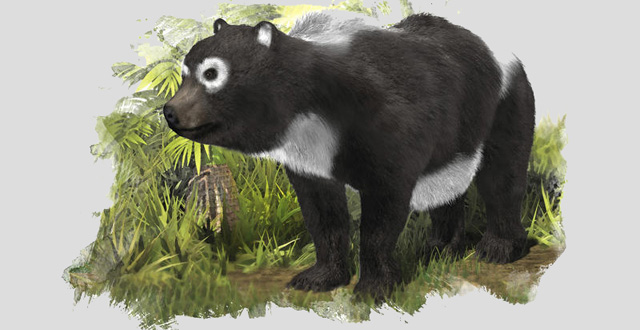
Artist’s reconstruction of Agriarctos beatrix (SINC)
The new ursid species, Agriarctos beatrix, was a small plantigrade omnivore and was genetically related to giant pandas. Its fossil remains have been found in the Nombrevilla 2 site in the province of Zaragoza, Spain.
The study by researchers from the National Museum of Natural Sciences in Spain and the University of Valencia, published in the journal Estudios Geológicos, suggests that this creature lived during the Myocene period some 11 million years ago.
“This bear species was small, even smaller than the Sun bear – currently the smallest bear species,” said to SINC Dr. Juan Abella, a researcher at the Department of Paleobiology of the Spain’s National Museum of Natural Sciences and a lead author of the study. “It would not have weighed more than 60 kg.”
Although it is difficult to determine its physical appearance given that only pieces of dental fossils have been found, the scientists believe that it would have had dark fur with white spots mainly on the chest, around the eyes and possibly close to the tail.
“This fur pattern is considered primitive for bears, such as that of the giant panda whose white spots are so big that it actually seems to be white with black spots,” Dr. Abella explained.
A. beatrix would have lived in the forest and could have been more sessile that those bears that tend to hunt more, such as the brown or polar bears. This extinct bear would have escaped from other larger carnivores by climbing up trees.
“Its diet would have been similar to that of the Sun bear, Ursus malayanus, or the Spectacled bear, Tremarctos ornatus, that only eat vegetables and fruit and sometimes vertebrates, insects, honey and dead animals,” Dr. Abella said.
“We know that it was a different species to those documented up until now because of its morphological differences and the size of its teeth,” the scientist confirmed. “We have compared it with species of the same kind (Agriarctos) and similar kinds from the same period (Ursavus and Indarctos)”.
The reasons for its extinction have yet to be determined but “the most probable cause is likely to be the opening up of the forests giving way to more open, drier spaces and the appearance of similar yet larger and more competitive species,” Dr. Abella said.
The study now suggests the appearance of this group related to giant pandas some two millions years later, from 9 million years ago to 11 million years ago. They could have originated in the north-east basins of the Iberian Peninsula.