Tyrannosaurs sit at the top of the food chain in the popular imagination, but a newly described fossil from Alberta, Canada, suggests that a much smaller predator may have fed on the carcass of Albertosaurus sarcophagus, a tyrannosaur relative.
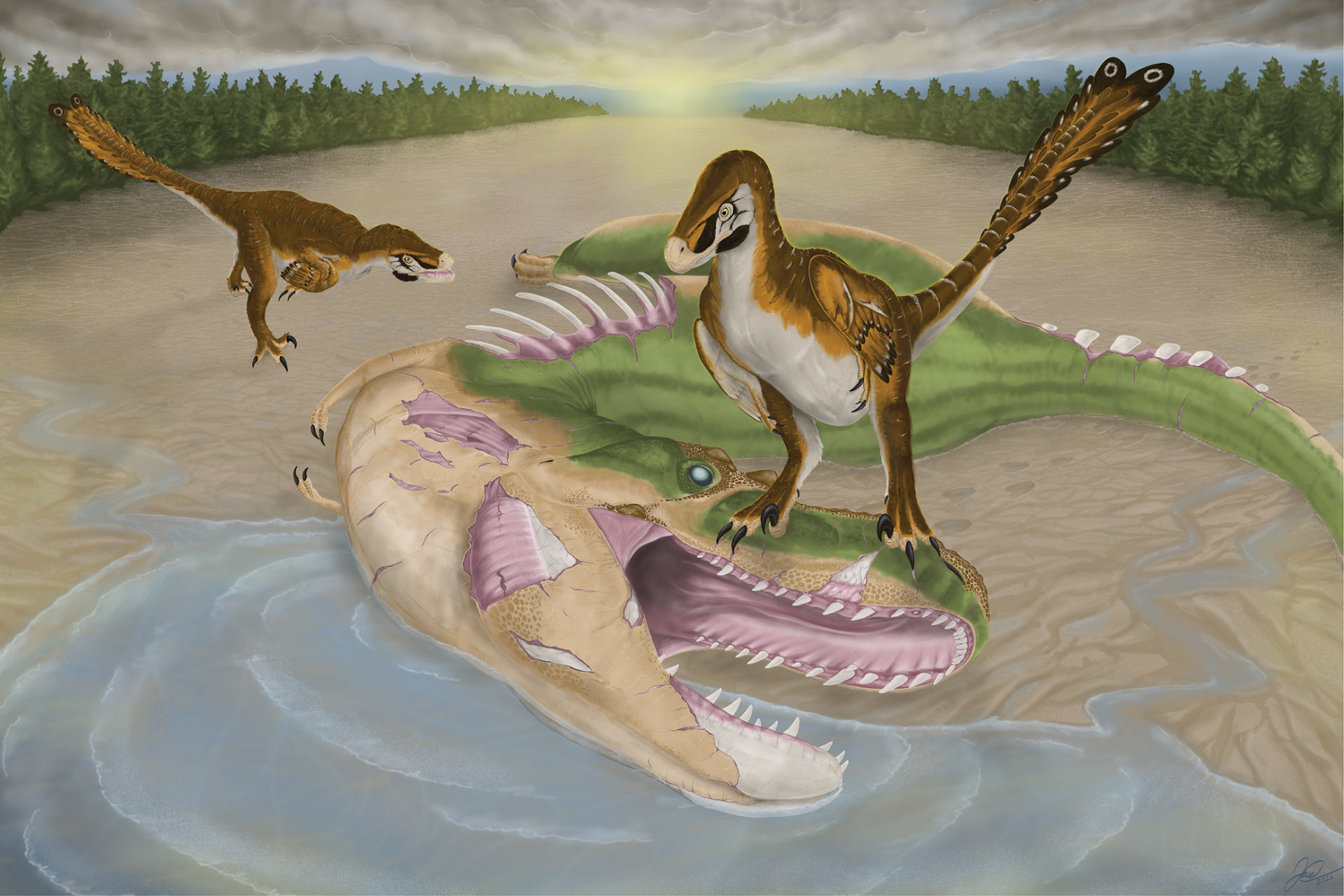
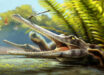
Atrociraptor scavenge the carcass of Albertosaurus along the edge of a river floodplain. Image credit: Joshua Adam Doyon.
“This turns everything on its head, because you’re dealing with a very small dinosaur eating a very big, mean, nasty dinosaur like a tyrannosaur,” said Dr. Philip Currie, a paleontologist at the University of Alberta.
In new research, Dr. Currie and his colleague focused on the skull of a young Albertosaurus sarcophagus.
The fossil was found in the Horseshoe Canyon Formation, a roughly 70-million-year-old rock layer along the Red Deer River.
By the researchers’ estimates, the individual was not yet fully grown — about 6 m (20 feet) long and weighed roughly 533 kg (1,175 pounds).
The dinosaur’s jaw bones carry two sets of tooth marks: three parallel scores on the splenial, a bone on the inner side of the lower jaw, and a single mark on the surangular containing about 28 tiny, evenly spaced serration marks.
To work out who made them, the scientists measured the spacing between the marks and compared it with tooth and serration spacing in dinosaurs known from the formation.
Because a tooth dragged at an angle leaves marks closer together than the teeth really are, they developed a trigonometric correction for the raking angle.
Their results were most consistent with a dromaeosaurid, the group of feathered, sickle-clawed raptors.
Atrociraptor marshalli, the only confidently identified dromaeosaur species from the Horseshoe Canyon Formation, was the best-supported candidate.
The authors estimate the trace maker weighed about 16 to 18 kg, a roughly 30-to-1 mass difference with the tyrannosaur.
Given this gap, Dr. Currie and co-authors consider scavenging more likely than hunting.
“Although a dromaeosaurid (i.e., Atrociraptor) is the best supported tracemaker, both Richardoestesia and a very young tyrannosaurid (Albertosaurus) cannot fully be eliminated,” they said.
Their paper was published this month in the Journal of Paleontology.
_____
Joshua Adam Doyon et al. Evidence for dromaeosaurid scavenging on Albertosaurus (Dinosauria: Tyrannosauridae). Journal of Paleontology, published online October 14, 2026; doi: 10.1017/jpa.2026.10269