Paleontologists have described a new genus and species of teleosaurid thalattosuchian based on two specimens found in eastern Morocco. The ancient predator had a mouth lined with thin, needle-like teeth, a dentition the researchers say is unlike that of any other known crocodile-line animal.
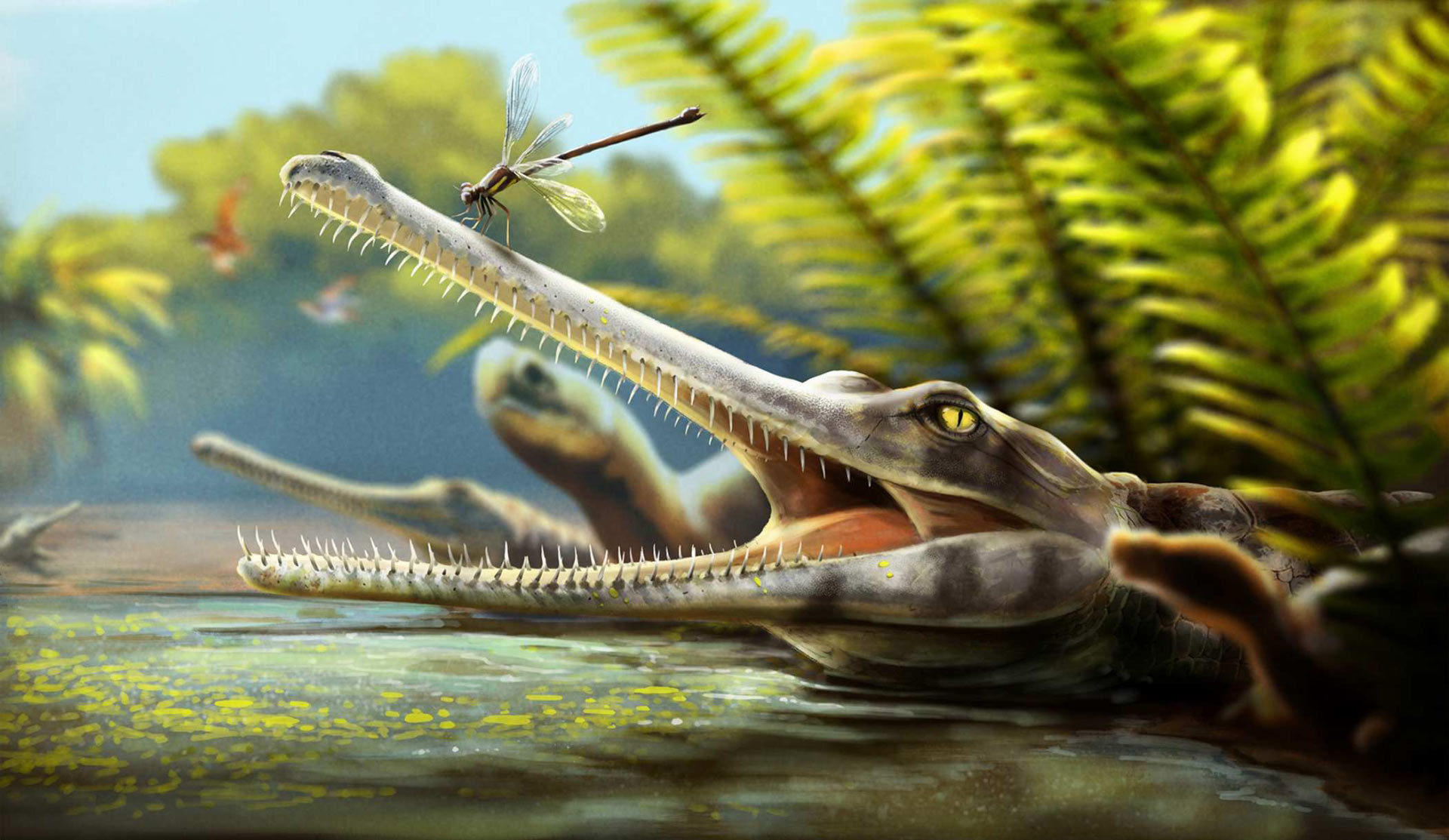
An artist’s reconstruction of Ctenosuchus tenuidens in a freshwater setting; the animal is depicted with an elongate rostrum and dense needle-like dentition, reflecting the anatomy described from the fossil specimens and a probable feeding strategy focused on small aquatic prey. Image credit: Nathan Dehaut.
Ctenosuchus tenuidens lived in what is now Morocco during the Middle Jurassic, about 165 million years ago.
The animal was a type of thalattosuchian, a group of mostly marine crocodylomorphs from the Early Jurassic to the Early Cretaceous.
“Crocodylomorph archosaurs were highly diverse during the Mesozoic inhabiting terrestrial, fluvial, lacustrine, and fully marine environments,” said University of Portsmouth paleontologist Hamzah Imran and colleagues.
“One group in particular, Thalattosuchia, were remarkable for their morphological adaptations to a semi-fully marine lifestyle, with some derived Late Jurassic forms resembling marine reptiles in overall body plan.”
“Thalattosuchia includes some well-known forms, notable for their long, slender rostra and ‘gharial-like’ bauplan.”
“Their geographic range extends around the globe between latitudes 57.4 degrees north and minus 39.8 degrees south, but they are best documented from northwest Europe, including Germany, the United Kingdom, and France.”
Two partial specimens of Ctenosuchus tenuidens came from red mudstone deposits of the Talsint-Anoual area in Figuig province, Morocco.
“The new material was purchased from commercial fossil collectors based in Morocco,” the researchers said.
“The collector supplied us with a number of photographs of the site and provided locality data.”
“This area, near the town of Talsint covers an enormous expanse of Mesozoic layers of Early Jurassic to Late Cretaceous age dominated by marine limestones and shales of Early Jurassic age overlain by red beds of Middle and Late Jurassic age.”
Ctenosuchus tenuidens’ teeth are unlike those of any other crocodile relative, living or extinct.
Each tooth is about 10 times taller than it is wide, and that the teeth are spaced roughly 2.3 mm apart.
The scientists estimate more than 35 teeth on each side of the upper jaw.
By comparison, the living Indian gharial, a fish-eater with a famously slender snout, has upper-jaw teeth spaced about 15 mm apart.
According to the authors, Ctenosuchus tenuidens probably ate small, soft prey such as little fish, crustaceans and soft-bodied invertebrates.
They considered whether it filtered food from the water, as some Jurassic flying reptiles may have, but call that a tentative idea.
An evolutionary analysis demonstrated that Ctenosuchus tenuidens is a member of Teleosauridae, a sister species to Seldsienean megistorhynchus and the group Aeolodontini.
“This species represents the only freshwater teleosauroid from Gondwana and the second teleosaur species — the other is Machimosaurus sp. — in the Jurassic of Morocco,” the paleontologists said.
The discovery is reported in a paper in the Journal of Vertebrate Paleontology.
_____
Hamzah Imran et al. A new teleosauroid (Crocodylomorpha, Thalattosuchia) with a unique dentition from the Middle Jurassic of eastern Morocco. Journal of Vertebrate Paleontology, published online October 8, 2026; doi: 10.1080/02724634.2026.2728670