Megacauda sungei, a furry, otter-size mammaliaform that lived in what is now Inner Mongolia, China, some 165 million years ago, was semiaquatic, swimming and foraging in water, with a lifestyle analogous to the living platypus.
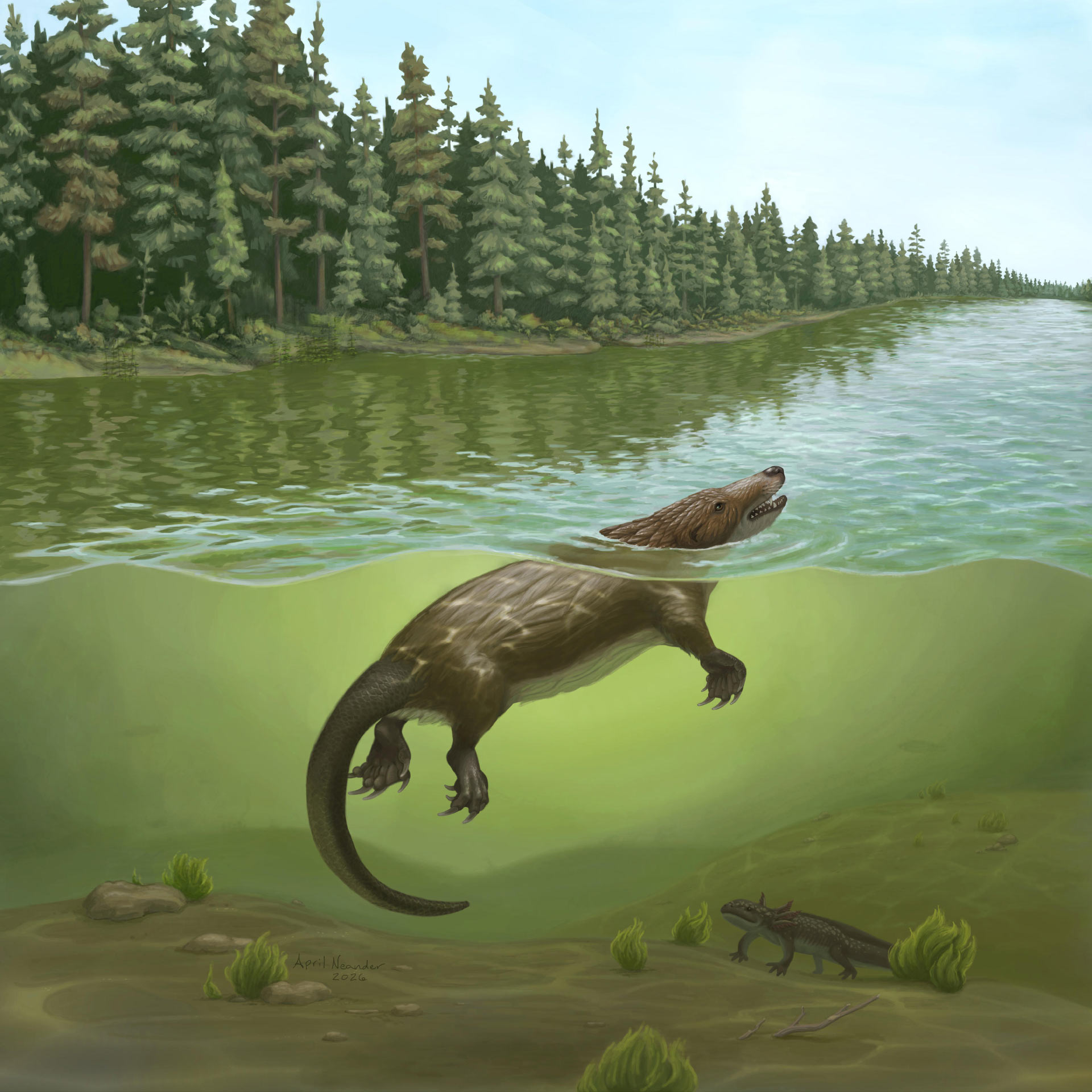
Life restoration of Megacauda sungei. Image credit: April I. Neander.
Megacauda sungei belonged to the docodonts, an extinct group of early mammaliaforms (living mammals and their extinct relatives).
At roughly 0.5 m (1.6 feet) long and one to two kilograms, about the size of a modern platypus, it is the largest Jurassic mammaliaform known. Most of its contemporaries weighed only a few grams.
The species had a wide, flattened tail, short hindlegs with relatively long feet, and distinctive teeth capable of shearing action.
It may have sheltered in burrows on land, and foraged in the water for fish, salamanders and invertebrates.
“It is the earliest evidence of an aquatic lifestyle in mammals,” noted University of Bonn paleontologist Dr. Thomas Martin.
Megacauda sungei’s remains also include exceptionally well-preserved pharynx and throat bones.
They show a configuration like that of living therian mammals, the group that includes marsupials and placentals like us.
“Many species of animal do not have a soft palate and only have a simple hyoid bone apparatus without a swallowing mechanism,” Dr. Martin said.
“Crocodiles, for instance, raise their head up and use jerky movements to make their unchewed prey slide down their throat. This is achieved with the aid of gravity.”
“In contrast, mammals, with their complex hyoid structure in the pharynx, are even able to swallow against gravity: as a result, we humans can drink upside down through a straw while breathing.”
“This ability is a key adaptation that allows mammals to feed on nutrient-rich milk and swallow it safely without it entering their nose.”
“It was this adaptation that made brain development, eventually leading to humans, possible.”
“The soft palate and the shaping of the oral cavity and pharynx are directly linked to the evolution of mammals.”
“This new development was already apparent in Megacauda sungei long before the emergence of modern mammals.”
The authors conclude that the anatomy for mammal-like swallowing, drinking and suckling was already present in the common ancestors of docodonts and mammals, long before modern mammals appeared.
The discovery also adds to evidence that early mammal relatives were more varied than their small size suggests.
“It expands the body size range of docodontans, and adds to a growing body of evidence that multiple docodontans exploited diverse niches with semiaquatic and other ecomorphotypes,” the researchers said.
“Docodontans are an early example of replicated evolution of the semiaquatic and other ecomorphotypes in the Mesozoic ecosystem dominated by dinosaurs, long before the diversification of living mammals.”
The team’s paper was published this week in the journal Nature.
_____
Y. Li et al. A Jurassic mammaliaform swimmer and transformation of the mammalian pharynx. Nature, published online October 7, 2026; doi: 10.1038/s41586-026-11107-0