Paleontologists have described a new genus and species of early bird from the Late Jurassic Zhenghe Fauna of southeastern China. The bird was flightless, had the teeth and killer toe claw of a small predatory dinosaur.
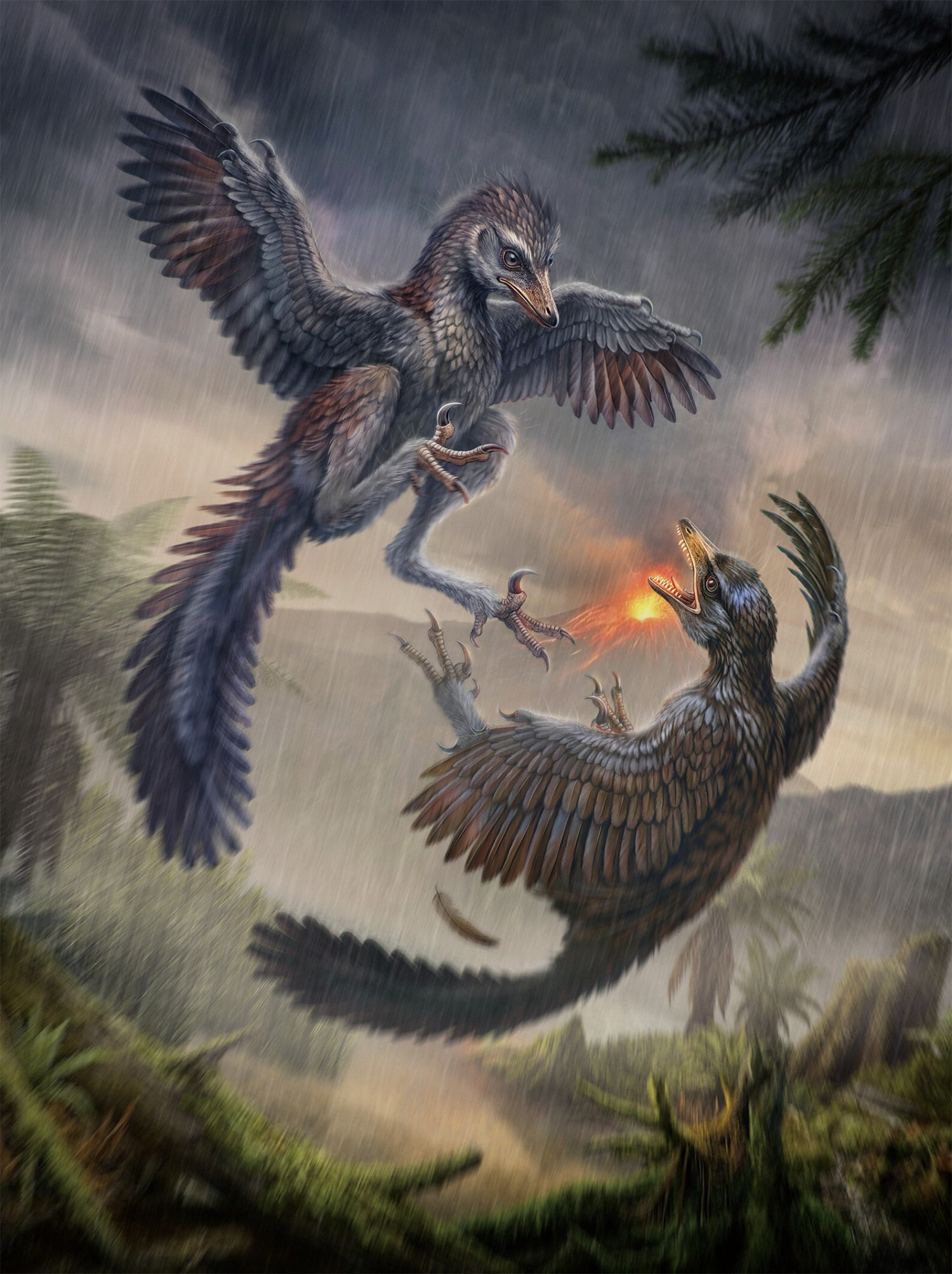
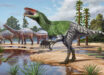
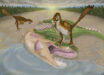
Life reconstruction of Yuezhuornis yangyuanensis. Image credit: Chung-Tat Cheung.
Yuezhuornis yangyuanensis lived in what is now China around 150 million years ago (Late Jurassic epoch).
The new species comes from the Zhenghe Fauna, a recently recognized collection of Jurassic fossils that has yielded some of the oldest birds, such as Baminornis and Zhengheornis.
“When we examined Yuezhuornis yangyuanensis, we were struck by its extraordinary mix of features,” said Dr. Min Wang, a paleontologist with the Institute of Vertebrate Paleontology and Paleoanthropology at the Chinese Academy of Sciences.
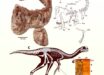
The holotype specimen of Yuezhuornis yangyuanensis was found in the Nanyuan Formation near Yangyuan village, China’s Fujian province.
The animal had bird-like hips and hind limbs, but also closely packed, serrated teeth and a hyperextensible second toe tipped with a sickle-shaped claw.
Those are traits typical of deinonychosaurs, the group of predatory dinosaurs that includes the dromaeosaurids and troodontids.
“It possesses bird-like pelvic and hind limb structures yet retains the specialized predatory foot and teeth of a small meat-eating dinosaur,” Dr. Wang said.
“It shows us that early bird evolution was far more complicated than we previously realized.”
Evolutionary analyses placed Yuezhuornis yangyuanensis among the earliest branches of the bird lineage, just beyond the famous Archaeopteryx, long considered the icon of early birds.
Its forelimbs were markedly short, a condition common in non-bird theropods, and its limb proportions resembled those of ground-dwelling birds.
“The results consistently placed Yuezhuornis yangyuanensis firmly within Avialae (a group containing modern birds and their closest extinct relatives), just crownward of Archaeopteryx and as a sister taxon to Zhengheornis,” said Dr. Zhonghe Zhou, also from the Institute of Vertebrate Paleontology and Paleoanthropology at the Chinese Academy of Sciences.
The team’s paper appears in the journal Nature.
_____
L. Xu et al. 2026. Jurassic flightless bird reveals early ecological diversity of avialans. Nature 658, 690-697; doi: 10.1038/s41586-026-10972-z