A tiny piece of amber from Myanmar has captured a defensive maneuver that lizards still use today: shedding part of their tail to escape a predator. The fossil provides direct evidence that this defensive mechanism was already in operation in mid-Cretaceous forest ecosystems.
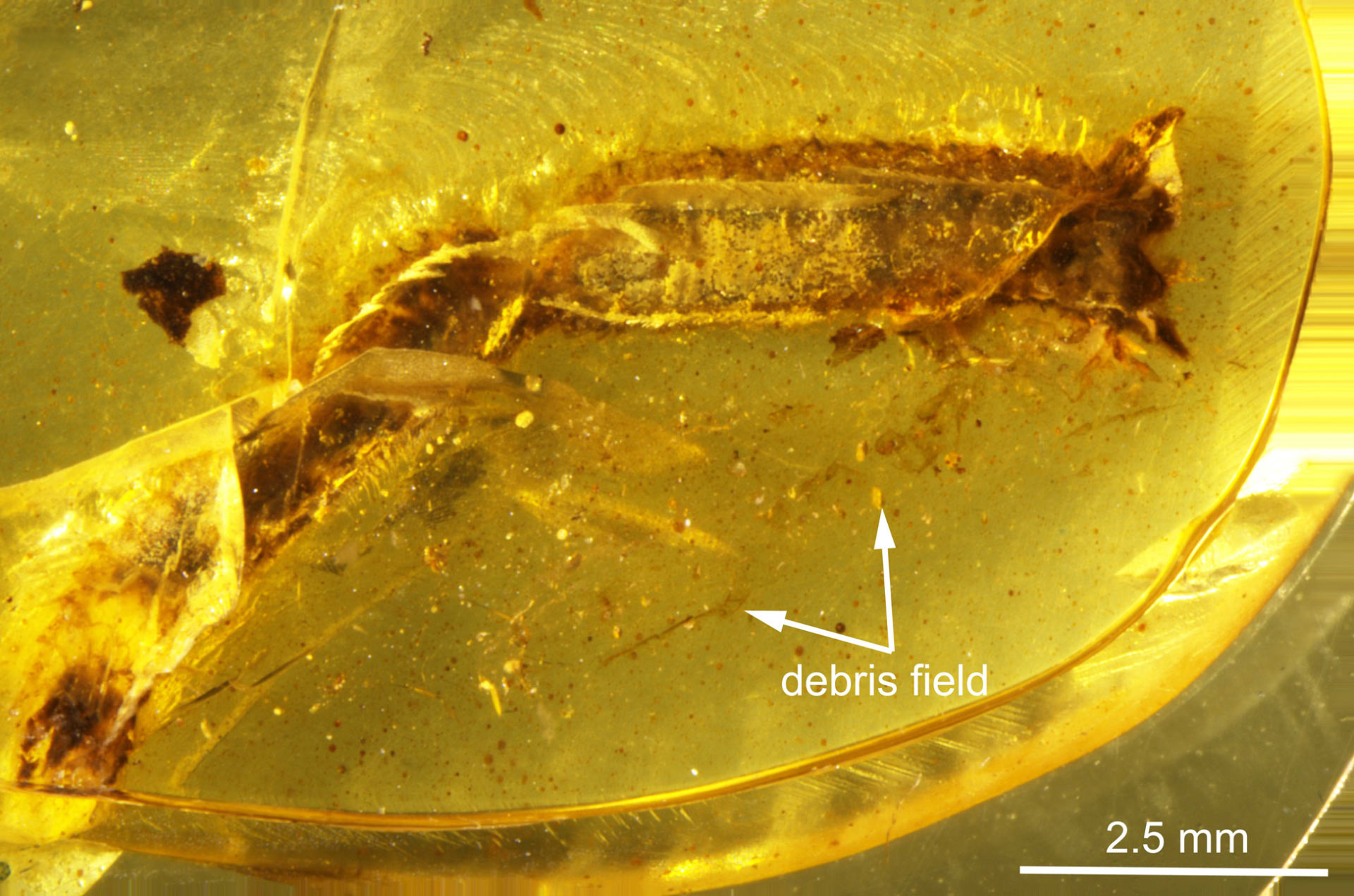
General view of the amber piece from Myanmar, arrows highlighting the debris stuck to the initial resin flow at the level of the ventral surface of the tail. Image credit: Fabrikant et al., doi: 10.26879/1706.
Tail shedding is a widespread defense among living lizards.
When threatened, a lizard can leave its tail behind while escaping; the detached appendage may continue moving, distracting a predator long enough for the animal to get away.
This strategy has costs, however, affecting locomotion, growth, reproduction and other aspects of the animal’s life.
Despite its prevalence today, the evolutionary history of the behavior has been difficult to establish.
“Caudal autotomy, the voluntary shedding of the tail, is one of the most distinctive and best-studied antipredator behaviors in present-day squamate reptiles, which comprise the most diverse clade of terrestrial vertebrates,” said Tel Aviv University paleontologist Dolev Fabrikant and colleagues.
“The mechanism of caudal autotomy involves the action of contracting muscles along specialized fracture planes, which enable the lizard to escape while the detached tail continues to move and distract predators.”
“The behavior is ecologically consequential and energetically costly, influencing locomotor performance, growth, social interactions, and reproduction, while it may even serve as the source for novel biomimetic technologies.”
“Phylogenetic studies indicate that caudal autotomy arose at the root of squamate phylogeny and is present in at least two thirds of modern-day lineages, with repeated secondary losses.”
The researchers examined a piece of mid-Cretaceous amber that contains a detached lizard tail with remarkably well-preserved skin and muscle tissue.
The specimen originates from a mine in the Hukawng valley, Kachin state, northern Myanmar.
“The specimen was legally acquired in 2022 through commercial channels (Burmite-miner) and is permanently housed in the publicly accessible research collection of the Steinhardt Museum of Natural History, Tel Aviv University,” the scientists explained.
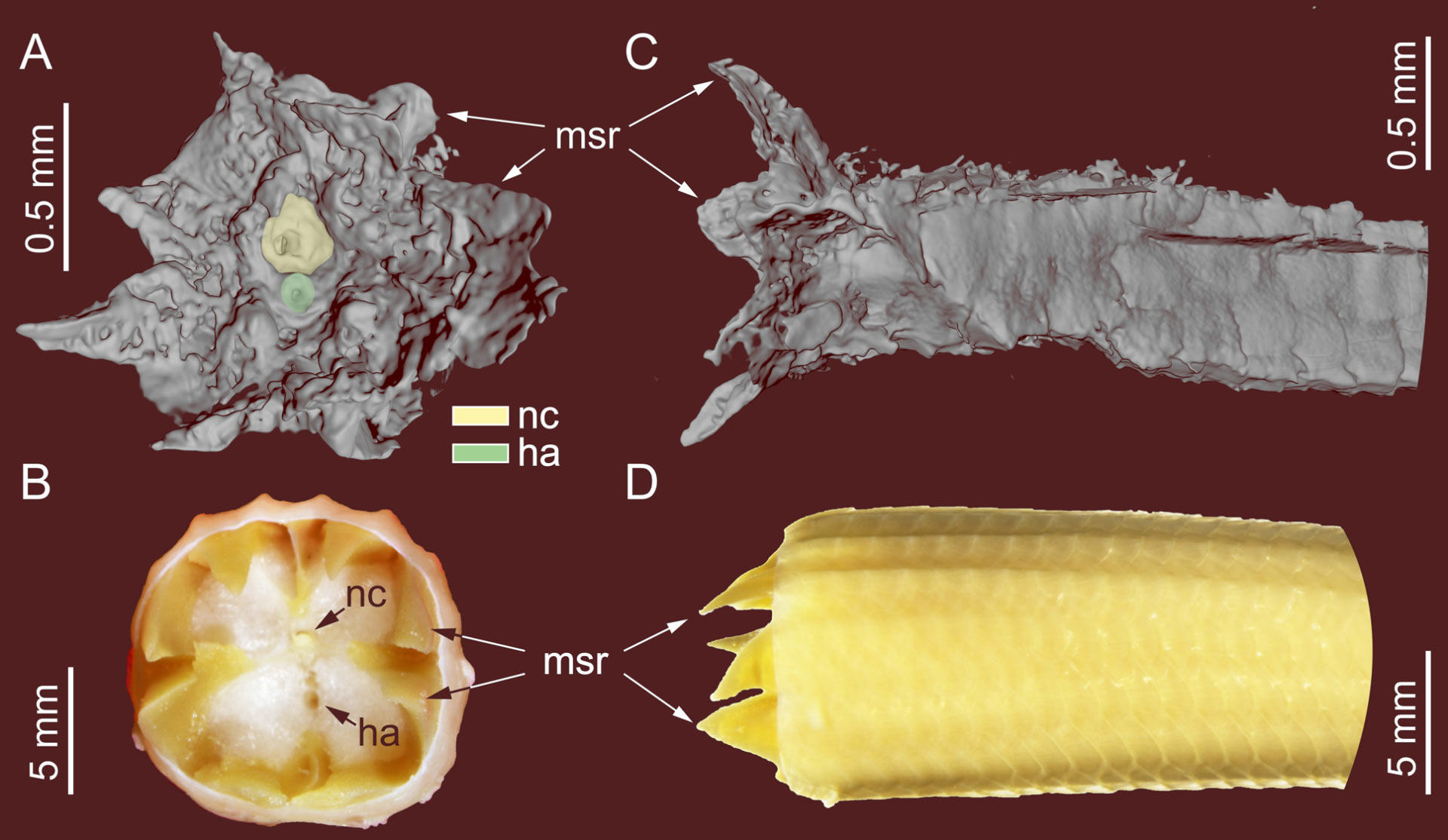
Comparison of the fossil lizard tail with an autotomized tail from a present-day scincid lizard (Eremiascincus sp.). Image credit: Fabrikant et al., doi: 10.26879/1706.
Using X-ray micro-computed tomography, they analyzed its structure and compared it with the tails of living skinks and lizards.
The scans showed a ring of muscle tissue around the break, arranged in a rosette or wedge pattern. Living lizards form this structure when muscles contract during a deliberate tail drop.
The tail belonged to a relative of monitor lizards or of lacertids, the group that includes European wall lizards.
According to the authors, the circumstances that led to the tail’s preservation remain uncertain.
They offer two scenarios: a tree-dwelling lizard became stuck in the resin and escaped by dropping its tail, or a predator caught the lizard, lost the tail in the struggle and dropped it onto the sticky surface.
“Considering that caudal autotomy in living lizards is often developmentally coupled to tail regenerative capacity, its confirmed presence in the mid-Cretaceous also constrains the antiquity of associated regenerative programs,” they concluded.
“Ergo, candidate genes involved in tail regeneration may have arisen by at least 99 million years ago.”
“By documenting a completed autotomy event rather than anatomical predisposition alone, the specimen provides a behavioral calibration point for the evolution of the predominant antipredator strategy in squamates.”
“More broadly, it showcases that amber can preserve discrete defensive events and functional responses, thereby extending the deep-time behavioral resolution of the vertebrate fossil record.”
The study appears online in the journal Palaeontologia Electronica.
_____
Dolev Fabrikant et al. 2026. Direct fossil evidence of caudal autotomy in a Cretaceous lizard. Palaeontologia Electronica 29 (3): a38; doi: 10.26879/1706