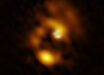
Using the Mid-Infrared Instrument (MIRI) aboard the NASA/ESA/CSA James Webb Space Telescope, astronomers have isolated dust emission from individual clumps of debris in Cassiopeia A, the youngest known supernova remnant in our Milky Way Galaxy.
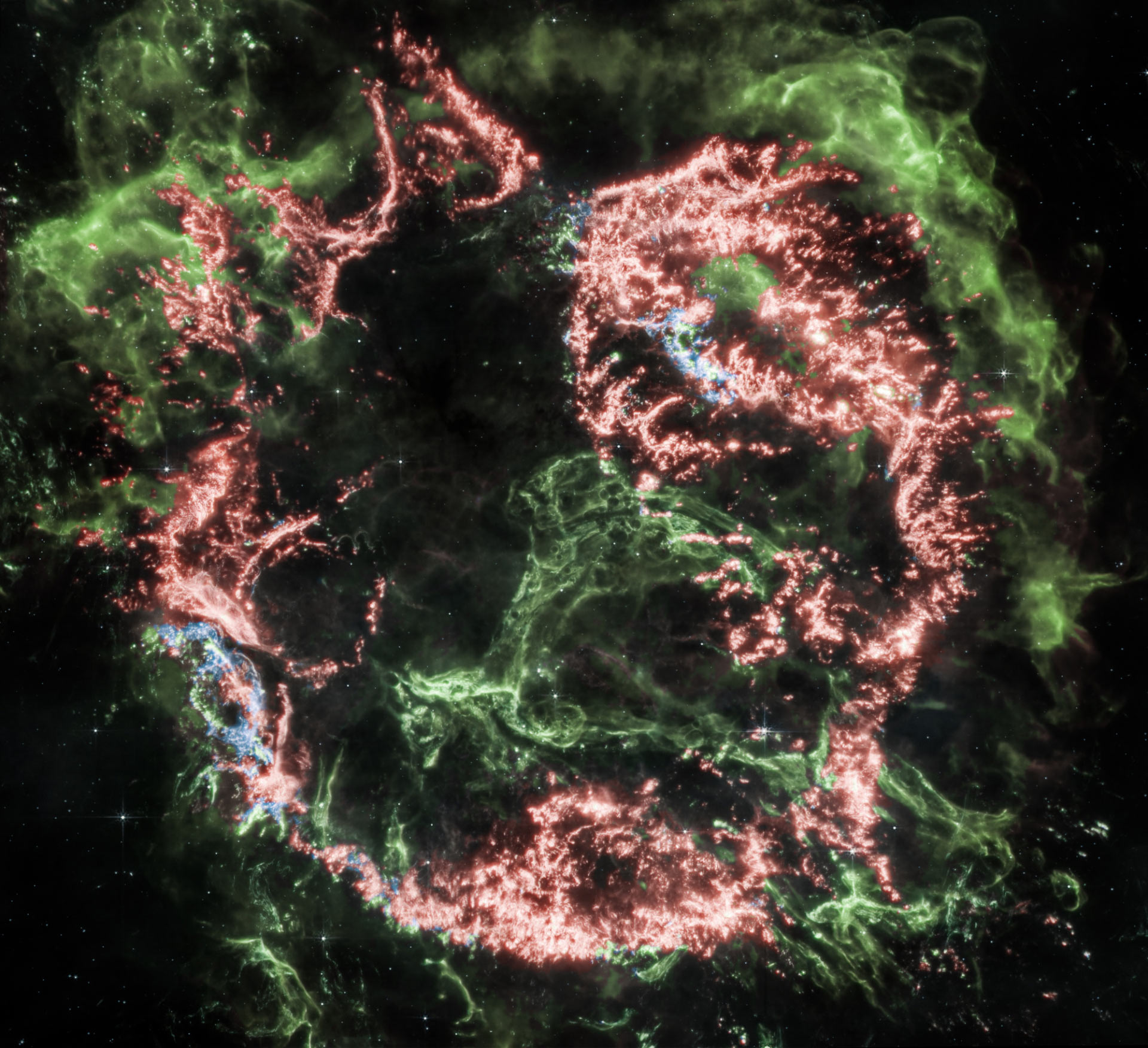
Webb reveals the hot dust that makes up Cassiopeia A. Image credit: NASA / ESA / CSA / STScI / Tea Temim, Columbia University / Rick Arendt, UMBC / Dan Milisavljevic, Purdue University / Joseph DePasquale, STScI.
Cassiopeia A is located about 11,000 light-years away in the constellation of Cassiopeia.
Also known as Cas A, SNR G111.7-02.1 or NRAO 711, the object spans approximately 10 light-years.
When the original star ran out of fuel, it collapsed onto itself and blew up as a supernova, possibly briefly becoming one of the brightest objects in the sky.
Although astronomers think that this happened around the year 1680, there are no verifiable historical records to confirm this.
“With Webb, the vast improvement in being able to resolve at the individual clump level helps us do more sophisticated dust chemistry,” said Dr. Dan Milisavljevic, an astronomer at Purdue University.
“As a result, we can tie the explosion back to the makeup of the progenitor star hundreds of years afterward.”
“It’s telling us about what was happening, we think, in the hours leading up to core collapse.”
“Understanding this process is essential to explaining which elements the supernova explosion will release into the galaxy and how those elements enrich future generations of stars and planets.”
Earlier observations by Webb blurred many regions together, so the dust seemed to be a messy mixture.
The telescope’s sharper vision shows otherwise: each clump is dominated by just one or two types of grain.
In a clump rich in argon, the astronomers found that the dust is mostly silicon dioxide, the main ingredient of sand.
A neon-rich, carbon monoxide-rich clump is dominated by amorphous carbon, essentially soot.
A third region, inside the Green Monster, a structure of gas the star shed before exploding, is dominated by warm magnesium silicate.
Its distribution supports the idea that this material came from the star’s surroundings rather than the explosion itself.
The ejecta dust points to what was inside the star. Silicon dioxide suggests a region with a lot of silicon relative to magnesium, while carbon dust suggests carbon was left over after oxygen was locked into carbon monoxide.
The researchers compared those conditions with computer models of exploding stars.
Only models in which the star’s carbon- and oxygen-burning layers merged before the explosion produced both regions at once.
“Our study demonstrates that spatially resolved dust compositions can provide constraints on the chemical structure and properties of core-collapse explosions, with broader implications for interpreting unresolved mid-IR emission from extragalactic supernovae,” the scientists concluded.
The study was published in the Astrophysical Journal Letters.
_____
Tea Temim et al. 2026. JWST Resolves Dust Emission from Individual Ejecta Clumps in Cassiopeia A: Dominant Grain Compositions Point to a Shell Merger in the Progenitor. ApJL 1012, L26; doi: 10.3847/2041-8213/aea901