Astronomers using the Atacama Large Millimeter/submillimeter Array (ALMA) have observed a powerful magnetic storm on the red giant Mira A create an enormous loop of gas that extends as far out as Saturn’s orbit. The findings, published in two papers in the journal Astronomy & Astrophysics, reveal how aging stars scatter the elements needed to build new stars and planets.
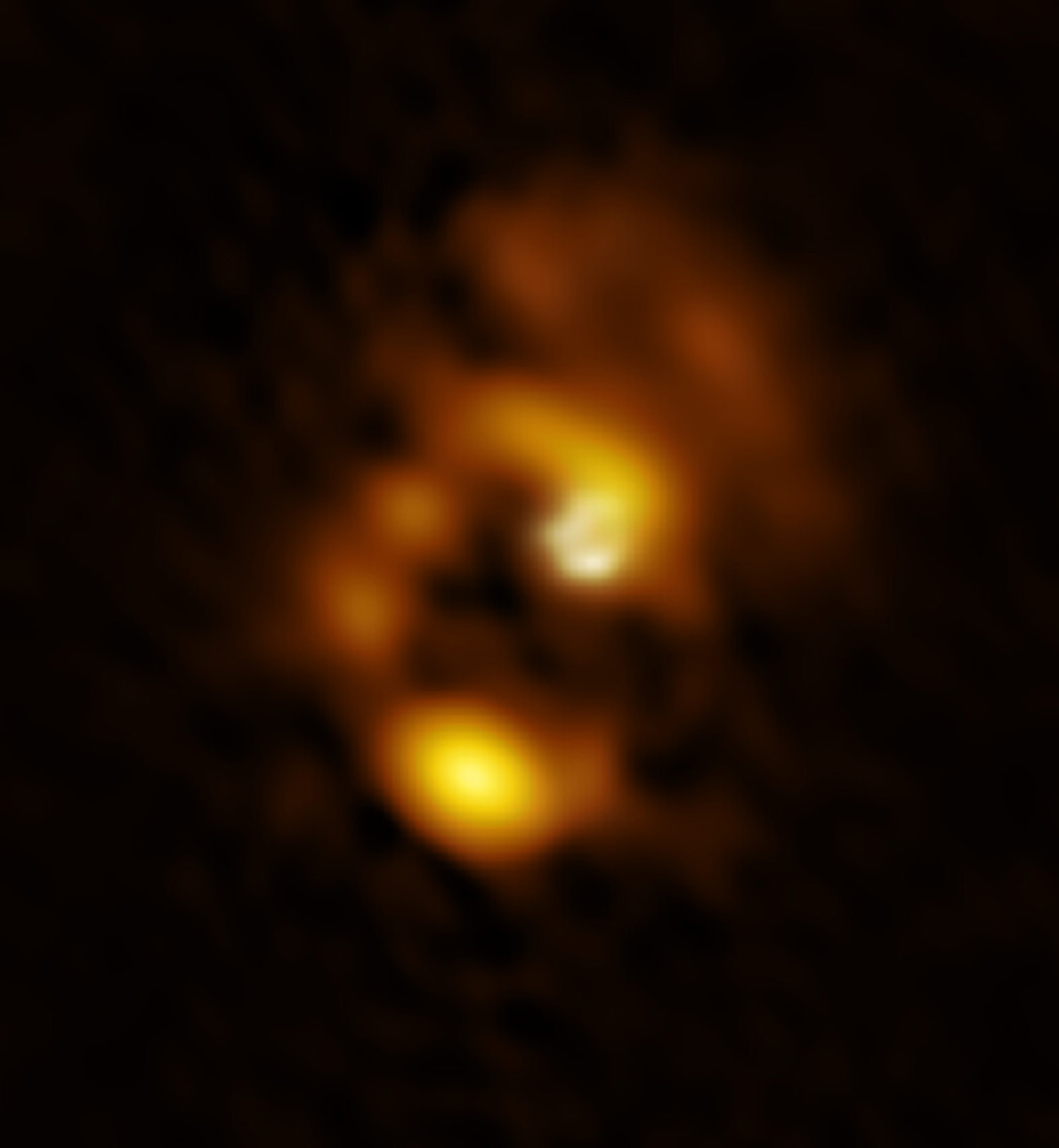
The lumpy and glowing patch at the center of this ALMA image is the surface of Mira A, a red giant star about 330 light-years away in the constellation of Cetus; the image also shows a giant loop of material ejected far away from the star. Image credit: ALMA / ESO / NAOJ / NRAO / Vlemmings et al.
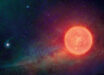
Mira A is a red giant approximately 330 light-years away from Earth in the constellation of Cetus.
Also known as omicron Ceti, this star is cooler than our Sun, but much bigger and brighter.
Because Mira A is much older than the Sun, it gives astronomers a glimpse of our star’s future, in real time. A few billion years in the future it will be like Mira A, a cool, windy star.
Using the ALMA, Dr. Miora Andriantsaralaza from the Chalmers University of Technology and colleagues were able to make the most detailed images ever of Mira A’s surface.
What’s more, the images showed that the star changed dramatically in less than ten years.
“We were astonished to see how the star’s surface is constantly changing,” Dr. Andriantsaralaza said.
“The brightest areas were different every time we looked, and the brightest patches are amazingly bright.”
“We realized that star is flaring, releasing vast amounts of energy each time.”
The astronomers estimate that the brightest of Mira A’s flares are brighter than any flare yet observed from any comparable star.
Most remarkably, one of the flares was accompanied by an even more spectacular display.
“In 2023, we saw one of these flares appear on the star’s surface, but it didn’t stop there,” said Behzad Bojnordi Arbab, a doctoral student at the Chalmers University of Technology.
“Over the next two years, this eruption on the surface created a vast, expanding loop of gas around the star, which we captured in an image in 2025.”
“The loop was much bigger than the star, extending as far out as the distance of Saturn from the Sun. We hadn’t seen anything like that before.”
The loop proved to be the key to the discovery that magnetism, not starlight, is powering Mira A’s wind.
“In the loop, there’s a strong magnetic field, which must also influence the star’s wind,” said Chalmers University of Technology’s Professor Wouter Vlemmings.
“That showed us a connection between the flare and the loop, and reminded us also of phenomena we can see on our Sun.”
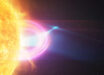
In our Sun, bright flares and magnetic storms lead to what are known as coronal mass ejections, sending streams of particles that can cause auroral displays when they reach Earth.
But until now, scientists had not expected to see the same phenomena on a red giant star.
“Now we see that magnetic storms on Mira A’s surface are continually creating bright flares,” Dr. Andriantsaralaza said.
“Even more surprisingly, each of these is strong enough to lift parts of the star’s outer layers and launch them into interstellar space.”
“Our study has consequences for our understanding of the whole of the galaxy’s ecosystem,” Professor Vlemmings said.
“Perhaps, Earth wouldn’t be here if it wasn’t for magnetic storms on a red giant star, billions of years ago before the Sun was born.”
_____
W. Vlemmings et al. 2026. A giant magnetic eruption from the asymptotic-giant-branch star Mira A. A&A, in press; doi: 10.1051/0004-6361/202662604
M. Andriantsaralaza et al. 2026. Periodic activity on the (sub)millimetre surface of the asymptotic giant branch star Mira A. A&A, in press; doi: 10.1051/0004-6361/202661338