Dr. Étienne Artigau from the Université de Montréal and colleagues have discovered a white dwarf orbiting a red dwarf star just 27.6 light-years away from Earth. The system forms a hierarchical triple with a more distant white dwarf, which has no known analogue within 100 light-years.
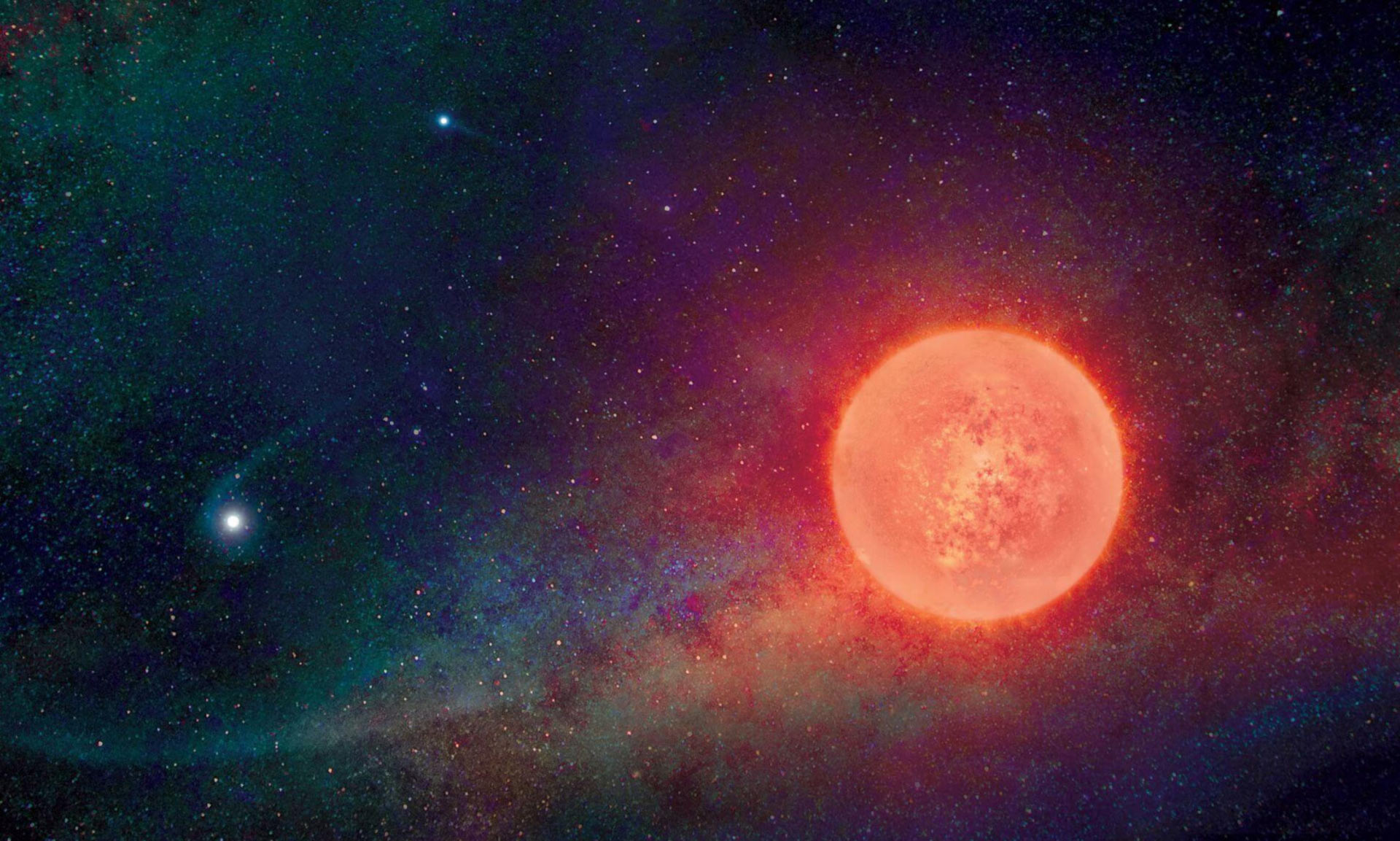
An artistic illustration of the Welopōʻai triple system. Image credit: Benoît Gougeon, Université de Montréal.
Nicknamed Welopō‘ai, the triple system contains two white dwarfs and a red dwarf star.
Dr. Artigau and co-authors were using the SPIRou spectrograph at the Canada-France-Hawai’i telescope to hunt for exoplanets around the red dwarf, known as TYC 3980-1081-1.
Instead, they saw its velocity shift by about 16 km per second over 4.8 years, far too large for any planet.
“We were actually looking for planets. Instead, we found something much more surprising,” Dr. Artigau said.
Follow-up imaging with the Gemini North telescope revealed the culprit: a white dwarf about 0.6 arcseconds from the red dwarf, roughly 6 magnitudes fainter.
Combining velocities and positions, the astronomers measured the white dwarf’s mass at 0.618 solar masses, with a precision of just 0.7%. This makes it one of the most precisely weighed white dwarfs within 20 parsecs.
The TYC 3980-1081-1 red dwarf weighs in at 0.419 solar masses.
The pair orbits every 9.8 years, at a distance of about 4.6 AU (astronomical units), similar to the distance between the Sun and a point just beyond Jupiter’s orbit.
A second, previously known white dwarf orbits the pair at a projected distance of about 124 AU.
The inner white dwarf’s progenitor star was likely about 1.4 times the Sun’s mass, and it would have swollen into a giant that nearly engulfed its red dwarf companion.
Yet instead of spiraling inward, the red dwarf survived on a wide orbit. How this happened, perhaps with help from gravitational tugs by the outer white dwarf, remains unclear.
Both white dwarfs suggest the system is 9 to 11 billion years old, yet the red dwarf is metal-rich, which is unusual for such an ancient star.
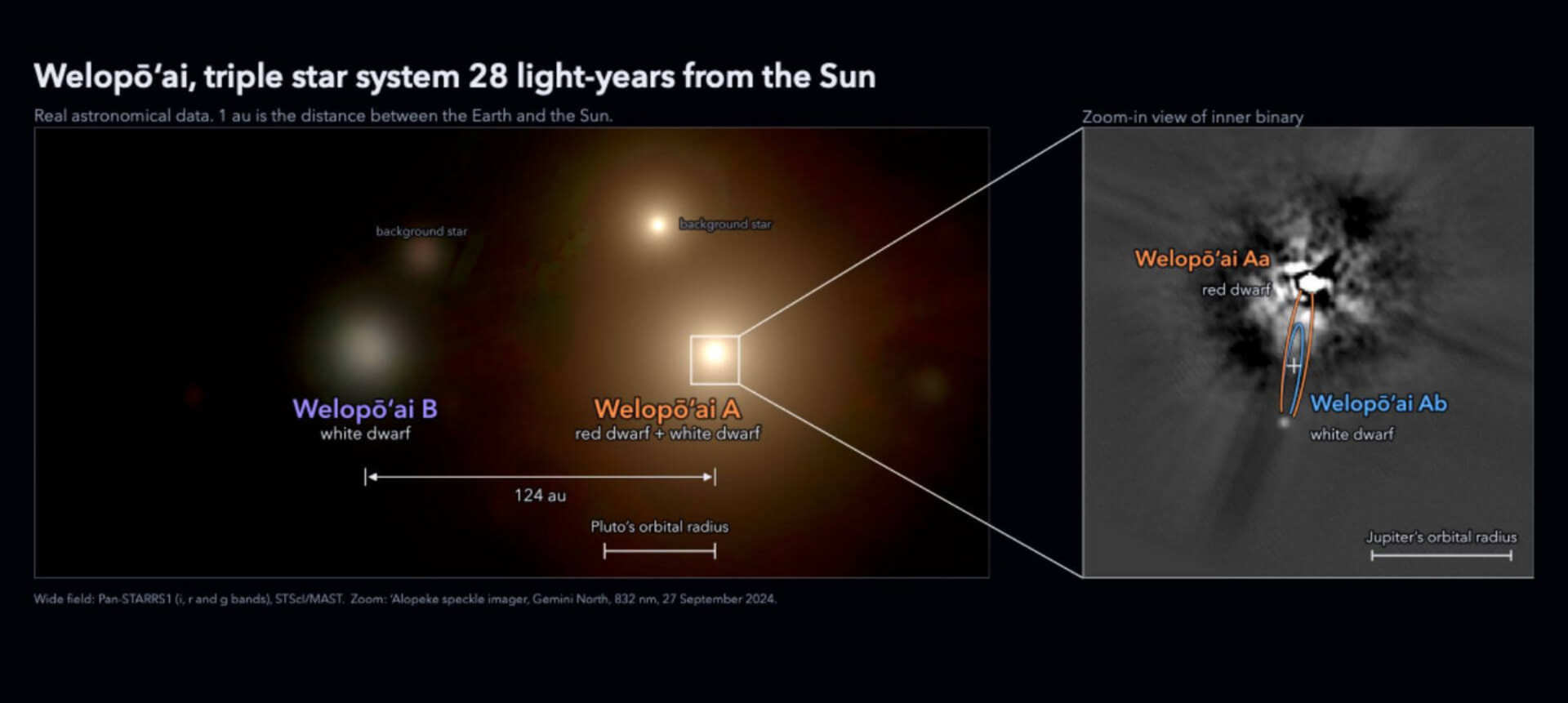
Observations of the Welopōʻai triple system. Image credit: Pan-STARRS1 / STScI / MAST / International Gemini Observatory / NSF / NOIRLab / Étienne Artigau & Heidi White, UdeM & IREx.
“This system should not exist,” said Université de Montréal’s Professor Patrick Dufour.
“We have no clean explanation for how it got here. That is the question driving our next observations.”
The astronomers also detected a tentative infrared excess around the inner white dwarf that could hint at a dusty debris disk, though they stress it needs confirmation.
Future observations, including from Webb and Gaia, could solve the system’s three-dimensional layout and settle the infrared mystery.
“Discoveries like this remind us that our own cosmic neighborhood still contains remarkable surprises,” Dr. Artigau said.
“Even when we’re searching for planets, our Universe often has something completely unexpected waiting for us.”
A paper reporting the discovery was published online in the journal Astronomy & Astrophysics.
_____
Étienne Artigau et al. 2026. Welopō‘ai: A peculiar triple system 8 pc from the Sun. A&A 715, A321; doi: 10.1051/0004-6361/202661214