A 2-million-year-old jaw of a young Australopithecus africanus individual has turned up an unusual feature — a harmless bony ridge that forms on the inside of the lower jaw — that scientists had assumed was a relatively recent quirk of modern humans.

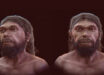
Forensic facial reconstruction of another Australopithecus species – A. afarensis. Image credit: Cicero Moraes / CC BY-SA 3.0.
“Finding such a pronounced, fully formed ridge in a young fossil specimen, where no other juvenile fossil of its kind shows it, is extraordinarily unexpected,” said La Trobe University Ph.D. student Luca Morris-Obst.
“It makes our ancestors relatable. It humanizes our ancient relatives, showing that even subadult hominins suffered from the exact same harmless anatomical oddities and jaw variations that we discuss at the dentist’s office today.”
Known as a mandibular torus, the jaw feature appears on both sides of a fossil called Sts 52b.
The specimen belongs to Australopithecus africanus and was excavated at Sterkfontein, near Johannesburg in South Africa, in 1949. The deposits that held it are dated to between 2.8 and 2.1 million years ago.
Mandibular tori are harmless and common today, especially in colder regions.
They appear in more than half of people in circumpolar populations, but in only about 3% of people in Africa.
Their cause remains unclear; researchers have pointed to genetics, heavy chewing forces, teeth grinding and gum disease.
The presence of the mandibular torus in Sts 52b complicates the chewing-force explanation.
The individual was an adolescent whose second molars had only just emerged, whereas such growths are usually reported in adults.
And the heavily built Paranthropus robustus, whose jaws withstood extreme chewing stresses, has not shown a single example.

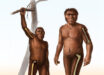
Paranthropus boisei. Image credit: © Roman Yevseyev.
Morris-Obst and colleagues also found no sign of tooth decay, infection or unusually heavy wear in Sts 52b.
The researchers conclude that strong bite forces alone cannot explain the trait.
They suggest it may instead reflect a rare genetic anomaly that was uncommon for some two million years before becoming more widespread in human populations over the past 10,000 years or so.
“The finding pointed to a more complex picture of how the human jaw developed,” Morris-Obst said.
“Because the mandibular torus is rare in the fossil record, even ‘robust’ hominins with massive chewing muscles that produce extreme masticatory stress lack this feature.”
“Therefore, high chewing forces alone cannot explain the occurrence of this benign bony ridge.”
The study was published in the journal Evolutionary Human Sciences.
_____
Luca Morris-Obst et al. 2026. A deep time perspective on a rare anatomical variant: Torus mandibularis presence in Australopithecus africanus from Sterkfontein, South Africa. Evolutionary Human Sciences 8: e42; doi: 10.1017/ehs.2026.10070