A scorpion that lived roughly 316 to 319 million years ago (Carboniferous period) is the oldest known member of the modern scorpion lineage in North America, according to a team of paleontologists from Flinders University in Australia, the American Museum of Natural History and the University of Alabama.
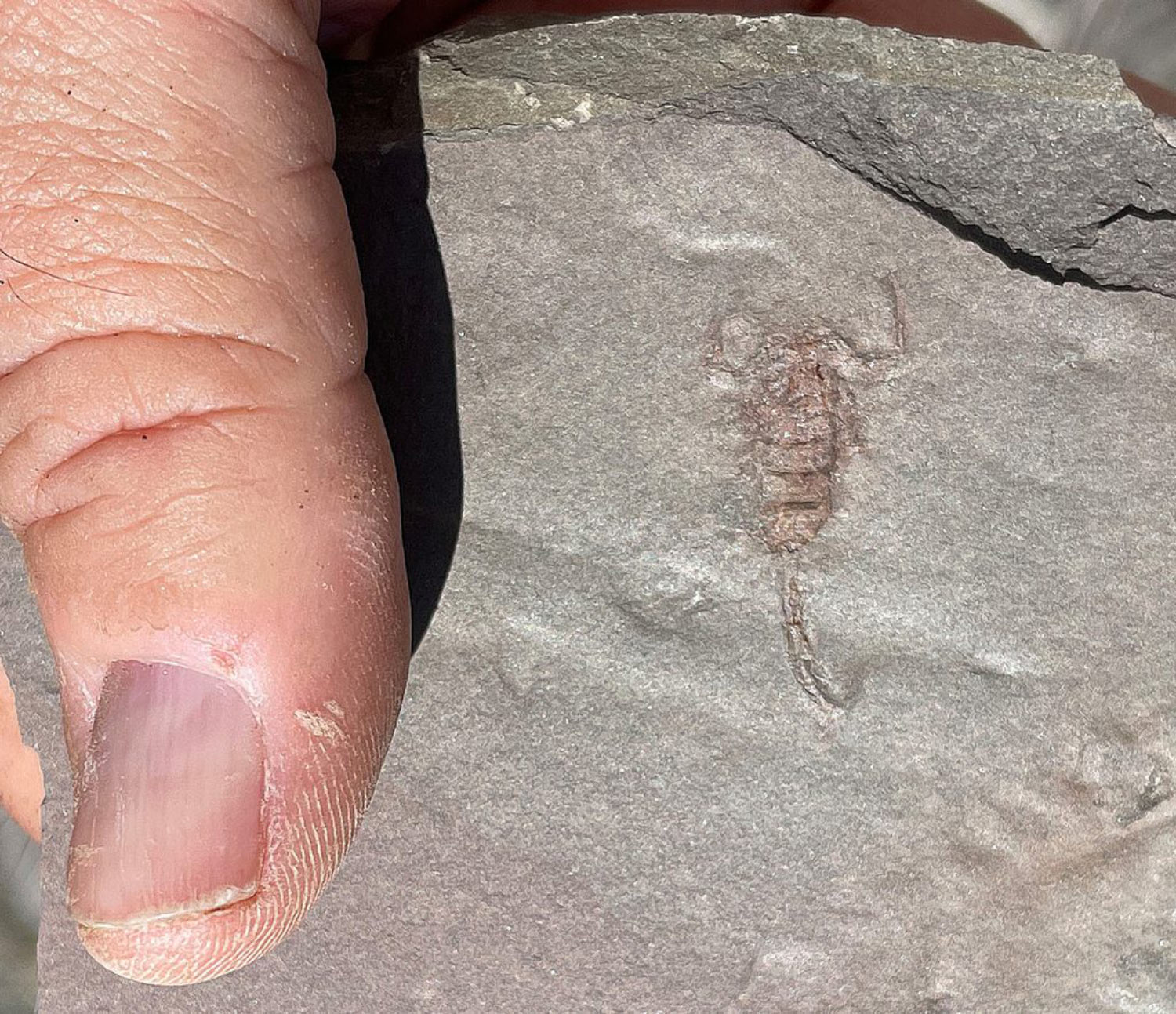
The fossil scorpion from the Union Chapel Mine in Walker County, Alabama, the United States. Image credit: Prescott Atkinson.
“Well before dinosaurs roamed the planet, the scorpions, millipedes and dragonfly relatives of 315-320 million years ago were generally much larger than they are today,” said Flinders University paleontology student Genevieve (Gen) Conway, lead author of the study.
“That is why we suspect this fossil could be a juvenile, and one of the first of its kind to be examined and connected to the evolution of modern scorpions on the North American continent.”
The fossil, about 22 mm long, is probably a molt, the shed skin of a young scorpion.
The specimen was found at the Union Chapel Mine in Walker County, Alabama.
The site is part of the Pottsville Formation and is well known for fossilized footprints of ancient animals.
“It’s the first fossil scorpion from this understudied site where lots of trackways have been found, including other fossils, by amateur fossickers and researchers,” said co-author Dr. Russell Bicknell, a paleontologist at Flinders University.
“The Pottsville Formation in Alabama, and other fossil sites like it around the world, and could contain many more discoveries to help us understand.”
“Even after a quarter century of collecting, important specimens keep being found and researched,” said co-author Dr. Adiel Klompmaker, a paleontologist at the University of Alabama.
“Another example is a recent report on shark teeth from the mine. Together, these finds give an increasingly detailed picture of ancient ecosystems in Alabama.”
According to the paleontologists, some trackways at the site were made by scorpions, though they cannot say whether an animal this size made them.
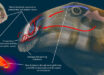
They used ultraviolet light to bring out details that are less visible under ordinary lighting.
The images showed what appear to be breathing pores, called spiracles, located within the belly plates rather than along their edges.
This arrangement places the animal in Orthosterni, the group that includes living scorpions.
Curved lines on the plates may also be traces of book lungs, the respiratory organs of modern scorpions.
The specimen lacks features such as the plates at the base of the legs and the lateral eyes.
The researchers found it distinct from the only other scorpion known from the Pottsville Formation, which has lobed belly plates.
Chemical analysis showed the fossil is made almost entirely of carbon, consistent with heat altering the chitin of the original shell.
“This scorpion has a wide and large metasoma, or the long segment at the end of the scorpion with a venomous stinger on its tip, and small and narrow pincers,” Conway said.
“In living scorpions, this shape is associated with scorpions that are quite venomous and tend to use venom for defense and prey capture, and often eat small fast-moving insects.”
The specimen represents the first fossil scorpion from the southeastern United States.
The only other comparably early, complete orthostern scorpion comes from Britain, and older orthostern-like fragments are known from Scotland.
The Alabama specimen find helps narrow down when modern-type scorpions emerged.
“Remarkably, this species appears very similar to the characteristics of scorpions alive today, including those in Australia,” Conway concluded.
The team’s findings appear in The Science of Nature.
_____
G.A. Conway et al. 2026. Oldest North American orthostern scorpion from the Carboniferous (Pennsylvanian: Bashkirian) Pottsville Formation of Alabama, USA. Sci Nat 113, 140; doi: 10.1007/s00114-026-02180-6