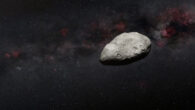
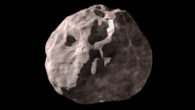
The newly-discovered asteroid is less than 230 m (755 feet) across, and orbits within the main asteroid belt, which is located between Mars and Jupiter.
An...
A small near-Earth asteroid designated 2023 BU made its closest approach on January 26, 2023 at 7:29 p.m. EST (4:29 p.m. PST, or January 27, 2023 at 00:29...
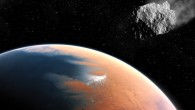
The Chicxulub-like asteroid crash landed in shallow ocean waters in the Martian region of Chryse Planitia 3.4 billion years ago (Hesperian period) and...
About 66 million years ago, a 10-km-wide asteroid crashed into Earth near the site of the small town of Chicxulub in what is now Mexico. The impact unleashed...
The sample of material delivered to our planet from the near-Earth asteroid Ryugu contained a mixture of extraterrestrial (helium and neon) and terrestrial...
Astronomers using the Dark Energy Camera (DECam) on the Víctor M. Blanco 4-m telescope at Cerro Tololo Inter-American Observatory have discovered two...
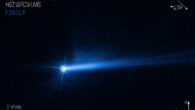
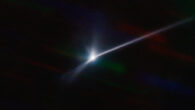
A new image from the NASA/ESA Hubble Space Telescope shows two tails of dust ejected from the 160-m-wide asteroid moonlet Dimorphos, which orbits a larger,...
3200 Phaethon, one of the largest potentially hazardous asteroids, rotates once every 3.6 hours, and that rotation period is decreasing by about 4 milliseconds...
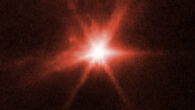
On September 26, 2022, NASA’s Double Asteroid Redirection Test (DART) intentionally slammed into Dimorphos, a moonlet of the asteroid Didymos. According...
About 66 million years ago, a massive asteroid crashed into Earth near the site of the small town of Chicxulub in what is now Mexico. This impact coincides...
About 66 million years ago, a massive asteroid crashed into Earth near the site of the small town of Chicxulub in what is now Mexico. The impact eradicated...
On September 26, 2022, NASA’s DART spacecraft intentionally crashed into the asteroid moonlet Dimorphos for the first planetary defense test. Two days...
The NASA/ESA/CSA James Webb Space Telescope and the NASA/ESA Hubble Space Telescope teamed up to collect data before and after NASA’s Double Asteroid...
NASA’s Double Asteroid Redirection Test (DART) spacecraft is set to crash into Dimorphos, a moon of the asteroid Didymos, on September 26, 2022, at 7:14...
Samples of the near-Earth asteroid (162173) Ryugu were brought to Earth by JAXA’s Hayabusa-2 spacecraft.
This image of the asteroid Ryugu was captured...
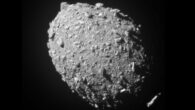
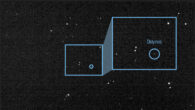
The Didymos Reconnaissance and Asteroid Camera for Optical navigation (DRACO) aboard NASA’s Double Asteroid Redirection Test (DART) spacecraft has captured...
The Jupiter trojan asteroid 15094 Polymele and its small satellite are among the targets of NASA’s Lucy mission, which will approach the asteroid system...
Earth is the only planet known to have continents, although how they formed and evolved is unclear.
An artist’s concept of meteors impacting the ancient...