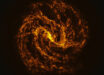
NGC 1792 is a stormy and highly active spiral galaxy located in the southern constellation of Columba.
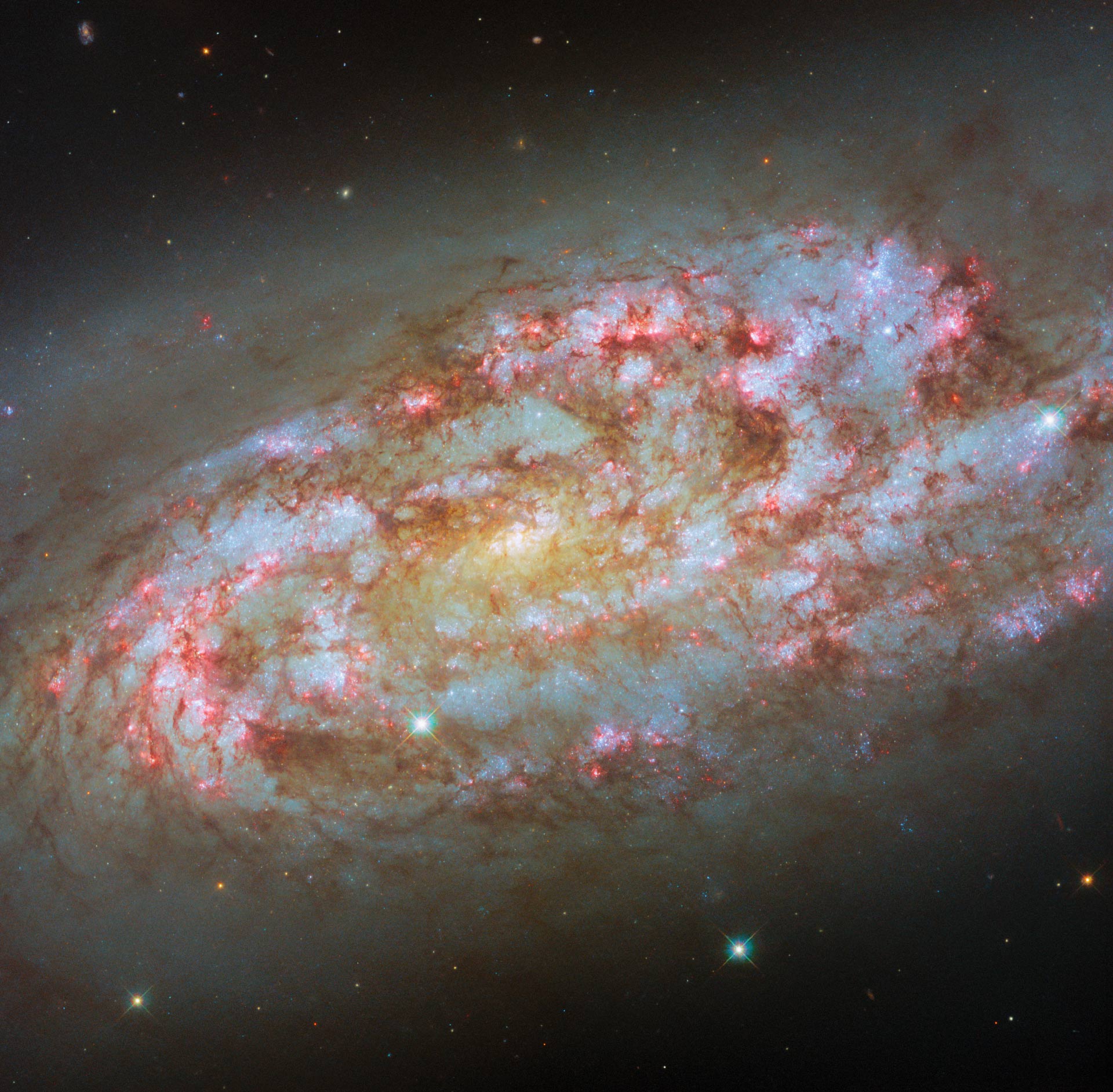
This Hubble image shows the active spiral galaxy NGC 1792. Image credit: NASA / ESA / Hubble / D. Thilker / F. Belfiore / J. Lee / PHANGS-HST Team.
NGC 1792 resides approximately 36.4 million light-years away from Earth in the southern constellation of Columba, almost on the border with the constellation of Caelum.
Also known as AGC 24019 or LEDA 16709, this galaxy was discovered by the Scottish astronomer James Dunlop on October 4, 1826.
NGC 1792’s appearance is quite chaotic, due to the patchy distribution of dust throughout its disk.
The galaxy is very rich in neutral hydrogen gas and is rapidly forming new stars.
“NGC 1792 is just as fascinating to astronomers as its chaotic look might imply,” the Hubble astronomers wrote in a statement.
“Classified as a starburst galaxy, it is a powerhouse of star formation, with spiral arms rich in star-forming regions.”
“In fact, it is surprisingly luminous for its mass,” they noted.
“The galaxy is close to a larger neighbor, NGC 1808, and the strong gravitational interaction between the two is believed to be what has stirred up the reserves of gas in this galaxy.”
“The result is a torrent of star formation, concentrated on the side where gravity has a stronger effect.”
“It’s a perfect target for astronomers seeking to understand the complex interactions between gas, star clusters and supernovae in galaxies.”
In 2020, astronomers used Hubble’s Wide Field Camera 3 (WFC3) instrument to observe NGC 1792.
The new image includes additional WFC3 data collected throughout 2025, providing a deeper view of the tumultuous astrophysical activity taking place in the galaxy.
“Blossoming red lights in the arms mark out so-called H-alpha emission from dense clouds of hydrogen molecules,” the astronomers said.
“Stars form within these clouds and shine powerfully with ultraviolet radiation.”
“They ionize the gas around them, causing the gas to emit a very particular red wavelength of light — a tell-tale sign of new stars.”