Ethnohistoric and recent archaeological evidence suggest that Easter Island (Rapa Nui) was a politically decentralized society organized into small, relatively autonomous kin-based communities across the island. The more than 1,000 monumental statues (moai) thus raise a critical question: was production at Rano Raraku — the primary moai quarry — centrally controlled or did it mirror the decentralized pattern found elsewhere on the island? Using a collection of over 11,000 UAV images, archaeologists have now created the first comprehensive three-dimensional model of the quarry to test these competing hypotheses.
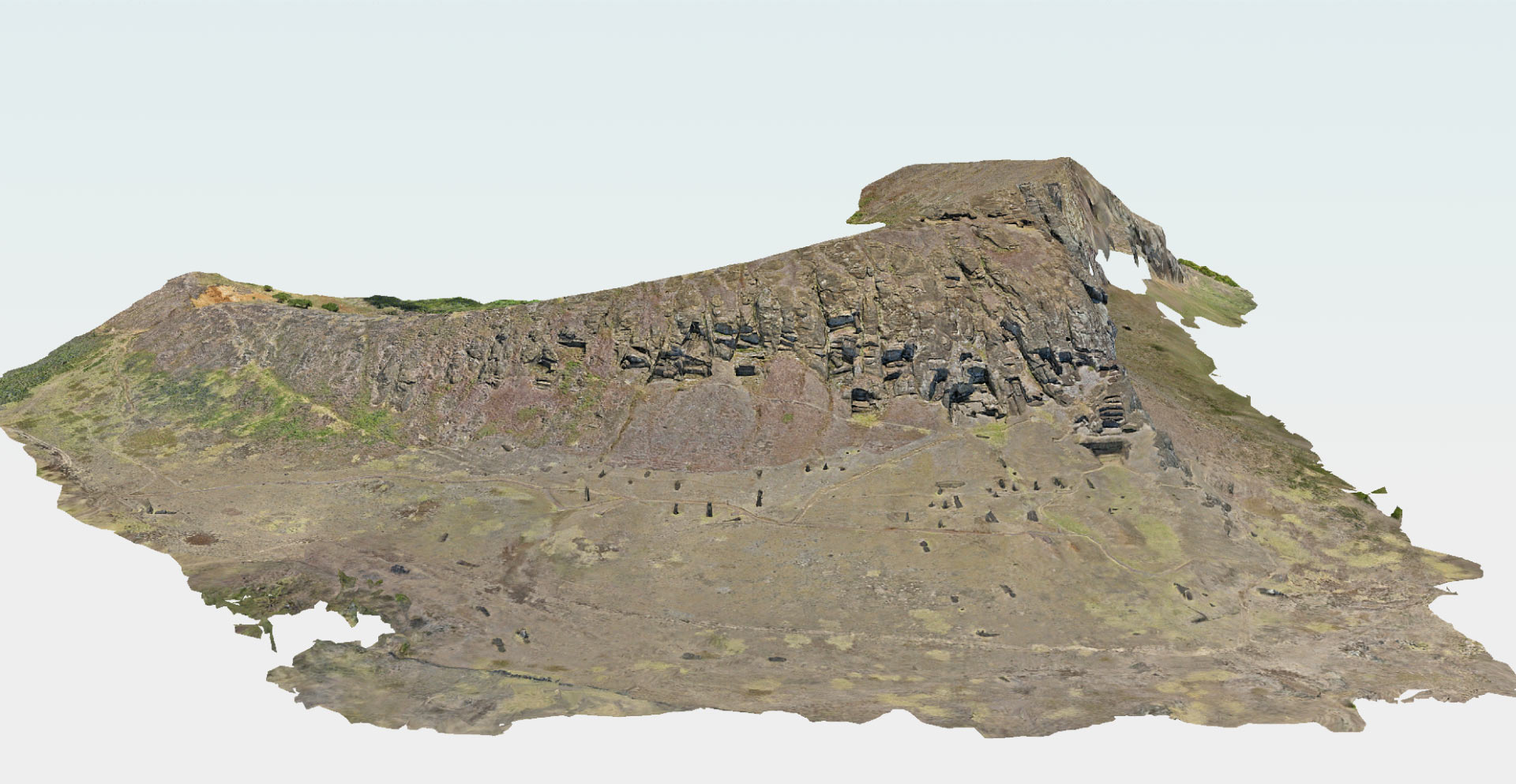
3D model of Rano Raraku quarry. Image credit: Lipo et al., doi: 10.1371/journal.pone.0336251.
The monumental moai of Easter Island represent one of Polynesia’s most striking archaeological phenomena, with over 1,000 megalithic figures distributed across the small volcanic island, which measures only 163.6 km2.
This remarkable investment in monumentality appears paradoxical when considered alongside ethnohistoric accounts that consistently describe Rapa Nui society as organized into relatively small, competing kin-based groups rather than a unified polity.
Early ethnographers documented a sociopolitical landscape characterized by multiple mata (clans or tribes) that maintained distinct territorial divisions, separate ceremonial centers, and autonomous leadership structures.
This raises the question of whether the construction of moai was similarly decentralized.
In a new study, Binghamton University Professor Carl Lipo and colleagues collected over 11,000 images of the primary moai quarry, Rano Raraku, to create a comprehensive 3D model of the quarry, including hundreds of moai preserved in various stages of completion.
“As an archeologist, the quarry is like the archeological Disneyland,” Professor Lipo said.
“It has everything you can possibly imagine about moai construction, because that’s where they did most of the construction.”
“It’s always been this treasure of information and cultural heritage, but it’s remarkably underdocumented.”
“It’s amazing how far and how fast the technology has come,” said Binghamton University’s Dr. Thomas Pingel.
“The quality of this model is far above what could be done even just a couple of years ago, and the ability to share such a detailed model in a way that is accessible from anyone’s desktop computer is remarkable.”
The detailed analysis of the model revealed 30 distinct centers of quarrying activity featuring a variety of carving techniques, suggesting multiple independent work areas.
There is also evidence for transport of moai out of the quarry in many different directions.
These patterns suggest that moai construction, like broader Rapa Nui society, was not organized by central management.
“We see separate workshops that really align to different clan groups that are working intensively in their specific areas,” Professor Lipo said.
“You can really see graphically from the construction that there’s a series of statues being made here, another series of statues here and that they’re lined up next to each other. It’s different workshops.”
The findings challenge the common assumption that this scale of monument production requires hierarchical organization.
The similarities that do exist between moai seem to reflect cultural sharing of information rather than communities actually working together to carve the figures.
“Much of the so-called ‘mystery of Rapa Nui comes from the lack of openly available, detailed evidence that would allow researchers to evaluate hypotheses and construct explanations,” the researchers said.
“We present the first high-resolution 3D model of the moai quarry at Rano Raraku, the central quarry for nearly 1,000 statues, offering new insights into the organizational and manufacturing processes of these giant megalithic figures.”
The findings were published online on November 26, 2025 in the journal PLoS ONE.
_____
C.P. Lipo et al. 2025. Megalithic statue (moai) production on Rapa Nui (Easter Island, Chile). PLoS One 20 (11): e0336251; doi: 10.1371/journal.pone.0336251