In a new paper published in the journal ChemSystemsChem, Hiroshima University’s Professor Tony Jia and colleagues outline the ‘prebiotic gel-first’ framework, which considers how the origin of life could have potentially emerged within surface-attached gels. The authors also discuss the potential existence of ‘xeno-films,’ i.e., alien biofilm-like structures composed of non-terrestrial — or with some terrestrial — building blocks, and emphasize the relevance of agnostic life-detection strategies in the search for life as we know it, and do not know it.

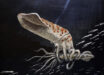
An artist’s impression of a prebiotic gel on the Early Earth’s surface. Image credit: Nirmell Satthiyasilan.
“The question of how life began has puzzled humanity for centuries,” said Professor Jia and co-authors.
“Whilst no one can travel back in time to witness the first spark of life, scientists continue to piece together plausible stories from chemistry, physics and geology.”
“While many theories focus on the function of biomolecules and biopolymers, our theory instead incorporates the role of gels at the origins of life.”
In their newly-proposed prebiotic gel-first framework, the researchers suggest how life could have originated within surface-attached gel matrices — sticky, semi-solid materials that share properties with today’s microbial biofilms, the thin layers of bacteria that grow ubiquitously on rocks, pond surfaces, and even man-made objects.
Drawing from soft-matter chemistry and insights from modern biology, they argue that such primitive gels could have provided the necessary structure and function for early chemical systems to become increasingly complex, long before the first cells emerged.
By trapping and organizing molecules, prebiotic gels may have overcome key barriers in pre-life chemistry through allowing for molecular concentration, selective retention, and environmental buffering.
Within these gels, early chemical systems might have developed proto-metabolic and self-replicating behaviors, setting the stage for biological evolution.
“This is just one theory among many in the vast landscape of origin-of-life research,” said Dr. Kuhan Chandru, a researcher with the Space Science Center at the National University of Malaysia.
“However, since the role of gels has been largely overlooked, we wanted to synthesize scattered studies into a cohesive narrative that puts primitive gels at the forefront of the discussion.”
The scientists also extend this idea to astrobiology, suggesting that similar gel-like systems might exist on other planets.
These potential ‘xeno-films’ could be non-terrestrial analogs of biofilms, composed of different chemical building blocks uniquely available at each locale.
This perspective broadens the scope of how astrobiologists search for life beyond Earth by suggesting that perhaps structures, rather than specific chemicals, could be the next target for life detection missions.
The authors now plan to investigate their model experimentally by exploring how such gels, composed of simple chemicals, might have formed in early Earth conditions and what properties these gels could have provided to emerging chemical systems.
“We also hope that our work inspires others in the field to further explore this and other underexplored origins-of-life theories,” said Dr. Ramona Khanum, also from the Space Science Center at the National University of Malaysia.
_____
Ramona Khanum et al. Prebiotic Gels as the Cradle of Life. ChemSystemsChem, published online November 19, 2025; doi: 10.1002/syst.202500038