Scientists have successfully extracted and sequenced ancient RNA from permafrost-preserved tissues of 10 woolly mammoths. One of these, dated to be 39,000 years old, represents the oldest ancient RNA sequences recorded to date.
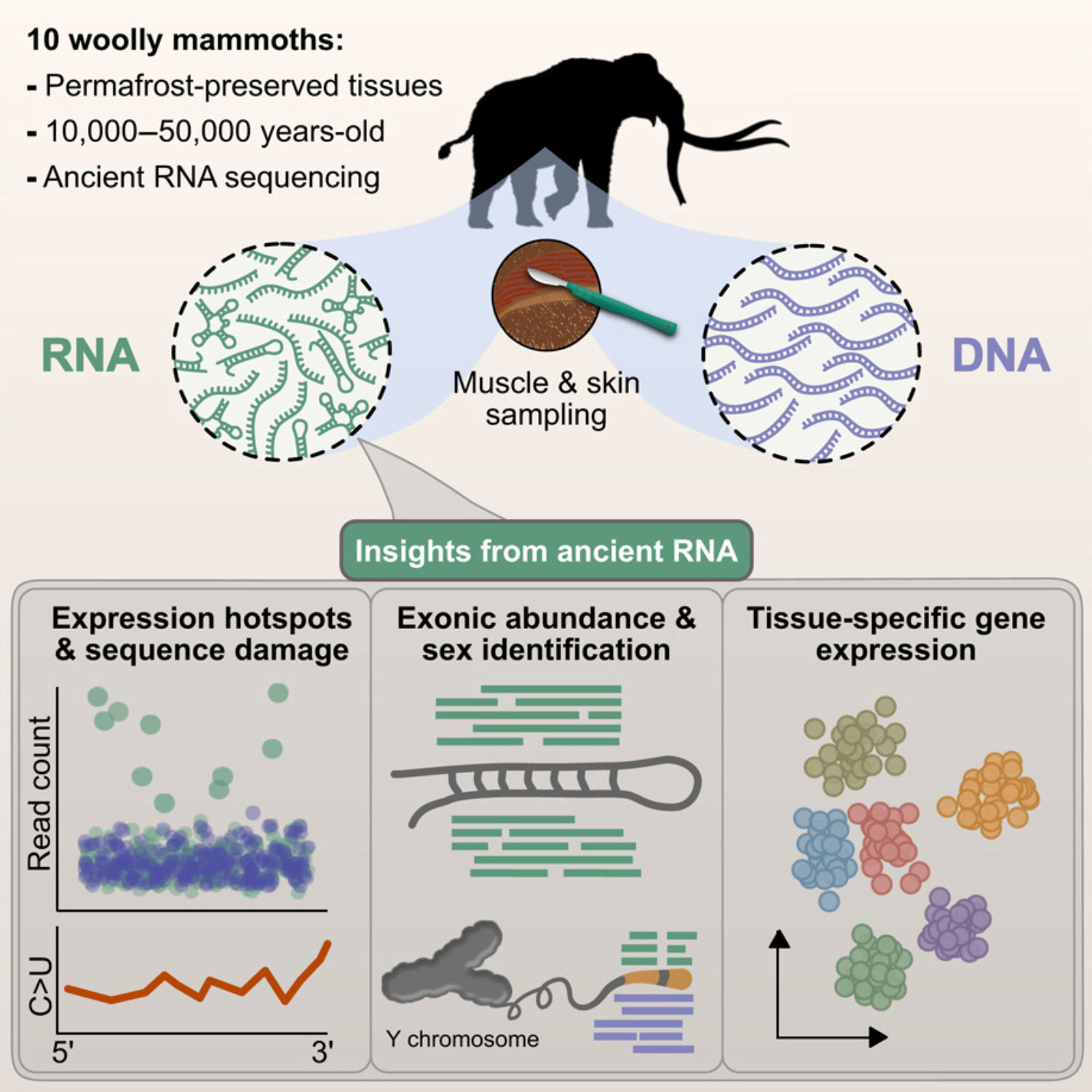
Mármol-Sánchez et al. found ancient RNA molecules in Late Pleistocene woolly mammoth tissues. Image credit: Mármol-Sánchez et al., doi: 10.1016/j.cell.2025.10.025.
Sequencing prehistoric genes and studying how they are activated is important to understand the biology and evolution of extinct species.
For years, scientists have been decoding mammoth DNA to piece together their genomes and evolutionary history.
Yet RNA, the molecule that shows which genes are active, has so far remained out of reach.
“With RNA, we can obtain direct evidence of which genes are ‘turned on,’ offering a glimpse into the final moments of life of a mammoth that walked the Earth during the last Ice Age,” said Dr. Emilio Mármol, a researcher at the Globe Institute.
“This is information that cannot be obtained from DNA alone.”
For the study, Dr. Mármol and colleagues collected permafrost-preserved tissues from 10 woolly mammoths dated to the Late Pleistocene and found in northeastern Siberian paleontological fields extending from the Central Indigirka region to the mainland Oyogos Yar coast and the New Siberian Islands.
“We gained access to exceptionally well-preserved mammoth tissues unearthed from the Siberian permafrost, which we hoped would still contain RNA molecules frozen in time,” Dr. Mármol said.
“We have previously pushed the limits of DNA recovery past a million years,” said Professor Love Dalén, a researcher at Stockholm University and the Centre for Palaeogenetics.
“Now, we wanted to explore whether we could expand RNA sequencing further back in time than done in previous studies.”
The researchers were able to identify tissue-specific patterns of gene expression in the 39,000-year-old muscle remains from the juvenile mammoth Yuka.
Among the more than 20,000 protein-coding genes in the mammoth’s genome, far from all of them were active.
The detected RNA molecules code for proteins with key functions in muscle contraction and metabolic regulation under stress.
The scientists also found a myriad of RNA molecules that regulate the activity of genes in the mammoth muscle samples.
“RNAs that do not encode for proteins, such as microRNAs, were among the most exciting findings we got,” said Dr. Marc Friedländer, a researcher with the Wenner-Gren Institute at Stockholm University.
“The muscle-specific microRNAs we found in mammoth tissues are direct evidence of gene regulation happening in real time in ancient times. It is the first time something like this has been achieved.”
The microRNAs that were identified also helped the authors confirm that the findings really came from mammoths.
“We found rare mutations in certain microRNAs that provided a smoking-gun demonstration of their mammoth origin,” said Dr. Bastian Fromm, a researcher at the Arctic University Museum of Norway.
“We even detected novel genes solely based on RNA evidence, something never before attempted in such ancient remains.”
“RNA molecules can survive much longer than previously thought.”
“Our results demonstrate that RNA molecules can survive much longer than previously thought,” Professor Dalén said.
“This means that we will not only be able to study which genes are ‘turned on’ in different extinct animals, but it will also be possible to sequence RNA viruses, such as influenza and coronaviruses, preserved in Ice Age remains.”
The results were published on November 14, 2025 in the journal Cell.
_____
Emilio Mármol-Sánchez et al. Ancient RNA expression profiles from the extinct woolly mammoth. Cell, published online November 14, 2025; doi: 10.1016/j.cell.2025.10.025