Using data captured by the SuperCam microphone aboard NASA’s Perseverance rover over two Martian years, planetrary scientists have detected 55 triboelectric discharge events associated with dust devils and dust storms.
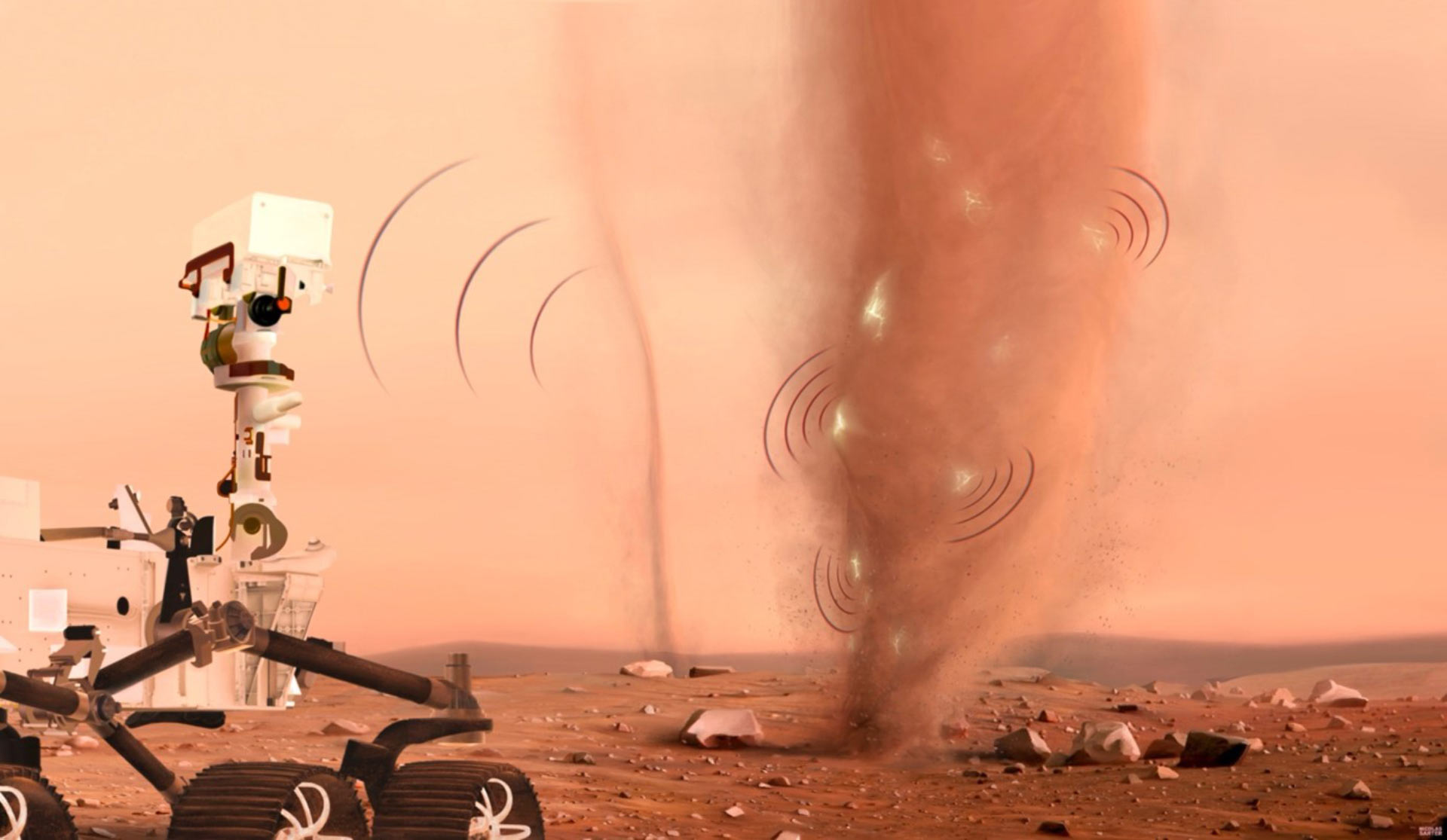
Detection of electric discharges in dust devils by the SuperCam instrument on board NASA’s Perseverance rover on Mars. Image credit: Nicolas Sarter.
In our Solar System, lightning and electrical activity occur on Earth, Saturn, and Jupiter.
The existence of electrical activity on Mars has been theorized, but never directly demonstrated.
The Martian dusty surface frequently hosts a range of localized and planet-wide events, including wind-blown dust and sand, dust storms, and dust devils, that are known to cause electrification on Earth.
Understanding whether such electrification occurs on Mars is critical because it informs our understanding of the surface chemistry of the planet and could affect the safety of robotic and human missions.
To answer this question, Université de Toulouse researcher Baptiste Chide and colleagues analyzed 28 hours of recordings collected with Perseverance’s SuperCam microphone over two Martian years.
By identifying interference and acoustic signatures that are characteristic of lightning, the authors categorized 55 electrical events.
They found that 54 of the events occurred within the top 30% of the strongest wind events recorded during the study period, indicating that wind plays a crucial role in initiating electrical charge on Mars.
Sixteen events were also recorded during the rover’s only two close encounters with dust devils, highlighting the possibility that more distant, or low-energy discharges, could have also taken place beyond the microphone’s range.
These observations suggest that Mars’ atmosphere is electrically active, particularly during localized dust lifting rather than during globally dusty seasons.
“On Earth, atmospheric electricity is dominated by the build-up of charge in clouds and storms and is violently discharged in the form of lightning,” said Dr. Ricardo Hueso, a researcher at the University of the Basque Country.
“On Mars, atmospheric electricity is dry and is produced by collisions between dust particles in whirlwinds and dust storms, resulting in much smaller discharges than on Earth.”
“With its thin atmosphere of carbon dioxide, Mars is a cold, dry dusty world, where the wind is sometimes very strong, blowing in gusts and creating whirlwinds and rising dust bubbles,” added Dr. Agustín Sánchez-Lavega, also from the University of the Basque Country.
“It can form fronts of giant storms hundreds of kilometers long, which sometimes cover the entire planet in dust.”
“So we are expecting the hitherto elusive electrical discharges to be particularly numerous when these environmental conditions occur.”
“Our study opens the door to numerous questions about the effects of natural electricity on the atmosphere of Mars,” the authors concluded.
Their paper was published on November 26, 2025 in the journal Nature.
_____
B. Chide et al. 2025. Detection of triboelectric discharges during dust events on Mars. Nature 647, 865-869; doi: 10.1038/s41586-025-09736-y