The Lamniformes are an order of sharks commonly known as mackerel sharks. It includes some of the most familiar species of sharks, such as the great white and mako sharks as well as less familiar ones, such as the goblin shark and megamouth shark. The discovery of enormous 115-million-year-old shark fossils in northern Australia reveals that lamniform sharks experimented with enormous body sizes around 15 million years earlier than previously suspected, and took the top place in oceanic food chains alongside massive marine reptiles during the age of dinosaurs.
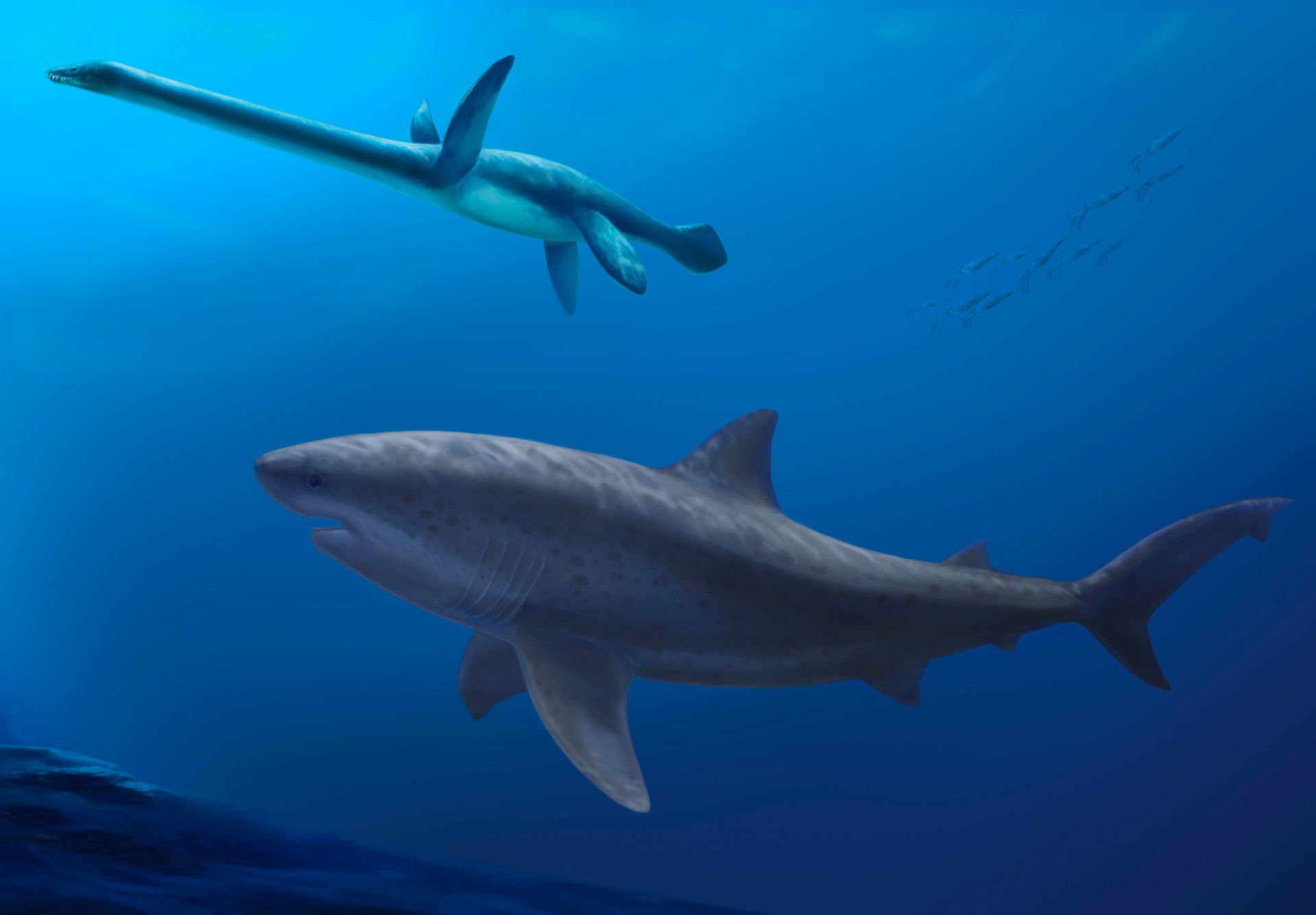
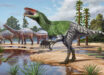
A gigantic 8 m long mega-predatory shark stalks an unwary long-necked plesiosaur in the seas off Australia 115 million years ago. Image credit: Polyanna von Knorring, Swedish Museum of Natural History.
Sharks are iconic predators in the oceans today, and can trace their ancestry back over 400 million years.
However, the evolutionary history of modern shark lineages began during the age of dinosaurs, with the oldest known fossils dating from around 135 million years ago.
Known as lamniforms, these early modern sharks were small, possibly only about 1 m long, but over time would give rise to giants, such as the famous‘megalodon that may have exceeded 17 m in length, and the living great white shark, which is an apex-predator in today’s oceans and tops the scales at around 6 m.
Sharks have cartilaginous skeletons; their fossil record is mostly represented by teeth, which sharks shed continuously as they feed.
Shark teeth are subsequently very common in rocks that were laid down as sediment at the bottom of the sea, and occur alongside the teeth and bones of other animals, such as fishes and gigantic marine reptiles, which the dominant predators in most marine ecosystems during the age of dinosaurs.
The rocky coastline fringing the city of Darwin in far northern Australia was once mud from the floor of the ancient Tethys ocean, which stretched from the southern shores of Gondwana (now Australia) to the northern island archipelagos of Laurasia (now Europe).
The remains of sea monsters, including plesiosaurs, ichthyosaurs, and large bony fish have all been found.
Yet most spectacularly, a handful of enormous vertebrae have turned up that reveal the presence of an unexpected predator — a gigantic lamniform shark.
The five recovered vertebrae were partially mineralized, which enabled their preservation, and are virtually identical to those of a modern great white shark.
However, whereas adult great whites have vertebrae that are around 8 cm in diameter, the vertebrae of the fossil lamniform from Darwin were over 12 cm across.
They were also morphologically distinctive enough to identify them as belonging to a cardabiodontid — huge mega-predatory sharks that roamed the world’s oceans from about 100 million years ago.
Significantly, however, the Darwin lamniform is some 15 million years older and had already clearly achieved the hallmark massive body-size of cardabiodontids.
“Our results show that mega-body size is an ancient lamniform trait, with the Australian cardabiodontid being around 6-8 m and over 3 tons,” said lead author Dr. Mohamad Bazzi of Stanford University and his colleagues.
“This rivalled some of the largest coeval marine reptiles and suggests that lamniforms invaded top-predator niches from an early stage in their adaptive evolution.”
“These sharks were massive, and they lived in shallow coastal waters,” added co-author Dr. Mikael Siversson, a researcher at the Western Australian Museum.
“That tells us a lot about how ancient food webs worked and it shows just how important Australia’s fossil sites are for understanding prehistoric life.”
“This discovery not only rewrites the timeline of shark evolution but also reinforces Australia’s global significance in paleontological research.”
“With each new fossil find, we gain a clearer picture of the ancient oceans and the incredible creatures that once ruled them.”
The discovery is described in a new paper in the journal Communications Biology.
_____
M. Bazzi et al. 2025. Early gigantic lamniform marks the onset of mega-body size in modern shark evolution. Commun Biol 8, 1499; doi: 10.1038/s42003-025-08930-y