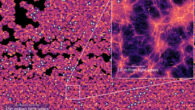
Using spectral data from the Hobby-Eberly Telescope at McDonald Observatory, astronomers have produced the most detailed 3D map yet of faint cosmic structures...
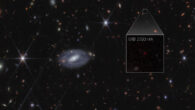
MoM-z14 existed just 280 million years after the Big Bang, according a team of astronomers led by Dr. Rohan Naidu from the Kavli Institute for Astrophysics...
Using ultra-sharp imaging from the NASA/ESA/CSA James Webb Space Telescope, astronomers have produced an extremely detailed, wide-area map of mass in the...
Dark matter may not have been ‘cold’ in the earliest moments after the Big Bang, as long believed; instead, new research from the University of Minnesota...
Using the high resolution images from the NIRCam (Near-InfraRed Camera) instrument onboard the NASA/ESA/CSA James Webb Space Telescope, astronomers have...
New observations of the young cluster SPT2349-56 with the Atacama Large Millimeter/submillimeter Array (ALMA) have revealed unexpectedly scorching intracluster...
Astronomers using the NASA/ESA/CSA James Webb Space Telescope have discovered chemical fingerprints of primordial stars weighing between 1,000 and 10,000...
Astronomers using the NASA/ESA/CSA James Webb Space Telescope have discovered a supernova explosion accompanying the gamma-ray burst event GRB 250314A...
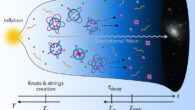
Knots emerge in various fields of mathematics and physics today. A team of physicists from Japan and Germany suggests that, during the early Universe,...
Using the Murchison Widefield Array (MWA) telescope at CSIRO’s Murchison Radio-Astronomy Observatory, astronomers are searching for the elusive Epoch...
The newly-discovered supermassive black hole sits in the center of a ‘little red dot’ galaxy called CAPERS-LRD-z9 and is seen just 500 million years...
A supermassive black hole in the center of the radio quasar RACS J032021.44-352104.1 (RACS J0320-35 for short) is growing at one of the fastest rates ever...
In his new paper, Professor Jonathan Tan, an astrophysicist at the University of Virginia and the Chalmers University of Technology, proposes that Population...
Astronomers using the NASA/ESA/CSA James Webb Space Telescope have observed the Hubble Ultra Deep Field (HUDF), an area of deep space with nearly 10,000...
As part of the CRISTAL (CII Resolved ISM in STar-forming galaxies with ALMA) survey, astronomers peered back to when the Universe was only about one billion...
Present-day disk galaxies often exhibit distinct thin and thick disks. The formation mechanisms of the two disks and the timing of their onset remain open...
The first generation of stars (Population III) must have formed from the unenriched gas that permeated the infant Universe. These stars produced the first...
As part of the Chicago-Carnegie Hubble Program, astronomers using the NASA/ESA/CSA James Webb Space Telescope have performed new measurements of the Hubble...