Using machine learning, a team of physicists at Lawrence Livermore National Laboratory has studied the phase behaviors of superionic water — a phase...
Massive galaxies in the early Universe should have contained large amounts of cold molecular gas, the fuel required to make stars. But new observations...
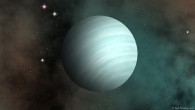
Hycean worlds are composed of water-rich interiors with massive oceans underlying hydrogen-rich atmospheres; with densities between those of rocky super-Earths...
An international team of experimental physicists from the United States and Sweden has made the first direct observation of how hydrogen atoms in water...
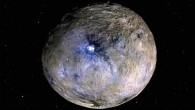
Using high spatial-resolution data gathered by the Gamma Ray and Neutron Detector (GRaND) aboard NASA’s Dawn spacecraft, planetary researchers have detected...
Individual regional dust events can boost planetary water loss by a factor of five to ten and represent an important driver of atmospheric evolution on...
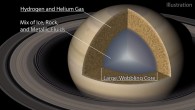
Jupiter, Saturn and numerous giant exoplanets discovered to date consist mostly of hydrogen and helium. In 1977, planetary scientists predicted the existence...
Astronomers using ESO’s Very Large Telescope have taken a picture of DG121, a HII region located in the constellation of Puppis.
This image, taken with...
Astronomers using ESO’s Very Large Telescope (VLT) have produced a spectacularly detailed image of a bubble of hot hydrogen gas called Sharpless 2-305...
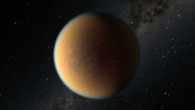
Using the NASA/ESA Hubble Space Telescope, astronomers have found evidence of volcanic activity reforming the atmosphere of Gliese 1132b, a rocky exoplanet...
Radionuclides are ubiquitous in sediment and rock, where their decay leads to the production of hydrogen and oxidized chemicals via radiolysis of water;...
A research team led by International Centre for Radio Astronomy Research (ICRAR) astronomers has studied the molecular-gas content of nearby massive galaxies...
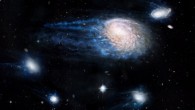
Using CSIRO’s Australian Square Kilometre Array Pathfinder (ASKAP) and background radio galaxies, astronomers have spotted a long cloud of cold hydrogen...
In a study published this month in the journal Icarus, planetary researchers from the United States and Germany modeled chemical processes in the subsurface...
The active Martian water cycle, i.e., the presence of shallow water and soluble perchlorate salts in the Martian soil, enables the production of hydrogen...
An international team of researchers from the United Kingdom and China has created droplet-based algal micro-reactors capable of aerobic or hypoxic photosynthesis...
Mars was once a wet planet, but it has lost most of its water through reactions that produce hydrogen. In standard models, molecular hydrogen produced...