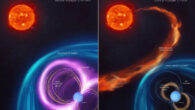
Magnetars are neutron stars with ultra-strong magnetic fields that are about a quadrillion times greater than the magnetic field of Earth. These huge magnetic...
Physicists from the Muon g-2 experiment have released their third measurement of the muon magnetic anomaly. The final result agrees with their published...
Since the Big Bang, the early Universe had hydrogen, helium, and a scant amount of lithium. Later, some heavier elements, including iron, were forged in...
Recent measurements from NASA’s InSight mission show that Mars’ core is less dense than planetary scientists previously believed. This indicates that...
New research provides the first conclusive evidence that a fast radio burst can originate from the magnetosphere, the highly magnetic environment immediately...
Physicists at MIT have directly stimulated atoms in an antiferromagnetic material using a terahertz laser, a light source that oscillates more than a trillion...
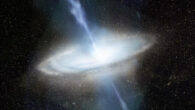
Messier 77 is a well-known, relatively nearby, bright spiral galaxy with a supermassive black hole at its center.
An artist’s concept of Messier 77,...
A team of researchers at Cornell University has created a new class of magnetically controlled microscopic robots (microbots) that operate at the visible-light...
Polar vortices are present in planetary atmospheres, from the Earth-like rocky planets to Jupiter- and Saturn-like gas giants. However, not much is known...
When NASA’s Voyager 2 spacecraft flew by Uranus in 1986, it provided scientists’ first close glimpse of this ice-giant planet. Alongside the discovery...
In August 2024, ESA’s JUpiter ICy Moons Explorer (JUICE) made history with a daring Moon-Earth flyby and double gravity assist maneuver. As the spacecraft...
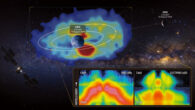
This milestone promises to enhance our understanding of the Sun’s atmosphere and how its changing conditions lead to impacts on our technology-dependent...
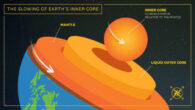
Movement of the inner core of our planet has been debated by the scientific community for two decades, with some research indicating that the inner core...
An ultra-weak geomagnetic field between 591 and 565 million years ago (Ediacaran period) coincided with a significant increase in the oxygen levels in...
Using sensitive instruments onboard ESA’s International Gamma-Ray Astrophysics Laboratory (Integral) mission, astronomers have detected a gamma-ray burst...
Recovering ancient records of Earth’s magnetic field is challenging because the magnetization in rocks is often reset by heating during tectonic burial...
In August 2021, the ESA/JAXA Mercury-bound BepiColombo spacecraft performed its second flyby of Venus and provided a short-lived observation of its induced...
Astronomers using CSIRO’s Parkes radio telescope (Murriyang) have detected unusual radio signals from XTE J1810-197, a radio magnetar (ultra-magnetic...
A team of physicists led by Dr. Yuan Lu from the Université de Lorraine’s Institut Jean Lamour has used electrical pulses to manipulate magnetic information...