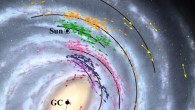
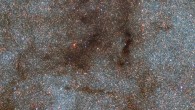
The distance between our Solar System and Sagittarius A*, the 4-million-solar-mass black hole at the center of our Milky Way Galaxy, is approximately 25,800...
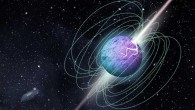
Astronomers have detected two more millisecond-duration radio bursts from SGR 1935+2154, a magnetar located over 14,000 light-years away in the constellation...
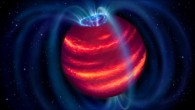
Astronomers using the Low-Frequency Array (LOFAR) radio telescope have discovered a new brown dwarf, a substellar object not quite massive enough to fuse...
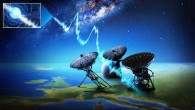
Astronomers using the CHIME (Canadian Hydrogen Intensity Mapping Experiment) and FAST (Five-hundred-meter Aperture Spherical radio Telescope) telescopes...
Most stars in the central 1,000 light-years of the Milky Way’s hub formed when it was swollen with infalling gas more than 10 billion years ago, according...
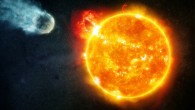
Barnard’s star, a 10-billion-year-old red dwarf just 6 light-years from Earth, is still very active and potentially destructive for the atmospheres of...
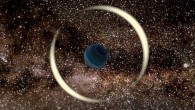
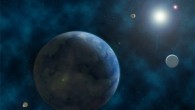
Astronomers from the OGLE (Optical Gravitational Lensing Experiment) project have discovered a Mars- to Earth-mass free-floating, or rogue, planet through...
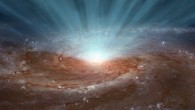
Supermassive black holes are characterized by just two numbers: mass and spin, but have a critical influence on the formation and evolution of galaxies....
Using data gathered by NASA’s Transiting Exoplanet Survey Satellite (TESS) and ESA’s Gaia satellite, a team of U.S. astronomers has identified 1,004...
A team of astronomers from Rensselaer Polytechnic Institute, the University of Pennsylvania, Flatiron Institute, and Queen’s University has spotted two...
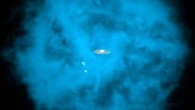
Using X-ray data from NASA’s HaloSat minisatellite, astronomers have found that our Milky Way Galaxy is surrounded by a clumpy halo of hot gases that...
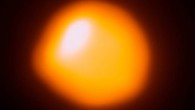
Using new observational data from the space-based Solar Mass Ejection Imager and three different modeling techniques, astronomers have found that Betelgeuse,...
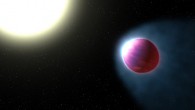
Astronomers using the HARPS (High Accuracy Radial velocity Planet Searcher) spectrograph at ESO’s La Silla Observatory in Chile have detected gaseous...
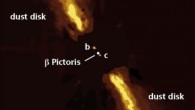
Astronomers using ESO’s Very Large Telescope Interferometer have captured the first direct images of the recently-discovered giant planet Beta Pictoris...
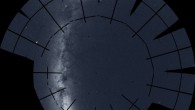
Assembled from 208 images captured by NASA’s Transiting Exoplanet Survey Satellite (TESS) during its second year of science operations, this striking...
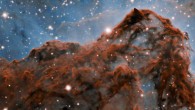
Astronomers using twin 8.1-m telescopes at Gemini Observatory in Chile have captured the most detailed near-infrared image yet of the Carina Nebula’s...
A team of geobiologists and astronomers from the United States and Germany has identified 24 extrasolar planets that may have conditions more suitable...
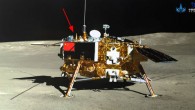
Using the Lunar Lander Neutrons and Dosimetry (LND) experiment aboard China’s Chang’E 4 lander, a team of researchers from Germany and China has measured...
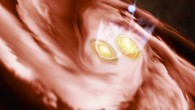
Astronomers using the Atacama Large Millimeter/submillimeter Array (ALMA) have detected sodium chloride, silicon compounds, and water vapor in the circumstellar...
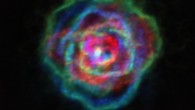
Stars with a mass of less than 8 solar masses end their lives as planetary nebulae, structures of ionized gas thrown off by the star and heated by the...