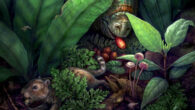
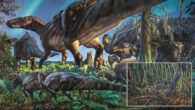
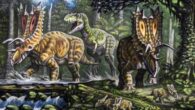
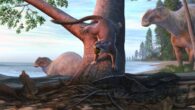
Fossils from the Jose Creek Formation in New Mexico reveal that angiosperms (flowering plants) had built dense, fruit-bearing forests nearly 75 million...
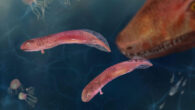
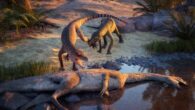
Paleontologists from the Field Museum of Natural History have described the fossilized remains of baby embolomeres, crocodile-like predators that prowled...
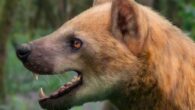
Paleontologists have identified a previously unknown species of amphicyonid — the extinct family of carnivorous mammals popularly known as bear-dogs...
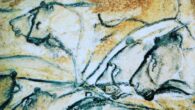
The extinct Eurasian cave lion (Panthera spelaea) and today’s African and Asian lions (Panthera leo) belong to separate evolutionary lineages that diverged...
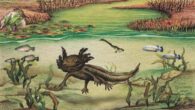
Paleontologists have identified a new species of the axolotl genus Ambystoma from several fossilized specimens found deep in the rocky outcrops of the...
A new species of corcoraniid arthropod that lived during the Furongian epoch, between 497 and 487 million years ago, has been identified from an exceptionally...
By studying fungal microfossils in 66-million-year-old rock samples from the Denver Basin in Colorado, Johns Hopkins University microbiologists have confirmed...
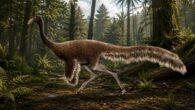
Paleontologists have described a new species of bipedal shuvosaurid archosaur from New Mexico, shedding light on a group of creatures that roamed North...
Paleontologists in Canada say they have recovered a dinosaur tail vertebra from 75- to 80-million-year-old marine rocks on a small island off the coast...
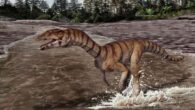
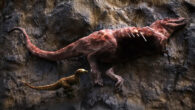
A large tyrannosaurid dinosaur may have stalked the floodplains of what is now New Mexico nearly 74 million years ago, according to a team of paleontologists...
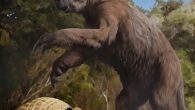
Fossils of a giant tortoise, a ground sloth, a lion-sized armadillo relative called pampathere, scimitar-toothed cats, horses, camels and mastodons found...
Earth experienced extreme climate swings during the Neoproterozoic epoch (one billion to 538.8 million years ago), including the Sturtian glaciation, when...
A study of radiation fog events over Pennsylvania has found that bacteria living inside fog droplets are actively growing and feeding on toxic chemicals...
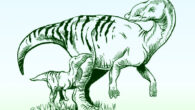
An analysis of wear on the fossilized teeth of the hadrosaurian dinosaur Maiasaura peeblesorum indicates their juveniles may have eaten softer, more nutritious...
New research led by Aarhus University paleontologists overturns the image of tyrannosaurs as pure apex predators. An analysis of 16 precisely mapped bite...
Paleontologists have descibed a new species of the multituberculate mammal genus Cimolodon based on a fossil found in Baja California, Mexico.
An illustration...
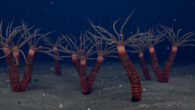
Paleontologists have identified a new genus and species of soft-bodied, tubicolous polyp medusozoan from well-preserved specimens found about 50 km northeast...
CT scans of a decades-old specimen from the Yale Peabody Museum of Natural History show a new species of short-snouted crocodylomorph with unusually strong...