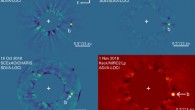
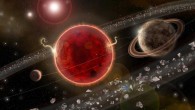
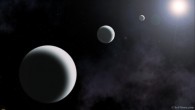
Using the Subaru Telescope and the Keck II telescope at the W. M. Keck Observatory, astronomers have discovered and directly imaged a brown dwarf orbiting...
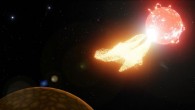
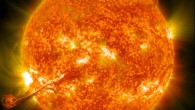
Astronomers have detected a bright, long-duration optical flare accompanied by intense radio bursts from Proxima Centauri, the Sun’s nearest stellar...
A small satellite galaxy, named Heracles, collided with our Milky Way Galaxy about 10 billion years ago and its remnants account for about one third of...
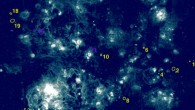
Astronomers have confirmed three supernova remnants and discovered 16 new supernova remnant candidates in the Large Magellanic Cloud, a small satellite...
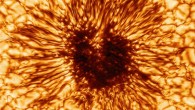
An image of a sunspot captured by NSF’s Daniel K. Inouye Solar Telescope clearly shows the potential of the telescope and its set of state-of-the-art...
New images, taken with the 520-megapixel Dark Energy Camera (DECam) on the Víctor M. Blanco 4-m Telescope at the Cerro Tololo Inter-American Observatory,...
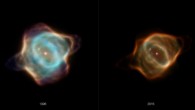
A planetary nebula called the Stingray Nebula has faded precipitously over just the past 20 years, according to an analysis of the archival images from...
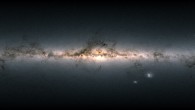
Astronomers from the Gaia Data Processing and Analysis Consortium released today the most detailed ever catalogue of Milky Way stars. The new data set,...
In a new study published in the Astrophysical Journal Letters, astronomers investigated the effects the activity of the red dwarf star Proxima Centauri...
For most of their existence, stars are fuelled by the fusion of hydrogen into helium. Fusion proceeds via two processes that are well understood theoretically:...
Using the MUSE (Multi Unit Spectroscopic Explorer) instrument on ESO’s Very Large Telescope (VLT) at Paranal Observatory in Chile, astronomers have imaged...
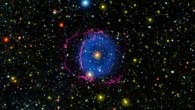
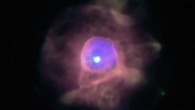
In 2004, astronomers using NASA’s Galaxy Evolution Explorer discovered an unusual, ring-shaped ‘blue’ nebula and the star at its center, TYC 2597-735-1....
Glycine and other amino acids form in dense interstellar clouds well before they transform into new stars and planets, suggests a new study led by researchers...
Astronomers using NASA’s Transiting Exoplanet Survey Satellite (TESS) and the Echelle SPectrograph for Rocky Exoplanets and Stable Spectroscopic Observations...
Astronomers using NASA’s Chandra X-ray Observatory have spotted a bubble of ultrahot gas at the center of a planetary nebula called IC 4593.
This composite...
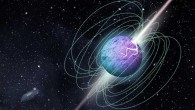
Astronomers using the CHIME (Canadian Hydrogen Intensity Mapping Experiment) and FAST (Five-hundred-meter Aperture Spherical radio Telescope) telescopes...
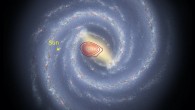
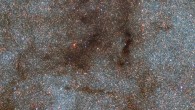
Most stars in the central 1,000 light-years of the Milky Way’s hub formed when it was swollen with infalling gas more than 10 billion years ago, according...
Barnard’s star, a 10-billion-year-old red dwarf just 6 light-years from Earth, is still very active and potentially destructive for the atmospheres of...
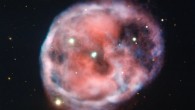
Astronomers using ESO’s Very Large Telescope (VLT) have captured a beautiful image of a planetary nebula called the Skull Nebula.
This image, taken by...
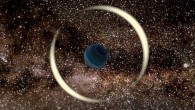
Astronomers from the OGLE (Optical Gravitational Lensing Experiment) project have discovered a Mars- to Earth-mass free-floating, or rogue, planet through...