Astronomers using the Atacama Large Millimeter/submillimeter Array (ALMA) have detected sodium chloride, silicon compounds, and water vapor in the circumstellar...
Stars with a mass of less than 8 solar masses end their lives as planetary nebulae, structures of ionized gas thrown off by the star and heated by the...
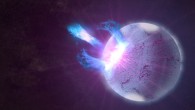
The solar corona, the outermost part of the Sun’s atmosphere, is shaped and mysteriously heated to millions of degrees by the magnetic field of our star....
An analysis of archival X-ray data from NASA’s Rossi X-Ray Timing Explorer has revealed a clear separation between the characteristics of stellar-mass...
Astronomers have discovered two planets orbiting a bright dwarf star in the binary stellar system Gliese 414.
An artist’s impression of the Gliese 414...
Using NSF’s Very Long Baseline Array, an international team of astronomers has made the direct geometric measurement of the distance to XTE J1810-197,...
Using NASA’s Transiting Exoplanet Survey Satellite (TESS) and several ground-based telescopes, astronomers have discovered a Jupiter-sized planet orbiting...
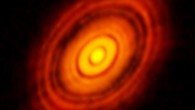
HL Tauri, a young star located 450 light-years away in the constellation of Taurus, is glowing at the center of an system of concentric protoplanetary...
A puffy gas giant slightly larger than Jupiter has been discovered orbiting the early M-type dwarf star TOI-1899, thanks to new data from NASA’s Transiting...
Using NASA’s Transiting Exoplanet Survey Satellite (TESS) and the HARPS fiber-fed Echelle spectrograph mounted at the 3.6-m telescope of ESO’s La Silla...
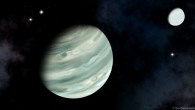
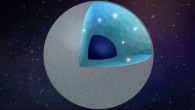
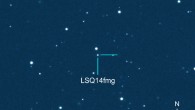
Extrasolar planets hosted by stars with sufficiently high carbon-to-oxygen ratios could be made of diamonds and silica, according to new research by Arizona...
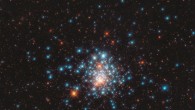
The NASA/ESA Hubble Space Telescope has captured the brilliance of a globular cluster called NGC 1805.
This Hubble image NGC 1805, a globular cluster located...
The Nebra sky disk, one of the oldest concrete depictions of cosmic phenomena, was created in the first millennium BCE, roughly 1,000 years later than...
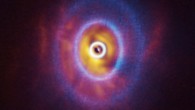
Astronomers using the Atacama Large Millimeter/submillimeter Array (ALMA) and the SPHERE (Spectro-Polarimetric High-contrast Exoplanet Research) instrument...
In a new study to be published in the Monthly Notices of the Royal Astronomical Society, a research team led by University of Manchester astronomers extended...
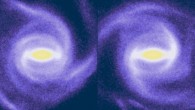
A team of astronomers from Germany, the United Kingdom, the United States, France and Japan may have solved the so-called ‘Galactic bar paradox,’ whereby...
A series of ‘black dwarf’ supernovae will be the last astrophysical events to occur in our Universe prior to the so-called heat death, when the Universe...