The question of whether we are alone in the Universe has been a source of wonder for humanity for millennia or more. Advances in planetary sciences, astronomy,...
Since the first observation of merging black holes in 2015, astrophysicists have been repeatedly surprised by their large masses. They originally expected...
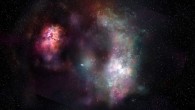
Astronomers using the Atacama Large Millimeter/submillimeter Array (ALMA) have detected water and carbon monoxide molecules in a larger member of SPT-S...
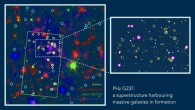
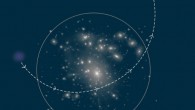
The newly-discovered protocluster, named PHz G237.01+42.50 (G237 for short), contains over 60 members, including blue star-forming galaxies and active...
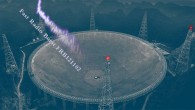
Astronomers using the new Five-hundred-meter Aperture Spherical radio Telescope (FAST) have detected 1,652 independent burst events from the FRB 121102...
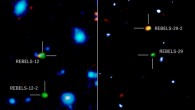
Astronomers using the Atacama Large Millimeter/submillimeter Array (ALMA) have discovered two heavily dust-obscured star-forming galaxies — REBELS-12-2...
Massive galaxies in the early Universe should have contained large amounts of cold molecular gas, the fuel required to make stars. But new observations...
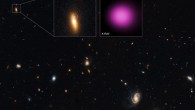
The intermediate-mass black hole in question was caught in the act of swallowing a star, called a tidal disruption event. Dubbed 3XMM J215022.4-055108,...
Using spectral data from the Sloan Digital Sky Survey (SDSS), the Chandra Source Catalog 2.0, and the Chandra COSMOS Legacy survey, astronomers have found...
Astronomers using the NASA/ESA Hubble Space Telescope have measured the metallicity of the neutral interstellar medium towards 25 bright stars in our Milky...
Ultradiffuse galaxies are dwarf galaxies whose stars are spread out over a vast region, resulting in extremely low brightness, making them very difficult...
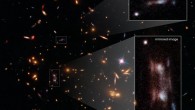
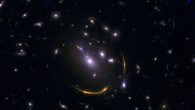
By combining gravitational lensing with the capabilities of NASA’s Chandra X-ray Observatory, astronomers have detected two X-ray-emitting objects —...
In a new theoretical paper, researchers from the Santa Fe Institute provide a new perspective on the origin of life by arguing that life has emerged many...
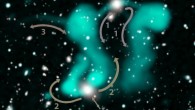
Astronomers using CSIRO’s Australian Square Kilometre Array Pathfinder (ASKAP) telescope, a radio telescope situated about 800 km north of Perth, in...
Astronomers using data from NASA’s Spitzer Space Telescope have looked for dust-extinguished supernovae in the nuclear regions of 40 luminous and ultra-luminous...
Black holes are famously compact objects where the paths of light are drastically bent by the curvature of space-time. While light itself cannot escape...
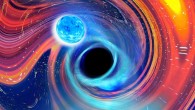
Astronomers using NSF’s Laser Interferometer Gravitational-Wave Observatory (LIGO) in the United States and by the Virgo detector in Italy have observed...