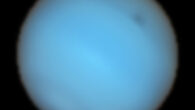
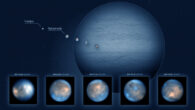
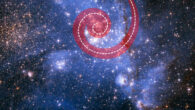
Astronomers using the Multi Unit Spectroscopic Explorer (MUSE) instrument on ESO’s Very Large Telescope (VLT) have observed a large dark spot in Neptune’s...
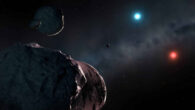
WD 0032-317B, a brown dwarf orbiting around the hot, low-mass white dwarf WD 0032-317, is estimated to have a surface temperature of about 8,000 K and...
The formation of giant planets has traditionally been divided into two pathways: core accretion and gravitational instability. However, in recent years,...
Astronomers using ESO’s Very Large Telescope (VLT) have detected three distant gas clouds whose chemical composition matches what they expect from the...
Astronomers using the FORS2 instrument on ESO’s Very Large Telescope have captured a striking new image of the large emission nebula Gum 10.
This image,...
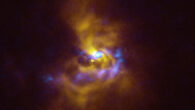
Astronomers using ESO’s Very Large Telescope have captured the most detailed image yet of the young stellar object 244-440 and the bipolar jet associated...
On September 26, 2022, NASA’s DART spacecraft collided with the asteroid Dimorphos in a controlled test of our asteroid deflection capabilities. The...
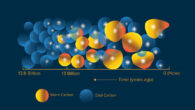
New research led by the Swinburne University of Technology shows that the amount of warm carbon suddenly increased by a factor of five over a period of...
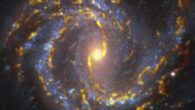
The new image of Messier 61, a spiral galaxy located in the constellation of Virgo, combines data taken at radio and visible wavelengths and is helping...
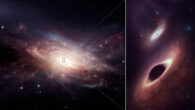
While close together in cosmological terms at just 750 light-years apart, or 6x the black hole sphere of influence, the supermassive black holes in the...
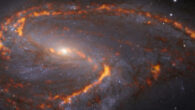
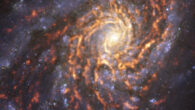
This image of Messier 66 is a composite of separate exposures acquired by the Multi-Unit Spectroscopic Explorer (MUSE) on ESO’s Very Large Telescope...
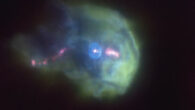
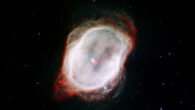
At least three, and possibly four, progenitor stars crafted the oblong, curvy shapes of the Southern Ring Nebula, according to a new analysis of data from...
On October 5, 1962, five countries agreed to create the European Southern Observatory (ESO) through the signature of a convention. Now, six decades later...
WD J2147-4035, an 11-billion-year-old white dwarf located 91 light-years away in the constellation of Grus, is accreting debris from orbiting planetesimals,...
This stunning image shows the well-defined arms of the grand design spiral galaxy Messier 99.
This composite image shows Messier 99, a grand design spiral...
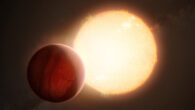
Barium, a chemical element with the symbol Ba and atomic number 56, is the heaviest element detected to date in any exoplanetary atmosphere.
This artist’s...
Astronomers using the X-SHOOTER instrument at ESO’s Very Large Telescope (VLT) have detected light from a gamma-ray burst at a redshift of 6.3, meaning...
Astronomers using the Multi Unit Spectroscopic Explorer (MUSE) instrument on ESO’s Very Large Telescope (VLT) and the NASA/ESA Hubble Space Telescope...