The globular cluster Messier 30 contains some of the oldest stars in the Milky Way Galaxy. New observations from the NASA/ESA Hubble Space Telescope offer clues to how these stellar populations formed and evolved, and whether some of them originated beyond our home Galaxy.
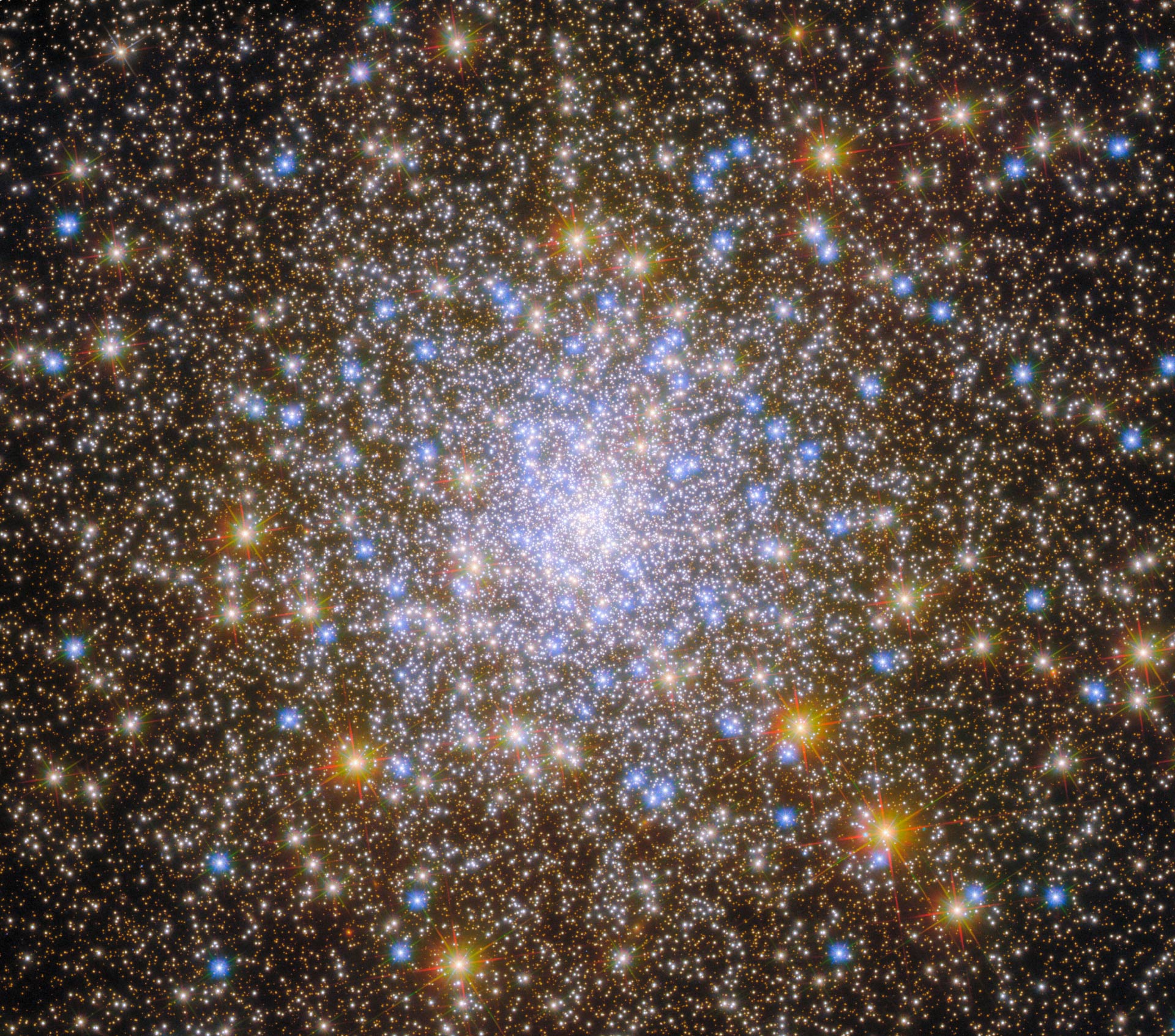
This image of Messier 30 includes the wide range of wavelengths Hubble can see: ultraviolet, visible, and near-infrared light; each wavelength helps astronomers better understand how various stellar populations formed and evolved. Image credit: NASA / ESA / Hubble / M. Libralato / G. Piotto / A. Sarajedini.
Messier 30 is located approximately 27,500 light-years away in the southern constellation of Capricornus.
Otherwise known as M30, NGC 7099, or the Jellyfish Cluster, the object was discovered by the French astronomer Charles Messier on August 3, 1764.
“Globular clusters have long played an important role in helping us learn about our Milky Way Galaxy,” the Hubble astronomers said in a statement.
“More than a century ago, astronomer Harlow Shapley used observations of a particular type of variable star to measure the locations of and distances to dozens of globular clusters within our Galaxy.”
“His work showed that the Sun is not in the center of our Galaxy, and that the Galactic center lies toward the constellation Sagittarius.”
Today, astronomers continue to learn about our galaxy by observing globular clusters such as Messier 30.
“Because globular clusters are so ancient, they can give us clues about how the Milky Way developed long ago,” the researchers said.
“Globular clusters that formed within our Galaxy can act as time capsules, preserving the original chemistry of the young Milky Way.
“However, it’s possible that not all globular clusters that orbit within our Galaxy today formed there.”
“Messier 30 and many other globular clusters orbit in the direction opposite from the way our Galaxy spins.”
“This may mean that these clusters did not form within our Galaxy at all. Instead, the Milky Way may have captured them in the distant past!”