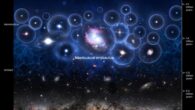
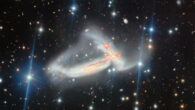
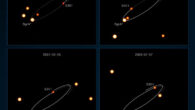
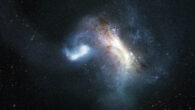
Named Nāpōwawāʻenakaulua, the compact pair contains two rapidly feeding supermassive black holes separated by just 18,100 light-years. Their existence...
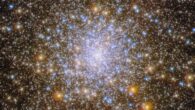
The globular cluster Messier 30 contains some of the oldest stars in the Milky Way Galaxy. New observations from the NASA/ESA Hubble Space Telescope offer...
Crowded star clusters in the early Universe could have built giant stars, seeded black holes and fed the mysterious little red dots, according to a team...
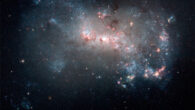
Gas-rich dwarf galaxies appear to retain only about a tenth of the oxygen their stars have made, according to a census of 37 nearby systems using data...
The enrichment in metals (any element heavier than hydrogen and helium, including carbon, oxygen, iron and gold) likely came from generations of exploding...
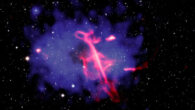
VLSS J0318.9+5755, a strange, musical-note-shaped radio source hiding behind the Milky Way’s dusty disk, has turned out to be the glowing remains of...
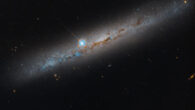
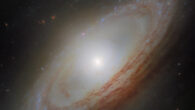
Astronomers using the NASA/ESA Hubble Space Telescope have captured a new view of NGC 1827, an intermediate spiral galaxy seen edge-on in the constellation...
This fast radio burst, designated FRB 20240304B, is the most distant ever detected, having traveled more than 10 billion years across the cosmos to reach...
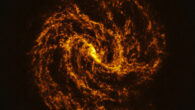
The life cycle of molecular gas in the barred spiral galaxy Messier 83 appears to be driven mainly by the galaxy’s large-scale structure and rotation,...
Named ‘hypersoft X-ray sources,’ these objects give off very low-energy X-rays that are difficult to detect.
This composite image shows the locations...
A barred spiral galaxy called NGC 4698 has a bizarre structure in which its central stars and gas rotate perpendicular to the galaxy’s main disk, possibly...
Astronomers using ESO’s Visible and Infrared Survey Telescope for Astronomy (VISTA) have observed the densest, most crowded regions at the centers of...
Astronomers have combined 2,884 Type Ia supernovae — which are used to measure cosmic distances — with cosmic microwave background and galaxy-mapping...
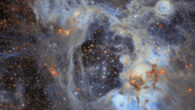
A new images from the NASA/ESA Hubble Space Telescope reveals LHA 120-N44, a striking nebula located roughly 160,000 light-years away in the Large Magellanic...
A new image from the Gemini North telescope on Maunakea in Hawai’i offers the sharpest look yet at a striking pair of interacting spiral galaxies, cataloged...
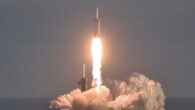
NASA’s Nancy Grace Roman Space Telescope launched August 30, 2026 at 7:26 a.m. EDT (11:26 UTC) aboard a SpaceX Falcon Heavy from Launch Complex 39A at...
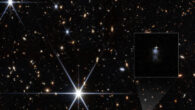
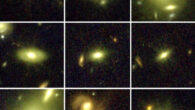
Astronomers using the NASA/ESA/CSA James Webb Space Telescope have revealed a surprisingly large population of faint, low-mass stars in distant galaxies,...
The mysterious objects spotted in the early Universe may not be isolated points of light after all. A new analysis of images of 217 ‘little red dots’...
Astronomers have spotted a faint, previously unknown star whipping around Sagittarius A*, the Milky Way’s supermassive black hole, on the tightest and...
Astronomers using the NASA/ESA Hubble Space Telescope have found definitive evidence that the young Milky Way swallowed a dwarf galaxy just two billion...