An overlooked particle could have altered the early Universe in ways that helped produce the imbalance between matter and antimatter, a new theoretical study suggests.

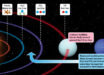
Rishav Roshan & Sudipta Show demonstrated that the decoupled right-handed neutrino can drive an epoch of early matter domination, significantly modifying the expansion history of the Universe. Image credit: M. Weiss / Harvard-Smithsonian Center for Astrophysics.
Why the Universe contains matter at all remains one of physics’ most enduring mysteries.
The Big Bang should have produced matter and antimatter in nearly equal quantities, allowing the two to annihilate one another.
Yet enough matter survived to form galaxies, stars, planets and, eventually, life.
Dr. Rishav Roshan from the University of Southampton and Dr. Sudipta Show from the Indian Institute of Technology Kanpur propose that a little-considered particle called a heavy right-handed neutrino could help explain how matter gained the upper hand.
“This decoupled heavy neutrino has long been dismissed as an irrelevant background detail in particle physics,” Dr. Roshan explained.
“However, it decays incredibly slowly. As the cosmos cooled after the Big Bang, the particle lived long enough that it temporarily took over the energy density of the Universe and triggered a matter-dominated period.”
When the particle eventually decayed, the resulting changes to the Universe’s expansion history could alter the temperature at which certain interactions involving charged leptons reached equilibrium.
These interactions matter for a process known as leptogenesis, in which differences between the behavior of particles and antiparticles can help generate the excess of matter needed to explain the Universe we see today.
The physicists’ calculations show that the altered conditions could change how this asymmetry develops, potentially allowing a comparatively lighter heavy neutrino to produce an imbalance consistent with observations.
“The fact that we are here at all proves that an asymmetry between matter and antimatter occurred,” Dr. Roshan said.
“The decoupled neutrino shifted the temperature in the early Universe at which fundamental particles — like electrons and other leptons — interacted with their anti-particles with the help of Standard Model Higgs boson.”
“This temperature acts like a switch that shapes how the matter-antimatter imbalance was built up.”
The proposal remains theoretical, and the study does not establish that the hypothesized particle existed in the early Universe.
But the researchers suggest that the scenario could be tested through neutrino experiments and observations of gravitational waves.
If such signals can be identified, they could help scientists determine whether an overlooked particle played a role in shaping the cosmos and creating the conditions for matter to survive.
“The findings change our understanding of how the early Universe expanded so quickly after the Big Bang,” Dr. Show said.
“It offers us a new explanation for how matter won.”
“The dramatic shift in the early expansion of the cosmos leaves distinct but detectable imprints of changes, for example on primordial gravitational waves.”
“These gravitational wave signatures open up new avenues for us to unravel the evolution of the early Universe after the Big Bang.”
The team’s paper was published in September 2026 in the journal Physical Review Letters.
_____
Rishav Roshan & Sudipta Show. 2026. Delayed Charged Lepton Yukawa Equilibration in Minimal Seesaw. Phys. Rev. Lett 137, 111802; doi: 10.1103/nfkx-q6z7